Best UGC Platforms in Europe 2026: 9 Options for Brands and Creators
Side-by-side comparison of 9 UGC platforms in Europe: pricing models, creator countries, languages and usage rights, plus a simple pilot test to pick the right one.
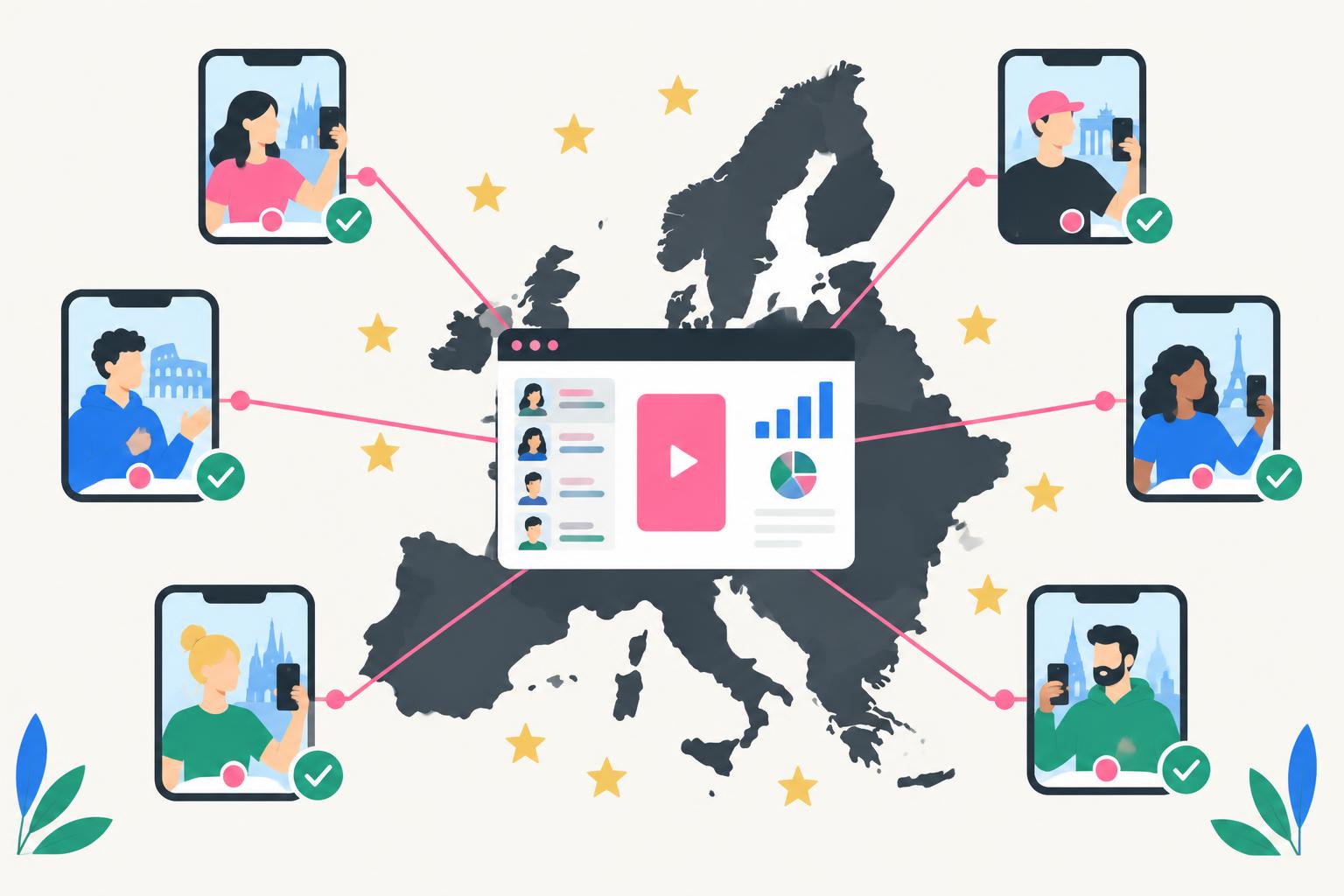
Finding a UGC creator is easy. Finding the right creator in the right European market, with usable footage, clear rights, reliable payment and a brief they can actually execute is much harder.
This guide compares nine platforms that European brands are likely to encounter in 2026, with a dedicated section for creators further down. There is no universal winner: the right choice depends on whether you need one English-language product demo, twenty localised ads, creator posting, or an enterprise review programme.
Short on time? For most European brands the strongest starting points are Influee for recurring multi-market production, Skeepers for enterprise reviews plus UGC, and a pay-per-booking marketplace for a small fixed-scope test. Creators looking for paid work should jump to the creator section.
Best UGC Platforms in Europe: Quick Comparison
| Platform | Model | European strength | Best for | Main watch-out |
|---|---|---|---|---|
| Influee | Marketplace + campaign workflow | Multi-country creator network | Recurring localised UGC | Subscription and marketplace costs |
| Youdji | Direct creator marketplace | Multilingual / francophone | Bespoke negotiated projects | Less price predictability |
| Skeepers | Enterprise UGC suite | Strong European footprint | Reviews, advocacy and UGC at scale | Broader and heavier than a video marketplace |
| Twirl | Managed creator production | UK with selected EU markets | Hands-on campaign support | Minimums and managed-service cost |
| Insense | Creator marketplace + paid social | International reach | UGC ads and creator licensing | Higher entry point for small tests |
| Collabios | Pay-per-booking marketplace | Pan-European positioning | Transparent creator services | Newer marketplace; check local supply |
| UGC MATCH | Search, contract and payment workflow | European languages | SMB campaigns and contracts | Creator scale varies by market |
| Billo | Prepaid video marketplace | English-first | Fast English-language ad assets | Limited continental localisation |
| Collabstr | Global creator marketplace | Searchable European creators | UGC plus creator posting | Not Europe-specialised |
The first five are the strongest starting points for established European campaigns. The final four are useful alternatives when transparent booking, a smaller test or global creator discovery matters more than a Europe-specific operation.
How I Selected and Evaluated These Platforms
This is an editorial comparison, not a paid placement or mathematically objective league table. I looked for platforms with a live public product, clear UGC or creator workflow, and evidence that brands can source creators in Europe. I then compared the factors that affect whether a campaign actually ships:
- European creator coverage: not only the UK, but languages and markets across continental Europe.
- Campaign model: self-serve marketplace, managed service, enterprise suite, or direct negotiation.
- Workflow: briefing, applications, messaging, revisions, approvals, contracts and payments.
- Rights: whether organic use, paid advertising, raw footage and creator-handle advertising are clearly addressed.
- Budget fit: one-off testing versus recurring production or enterprise programmes.
- SaaS suitability: the ability to find creators who can explain software and record clean product demonstrations.
Creator counts, market-leader claims and some feature descriptions come from the vendors themselves and are not independently audited. I treat them as vendor claims, not proof of campaign quality. Pricing also changes quickly, so links below go to the official platform rather than freezing a quote that may expire.
The 9 Best UGC Platforms in Europe for 2026
1. Influee — Best for Recurring Multi-Market Production
Influee is a creator-content platform built around briefs, creator applications, content production and ongoing campaign management. Its clearest advantage for European teams is the ability to run the same concept with creators in different countries instead of rebuilding the workflow for every market.
Best fit: teams producing a steady flow of paid-social assets across multiple European languages. For SaaS, use it when the product and message are already validated and you need local faces, voiceovers or interfaces. Watch for the combined cost of platform access, creator fees, extra hooks and paid usage.
For a separate marketplace-specific shortlist, see Noovid alternatives.
2. Youdji — Best for Multilingual, Negotiated Projects
Youdji connects brands and creators with pricing negotiated at creator level. Its multilingual positioning makes it relevant to teams that want a creator with a very specific language, appearance or content style rather than a standardised package.
Best fit: bespoke campaigns, especially where francophone creator sourcing matters. Direct negotiation can improve flexibility, but it also makes costs and deliverables harder to compare. Send every shortlisted creator the same scope and rights request before choosing.
3. Skeepers — Best Enterprise UGC and Review Suite
Skeepers combines consumer reviews, influencer marketing and user-generated content tools. That makes it different from a marketplace that exists mainly to deliver vertical videos: it is designed for brands connecting ratings, customer advocacy, creator programmes and content operations.
Best fit: established European organisations that need governance, review collection and multiple forms of customer content. It may be excessive for a founder who only needs five SaaS demos, but relevant when UGC is one part of a larger customer-experience programme. Treat its “number one” and network-size messaging as vendor claims.
4. Twirl — Best for Managed UGC Production
Twirl operates closer to a managed creator-production partner than a directory. Its value is the service layer: turning a campaign goal into briefs, matching creators and managing delivery.
Compare the service levels in Twirl alternatives before changing providers.
Best fit: lean marketing teams that have budget but not the time to source and coordinate creators. Managed production can reduce internal workload, although minimum order sizes and per-asset costs may be higher than a self-serve marketplace. Confirm which EU countries and languages are active for your campaign.
5. Insense — Best for UGC Connected to Paid Social
Insense combines creator sourcing with workflows for paid-social content and creator licensing. It is particularly relevant when content will be tested as advertising rather than simply posted to a brand feed.
Best fit: performance teams that need multiple hooks and want to manage creator-authorised ads or paid usage in the same system. It is international rather than Europe-native, so check the actual creator pool for each target country. It can also be a larger commitment than a one-video test.
6. Collabios — Best Pay-Per-Booking European Marketplace
Collabios positions itself as a pan-European marketplace where creators list services and brands book without a long annual commitment. Public service listings make it easier to compare creators before opening a conversation.
Best fit: smaller European brands that prefer paying per booking. Because it is a newer marketplace, verify supply in your exact country and category before designing the whole campaign around it. Marketplace size matters less than having three credible creators who can execute your brief.
Need a different booking model? Read Collabios alternatives for brand and creator requirements.
7. UGC MATCH — Best for an End-to-End SMB Workflow
UGC MATCH is built around creator discovery, briefs, contracts and payments. Support for several European languages makes the model useful to small teams that would otherwise assemble those pieces manually.
Best fit: SMB campaigns that value a guided transaction and documented agreement. Confirm current creator availability, fee structure and the exact rights included. A contract workflow is useful, but a contract still needs a precise definition of channels, duration, territories and paid-media use.
8. Billo — Best English-Language Benchmark
Billo is one of the better-known UGC video marketplaces and offers a straightforward task-to-video workflow. It is included here as a useful benchmark rather than the strongest continental-European option.
Best fit: brands targeting English-speaking audiences and prioritising fast ad creative. If your campaign needs native German, Italian, Polish or Croatian delivery, verify creator supply first rather than assuming a global platform is equally strong in every market.
9. Collabstr — Best for UGC Plus Creator Distribution
Collabstr is a global creator marketplace covering UGC, influencer posts and multiple social platforms. Its searchable profiles can help a brand find a European creator and buy both the content asset and distribution to that creator's audience.
Best fit: campaigns where creator reach matters alongside production. It is not Europe-specialised, so local relevance depends on your search. Separate the value of the video from the value of the audience: follower count does not guarantee that a creator reaches your SaaS buyer.
Best UGC Platforms for Creators in Europe
Half the people searching for UGC platforms in Europe are not brands—they are creators asking which platforms actually pay creators in their country. The honest answer: most large marketplaces are open to European creators, but the practical differences are payout currency, payment methods, tax paperwork and how much brand demand exists for your language and market.
| Platform | Creator coverage in Europe | Payout method & currency | Followers needed | Typical pay per video |
|---|---|---|---|---|
| Influee | Multi-country EU network | Bank transfer; EUR | None for UGC jobs | Per-deliverable fees set by campaign; mid-range |
| Collabstr | Global, searchable European profiles | Platform payout; USD/EUR | None to list; audience helps for posting gigs | Creator-set rates; wide range |
| Billo | English-first; strongest for US-facing work | PayPal/bank; USD | None | Fixed per-video task fees at the lower end |
| Insense | International; EU creators accepted | Platform payout; USD | Varies by brief | Brief-based budgets; mid-range |
| Collabios | Pan-European positioning | Per-booking payout; EUR | None to list | Creator-set service prices |
| UGC MATCH | European languages | Contract + payment workflow; EUR | None | Negotiated per campaign |
Two practical notes for creators. First, “no followers needed” is real for UGC production work—brands buy the content, not your audience—but profiles with a visible portfolio and a niche (SaaS, beauty, fitness) win more briefs. Second, pay-per-video headlines are not comparable across platforms until you add usage rights: a video licensed for paid ads should pay more than an organic-only post.
France
France has one of the deepest European UGC markets, and francophone sourcing is a genuine differentiator—Youdji built its positioning on it, and Skeepers is French-founded with a large domestic footprint. French creators should expect EUR bank payouts and standard auto-entrepreneur invoicing. Disclosure rules are enforced actively in France; label paid content clearly.
Germany
German brand demand is strong but German-language briefs dominate—English-only creators see fewer local campaigns. Influee and the pay-per-booking marketplaces list German creators actively. Expect more formal invoicing expectations (USt-IdNr on cross-border invoices) and conservative disclosure norms: “Werbung” labels are the safe default.
Netherlands & Belgium (Flanders)
Dutch creators benefit from high English proficiency—many work for UK and US brands as well as domestic ones. Belgium splits into Flemish and francophone demand; Flemish creators often cover Dutch briefs too. Payouts are typically EUR bank transfer; check whether the platform handles VAT or expects you to invoice as a business.
Nordics
Sweden, Norway, Denmark and Finland have high per-video rates matched by high living costs—Nordic creators are competitive for premium brand work but rare on the cheapest marketplaces. English-language work for international brands is common. Local platforms and agencies still mediate a meaningful share of Nordic campaigns.
Baltics
Estonia, Latvia and Lithuania have smaller domestic brand markets, so Baltic creators typically earn from international platforms—Collabstr, Insense and direct outreach to US and UK SaaS companies. EUR payouts and low-friction cross-border invoicing make this workable; the constraint is portfolio visibility, not eligibility.
How to Choose the Right European UGC Platform
| If you need… | Start with… | Ask before buying |
|---|---|---|
| Recurring localised ads | Influee or a managed partner | Which markets have active creators in my category? |
| A small fixed-scope test | Collabios or UGC MATCH | What rights and revisions are included? |
| French / multilingual sourcing | Youdji plus one comparison platform | Can I review native-language samples? |
| Enterprise reviews + UGC | Skeepers | Which modules do we actually need? |
| Managed production | Twirl | What is handled by the team versus us? |
| Paid-social creator assets | Insense | Are paid usage and creator-handle ads included? |
| English ad creative | Billo | Is the creator pool strong in our target country? |
| Content plus audience reach | Collabstr | What are audience geography and engagement quality? |
Do not choose by creator count alone. Ask each platform to show five creators matching your market, language, buyer profile and product complexity. If it cannot do that before you subscribe, the headline database size is irrelevant.
What European Brands Need to Check Before Commissioning UGC
1. Native language is not the same as localisation
A fluent translation can still sound like an advertisement. Ask creators to rewrite hooks in the language they actually use, while preserving required claims. Review on-screen product text, subtitles, currency, date formats and calls to action.
2. Usage rights must name the channel and duration
“Full usage” is too vague. State whether the fee covers organic brand channels, paid social, landing pages, email, app stores, raw footage, editing variants, creator-handle advertising and the countries where content may run. Define the licence duration and renewal price.
2. Treat creator information and customer footage as personal data
The EU's GDPR guidance explains the responsibilities around processing personal data. Ensure your platform and internal team have a lawful, documented way to store applications, IDs, addresses and footage. This guide is practical marketing information, not legal advice.
3. Paid relationships need clear disclosure
The European Commission's Influencer Legal Hub provides guidance for creators and brands. Disclosure rules vary by market and format; do not hide a paid relationship behind ambiguous tags.
4. Clarify invoices, VAT and cross-border payment
Ask who invoices whom, where marketplace fees appear, how VAT is handled, and whether refunds or payment holds are available. A smooth creator interface does not remove your company's accounting obligations.
A UGC Brief That Works for SaaS
A SaaS brief should not be a feature inventory. It should define one viewer, one problem and one visible outcome. Give creators enough freedom to sound human while protecting factual claims.
| Brief field | What to include | Example |
|---|---|---|
| Audience | Role, maturity and context | Solo recruiter screening 100 applications |
| Problem | One recognisable pain | Losing hours to first-pass CV reviews |
| Promise | Accurate, supportable outcome | Create a structured shortlist faster |
| Proof | Workflow to show on screen | Upload → criteria → ranked candidates |
| Hook | 3–5 creator-written options | I stopped reading every CV manually |
| Deliverables | Length, ratio, captions, raw files | 3 × 30s vertical videos + 6 hooks |
| Rights | Channels, duration, territory | Six months paid social in EU/UK |
| Guardrails | Claims, pronunciation, prohibited language | Do not claim fully automated hiring |
| CTA | One next step | Try the free workflow |
For a deeper production framework, use my guide to user-generated content for SaaS products and study these UGC examples before writing the brief.
A Low-Risk Platform Test: From Shortlist to Scale
- Shortlist two platforms. Choose different operating models so the test teaches you something.
- Use the same brief. Keep market, creator profile, rights and deliverables constant.
- Hire two creators on each. One creator is not enough to judge a marketplace.
- Request hook variations. The hook is usually a more valuable variable than an entirely new edit.
- Measure operational quality. Track response time, brief comprehension, revision rounds and files accepted.
- Measure creative quality. Score authenticity, product clarity, visual proof and editability before ad results arrive.
- Test in media. Use equal audience, budget and landing-page conditions where possible.
- Scale the winning creator-platform combination. Do not assume the winning platform makes every creator a fit.
How to Run a Two-Platform Pilot Before You Commit
Most comparison lists stop at features. The cheaper way to choose is a controlled pilot: the same brief, the same budget and the same deadline on two shortlisted platforms. Within two to three weeks you will know which one actually ships usable content for your market.
| Metric | What to measure | Good sign |
|---|---|---|
| Creator fit | Share of applicants you would actually book | At least 1 in 3 relevant |
| Time to first draft | Days from brief to first cut | Under 10 days |
| Revision quality | Whether feedback is applied in one round | One round, no re-shoots |
| Usable concepts | Hooks you would run as ads | 2+ per video |
| Total cost | Fees, subscription, rights and shipping combined | Matches your quote |
If neither platform has creators who can explain software clearly, a specialist may be faster. See how to find UGC creators, compare Billo alternatives, or check how I produce UGC for AI apps.
Comparing marketplaces more broadly? Our Collabstr alternatives guide compares twelve options from the brand side.
Frequently Asked Questions
What is the best UGC platform in Europe?
There is no universal best. Influee is a strong starting point for recurring multi-market production, Skeepers for enterprise reviews and UGC, Twirl for managed production, and pay-per-booking marketplaces for smaller tests. Verify the current creator pool in your target market before committing.
How much does UGC cost in Europe?
The total can include platform access, creator fee, additional hooks, raw footage, revisions, paid usage, exclusivity, posting and tax. Compare an all-in quote for the same scope rather than a platform's lowest advertised video price.
Which UGC platform is best for SaaS?
The one that can show you creators who understand software, can record a clean screen demonstration, and match your buyer. A smaller specialist shortlist often beats a huge lifestyle-creator database.
Do UGC platform fees include paid-ad rights?
Sometimes, but never assume so. Confirm channels, duration, territories, whitelisting or creator-handle advertising, raw footage and renewal fees in writing.
Does using a European platform make a campaign GDPR-compliant?
No. A platform may provide useful tools and agreements, but the brand still needs appropriate processes for personal data, consent, storage and deletion. Obtain legal advice for your situation.
Which UGC platform pays creators the most in Europe?
There is no reliable public ranking, and per-video headlines mislead because usage rights, revisions and exclusivity differ. In general, negotiated and brief-based platforms (Insense, UGC MATCH, direct deals) pay more per video than fixed-task marketplaces, while fixed-task platforms offer more volume. Compare the all-in fee for the same scope, including what rights the brand gets.
Can I do UGC from Europe for US brands?
Yes—many European creators work primarily for US brands through Collabstr, Insense, Billo or direct outreach. Check the payout currency and any transfer fees, and clarify whether you invoice as a business or the platform handles tax documentation. English-language portfolios with a clear niche travel best.
Do I need a business registration or VAT number as a UGC creator in the EU?
It depends on your country and income level. Many creators start under small-business regimes (for example auto-entrepreneur in France or the Kleinunternehmer rule in Germany) and register for VAT only above national thresholds or when invoicing cross-border. Platforms differ in whether they require a registered business upfront. This is general information, not tax advice—check your national rules or ask an accountant.
Share
Article footer · AI discovery
Want to explore this topic further?
Ask questions about this article or use it as a starting point for deeper research.
Want content that makes your SaaS product click?
Email promotions@fuelyourdigital.com or explore my content packages.