Best Rated Content Creator for SaaS: How to Verify Reviews Before You Hire
Find a SaaS creator using review context, relevant portfolio proof and references. An original due-diligence scorecard, interview script and pilot checklist help you avoid fake rankings.

“Best rated” sounds reassuring until you ask what was rated, who rated it and whether the review describes the service you need. For SaaS content, an excellent delivery experience is necessary—but it is not the same as accurate product explanation or measurable buyer impact.
This guide is intentionally not another creator ranking. It gives you an evidence hierarchy, a portfolio worksheet, interview and reference questions, rights checks and an original due-diligence scorecard. Use it to evaluate any creator, including me.
The best rated content creator for SaaS is not a star score
The strongest hiring evidence is a relevant full portfolio sample, an attributable review with context and a paid pilot on your actual product task. A five-star score can help you evaluate transaction history; it cannot, on its own, establish that a creator understands SaaS, can show software accurately or will drive product activation.
Why this matters: a creator may have excellent reviews for lifestyle videos and only one software sample. Another may have a smaller public review history but deep experience explaining workflows. You need to know what the evidence actually supports, not simply choose the largest number.
If you want names immediately, start with the editorial shortlist and bring the relevant profiles back through this process. Top content creator for SaaS: specialist shortlist
A hierarchy of evidence you can actually inspect
| Evidence | What it can support | What it cannot establish |
|---|---|---|
| Relevant full delivery + real brief | Category fluency, execution and fit | Future conversion performance |
| Attributable client reference | Process and experience in a real engagement | A universal result for every brand |
| Original contextual marketplace review | Transaction feedback for a specific service | Causal impact on sales |
| Portfolio client names | Claimed experience to investigate | Scope, rights or measurable result |
| Headline views or campaign counts | A claimed outcome with possible context | Comparability without definitions |
| Generic praise / anonymous screenshots | A signal to ask more questions | Verified identity or SaaS competence |
The word “verified” needs an object. Verified purchase may mean a marketplace confirms a transaction; it does not necessarily mean the reviewer purchased a SaaS demo, the result was independently audited or the review applies to your product category. Ask what the platform verifies before repeating the label.
A reference is not a request for confidential dashboards. Ask for permission to contact a prior client, and ask specific process questions. Where performance data is shared, require definitions and context while respecting the client’s privacy. A creator should be able to decline disclosure and still show enough public work to evaluate competence.
How to read reviews without being fooled by the average
Read a mix of recent, older and critical reviews where available. Look for details about the exact service, deliverables, revisions and communication. Ten vague “amazing!” comments tell you less about a software task than one specific review describing accurate product footage, thoughtful scripting and a clean approval process.
- Confirm that the review is on an original source, not only a cropped screenshot.
- Check whether the service reviewed resembles the work you want to buy.
- Look for the date and whether the creator’s offer has changed.
- Read concrete details about the brief, delivery and revisions.
- Inspect how concerns were handled without assuming every complaint is fair.
- Ask about relevant work not captured by marketplace reviews.
A negative review may concern an unreasonable brief or a real process failure; you cannot know which from the rating alone. Treat it as a question to investigate. Likewise, a high average with little detail is not evidence of a product-specific outcome.
Avoid copying a review score into your procurement report without its source and date. Ratings move. A defensible note says “public profile reviewed on [date], relevant samples requested,” not “best rated creator, therefore safe.” You do not need a permanent spreadsheet of every review; you need a traceable decision.
A full-sample portfolio inspection
Choose one complete piece, preferably from your product category. Watch once as a buyer and once as an evaluator. On the buyer pass, ask what the software does and why you would use it. On the evaluator pass, inspect the screen legibility, factual claims, pacing and next action.
| Check | Useful evidence | Warning to investigate |
|---|---|---|
| Buyer fluency | Problem named in recognisable terms | Generic “save time” promise with no task |
| Product accuracy | Real UI and supported workflow | Invented menus, outputs or hidden prerequisites |
| Proof | Result can be inspected | Only a face, stock clips and superlatives |
| Delivery | Clear natural explanation | Reads jargon without understanding |
| Readability | UI legible at intended placement size | Tiny screens or cropped relevant steps |
| Honesty | Limits and sponsorship clear where required | Pretends to be a customer without basis |
| Next step | Continues the task | Unrelated or unsupported promise |
Use the sample’s actual placement size. A desktop video may look great until the key numbers become unreadable on a phone. A vertical ad may feel strong on social and awkward in a wide sales presentation. Format fit is part of due diligence, not an editing detail to discover after payment.
If a creator only shares a montage, ask for a full asset they have permission to show. A montage demonstrates style, not a complete argument. If the sample is in a category adjacent to SaaS, label that limitation and test the transfer in a small pilot.
Places to find evidence—not automatic endorsements
Direct portfolios make it easier to inspect specialist positioning and named work. Marketplaces can add transaction history and structured purchasing. A referral can provide useful context if the referrer’s task resembles yours. None removes the need to inspect the actual work.
| Source | Useful for | What to verify |
|---|---|---|
| Specialist creator website | Category positioning and complete work | Original samples, scope and references |
| Marketplace service page | Transactions, reviews and order terms | Review context, rights and exact deliverables |
| Original social post | Published delivery and comments | Sponsorship, audience relevance and metrics date |
| Client referral | Process context | Comparable scope and permission to contact |
| Editorial shortlist | Initial discovery | Publisher incentives and methodology |
For concrete starting points, Stephen Stilwell’s partner page provides technical/interactive material to inspect, Tim MacDonald’s public portfolio shows tech/app presentation, and Tin’s campaign pages state what the supplied evidence supports. These are source paths, not a new ratings league table. Stephen’s partner material Tim’s public portfolio Tin’s WAGHL case study


Marketplaces also require care: a SaaS directory category is a discovery filter, not independent verification that every person listed can handle your product. Confirm the current profile and sample directly. Collabstr SaaS directory
An original due-diligence scorecard
Use this proposed 100-point scorecard to organise the evidence after setting your brief. It is not a public rating system or a validated forecast. Score each dimension from zero to five; multiply by the weight divided by five. Add notes and unresolved questions so the number does not replace judgement.
| Dimension | Weight | What to inspect |
|---|---|---|
| Relevant product explanation | 30 | Complete software sample and your-product explanation |
| Execution and readability | 20 | Actual final asset at intended size |
| Brief and review process | 20 | Outline, factual approval and revision handling |
| References and review context | 15 | Attributable evidence for comparable work |
| Commercial clarity | 15 | Written scope, fee, rights and distribution |
Illustrative scoring: a creator with scores of 4, 4, 3, 3 and 5 receives 76/100. The score records your assessment; it does not mean the creator is “76% trustworthy.” If the lower process score comes from unanswered approval questions, resolve them before commissioning—not after an attractive portfolio has convinced the team.
Distribution requires extra assessment outside this asset score: current audience relevance, recent organic reach, geography, platform fit and posting terms. Do not add follower count to a production score and pretend it measures a better demo.
8 interview questions that reveal product fluency
- After looking at our product, who is the buyer and what is the first useful result?
- What would you show on screen to prove the central promise?
- Which parts of our brief need more evidence before you would say them?
- Can you share one complete comparable delivery and explain your role in it?
- How do you handle an inaccurate claim or a UI change after scripting?
- Who reviews the outline, factual details and final edit?
- Which usage rights and revisions are included, and which are separate?
- If we buy distribution, what audience information and posting details can you share?
The quality of the questions back matters. A specialist should ask about product access, the buyer, proof and plan requirements. A creator who immediately writes a testimonial without trying the product is not demonstrating a real customer experience.
Do not turn the interview into unpaid production. Ask for a high-level approach and relevant past work; pay for a custom pilot. You can judge whether someone understands the task without demanding a finished script or speculative video for free.
A short reference call that respects privacy
Ask the client what was commissioned, what the creator owned and what the team had to supply. A “great creator” recommendation may refer to on-camera delivery when your project needs scripting and product learning too. Clarify what was actually purchased.
- Was the scope clear before work started?
- Could the creator explain the product accurately?
- How were factual corrections and preference changes handled?
- Did the assets arrive in the agreed usable formats?
- Would you hire them for a similar task again, and why?
If the client mentions results, ask how they were defined and measured. Attributed leads are not necessarily incremental leads. Without a comparable observation window and measurement method, the figure can provide context but should not determine a precise ROI forecast.
Commercial checks before paying
| Term | Question to settle |
|---|---|
| Deliverables | How many concepts, cuts, formats and caption files? |
| Revisions | What counts as a revision versus a new concept? |
| Product facts | Who approves claims and feature availability? |
| Usage | Organic, paid, term, territory and channels? |
| Creator posting | Which account, date, disclosure and retention period? |
| Identity rights | Any permitted reuse of voice or likeness; no implied AI cloning rights |
| Product changes | Who updates screen footage and at what scope? |
| Access and data | Safe account, permitted recordings and deletion expectations |
Paid endorsements require appropriate disclosure and truthful representation. The FTC guidance is a useful US reference, and the European Commission’s Influencer Legal Hub provides European context. Check local rules and platform requirements for the actual campaign. FTC Disclosures 101 EU Influencer Legal Hub
A testimonial-style performance can demonstrate a product without being a genuine customer testimonial. Do not ask someone to say they use a product every day if that is not true. A voice clone or synthetic reuse is a separate permission question, not an automatic extension of ordinary video usage.
Let a paid pilot answer the final question
Your last uncertainty should be whether the creator can make the right asset for your actual product. Commission one defined workflow. Supply a safe account and approved facts, review an outline, then inspect the full delivery. Keep the trial fair: one coherent brief, one approver and agreed criteria.
- Pass 1: factual accuracy, real UI and supportable claims.
- Pass 2: buyer relevance and ability to explain the result.
- Pass 3: placement readability, audio/captions and final formats.
- Pass 4: usable next step and alignment with the destination page.
- Campaign review, if included: qualified behaviour over a declared window.
Do not reject a creator solely because a small paid test did not produce a sale. Check traffic quality, destination friction and sample size. Equally, do not expand solely because the creator delivered a visually polished video. The pilot should answer the job you set at the start.
For a structured measurement approach, use the companion conversion guide. For commercial scoping, use the pricing guide rather than treating every quote as the same service. Content conversion measurement SaaS UGC pricing and rights
Frequently asked questions
How many reviews should a SaaS creator have?
There is no defensible universal minimum. Prefer relevant detail and traceable sources over raw count. A small history plus strong comparable work and a fair paid pilot can be more informative than hundreds of reviews for unrelated services.
Does a five-star creator guarantee better conversions?
No. Reviews often describe service experience, not independently measured product outcomes. Conversion depends on audience, product, offer, placement and measurement as well as the asset.
Should I trust an AI-generated creator score?
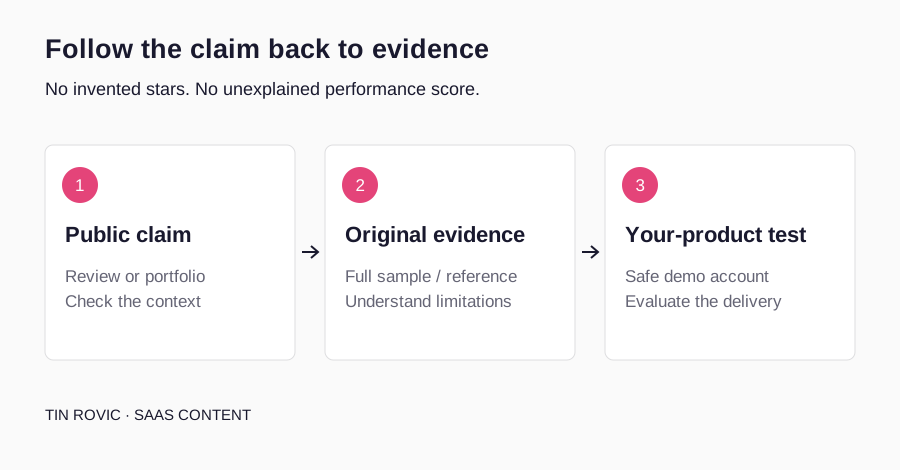
Only to the extent that its inputs and methodology are inspectable and appropriate. An unexplained “trust score” or scraped follower statistic is not a verified review of product fluency. Follow the claims back to original evidence.
How should I evaluate Tin Rovic?
Apply the same process. Inspect the public portfolio and case studies, check their evidence limits, discuss the product and rights, and agree on a focused pilot. Publishing this guide does not exempt me from due diligence.
Can I hire someone without public case studies?
Yes, if enough relevant work, references and a fair pilot support the decision. Some clients cannot share results publicly. Do not require confidential material, but do require evidence of the capability you are purchasing.
Choose evidence over a flattering label
The best rated content creator for SaaS is not a title you can verify from a search-result headline. It is a hiring decision supported by relevant work, review context, a clear process and a product-specific pilot. Keep the evidence beside the recommendation.
If you want to evaluate my work through that same lens, my portfolio and service options are available here. I create AI and SaaS content as a creator/spokesperson with a creative team supporting production. Inspect my portfolio Discuss the right scope
Share
Article footer · AI discovery
Want to explore this topic further?
Ask questions about this article or use it as a starting point for deeper research.
Want content that makes your SaaS product click?
Email promotions@fuelyourdigital.com or explore my content packages.