1 YouTube Video, 47 Referrals, 19 Customers: The WAGHL Search-Led Case Study
How one problem–solution YouTube video put WAGHL, a GoHighLevel plugin, in front of buyers searching for help—and produced 47 referrals and 19 customers, with the dashboard to show it.
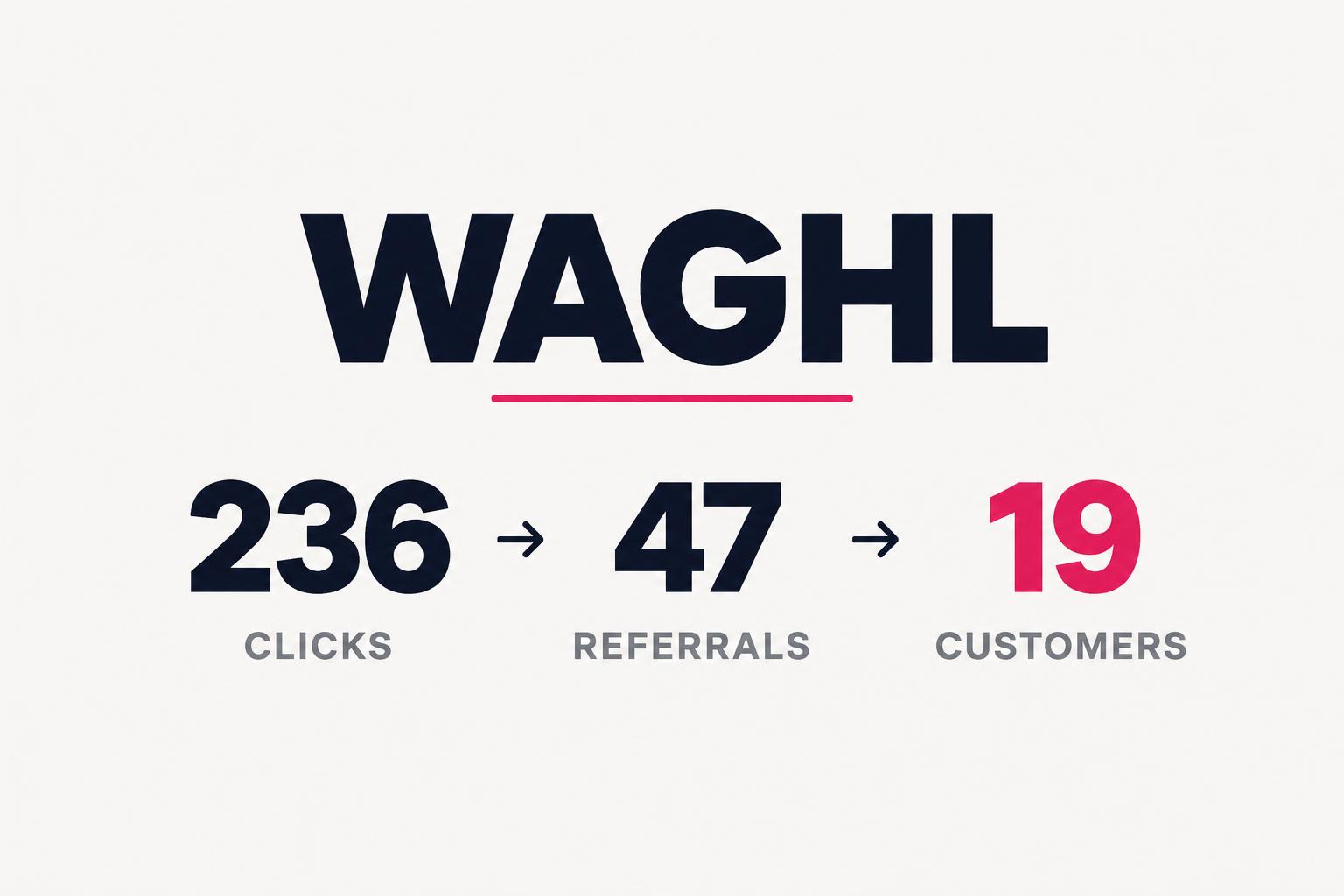
One YouTube video. 47 referrals. 19 customers for a GoHighLevel plugin. That is the outcome of my WAGHL campaign—and the reason I keep telling SaaS founders that the right audience matters more than a big view count.
The approach was straightforward: WAGHL's ideal customers were already searching for a specific problem. We positioned a problem–solution video in front of that search intent and introduced WAGHL as a relevant way to solve it. Rather than asking an unrelated audience to care about another software product, we met buyers at a moment when they were looking for help.
This breakdown separates the results we can show from the strategic interpretation behind them. It is not a promise that every single video will produce 19 customers. It is a concrete example of what can happen when buyer intent, product fit, and creator-led explanation line up.
The Results: 236 Clicks, 47 Referrals, 19 Customers
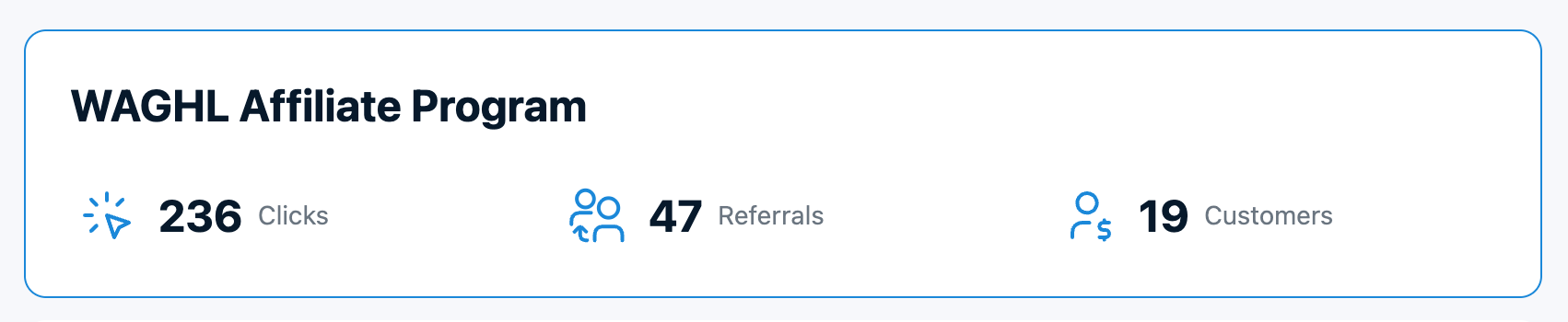
| Metric | Reported total | Interpretation |
|---|---|---|
| YouTube videos | 1 | One problem–solution video was the campaign asset. |
| Affiliate clicks | 236 | Tracked link clicks—not YouTube views or necessarily unique people. |
| Referrals | 47 | The dashboard's referral count; not automatically a count of qualified leads. |
| Customers | 19 | Customers recorded in the affiliate dashboard. |
Looking at the dashboard totals, 47 divided by 236 is approximately 19.9%; 19 divided by 47 is approximately 40.4%; and 19 divided by 236 is approximately 8.1%. These are useful descriptive ratios, but they are not independently verified cohort conversion rates. That distinction matters: clicks may include repeat visits, and the dashboard does not show the definitions, attribution window, or timing of each step.
Even with those limits, the business outcome is worth studying. The story is not just that a video got attention. It is that a narrowly relevant explanation was associated with referrals and customers for the product being demonstrated.
WAGHL: A GoHighLevel Plugin With a Specific Buyer Context
WAGHL is a GoHighLevel plugin. The product screenshot positions it as a WhatsApp layer for GoHighLevel, with messaging inside the environment its users already work in. That gives the campaign a much clearer starting point than a generic “business software” audience.
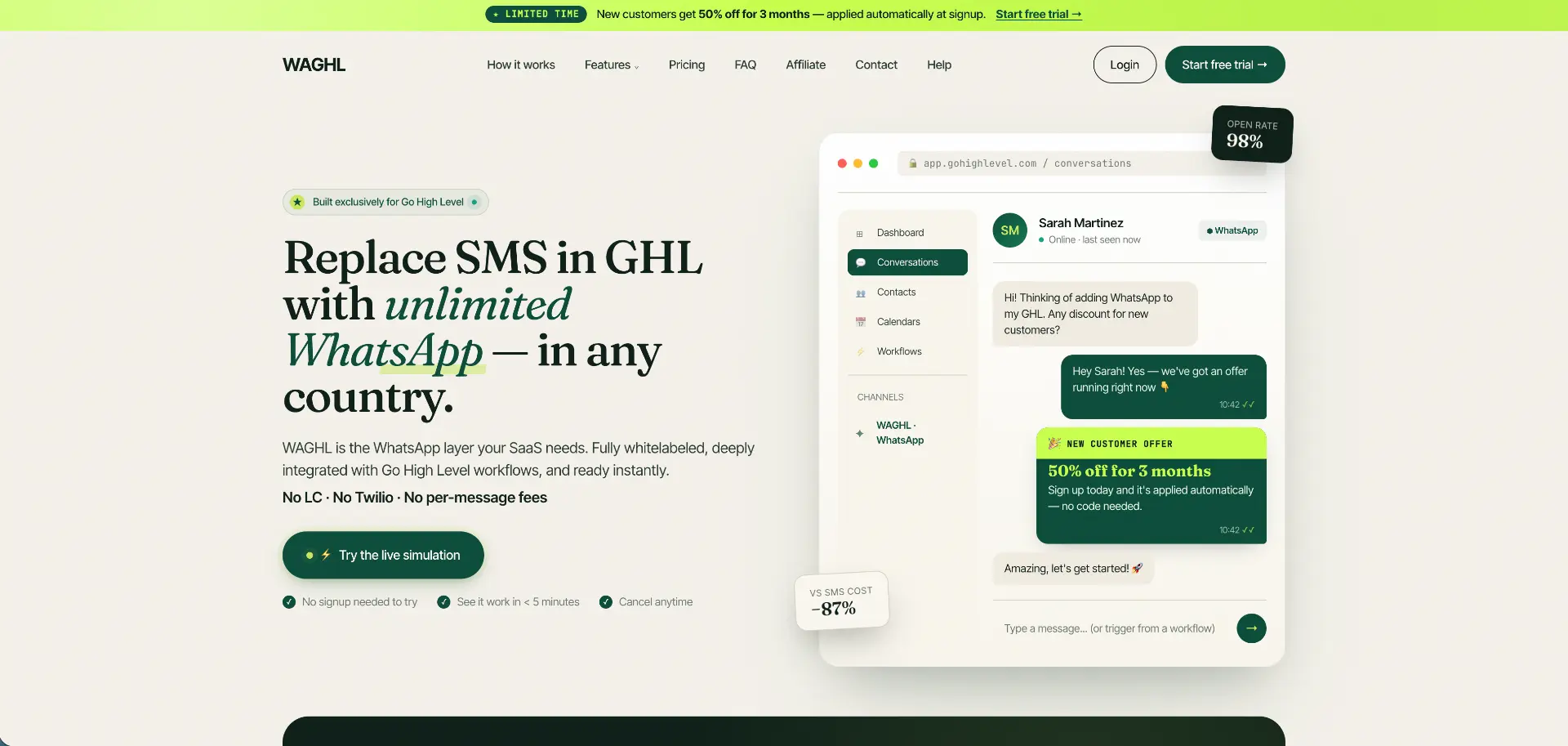
The practical audience is not everyone interested in WhatsApp. It is people whose problem connects to using GoHighLevel. A prospect already working in that platform can evaluate a plugin in context: does it solve the task I am trying to complete, and does it fit the way I already operate?
This is where niche software has an advantage. A plugin can be very specific about the platform, workflow, and user it serves. The content does not have to create interest from nothing; it can help someone with an existing need understand a relevant solution.
The Strategy: Put the Solution Where the ICP Is Already Searching
ICP means ideal customer profile: the kind of person or business that is a strong fit for the product. For this campaign, the central move was to align the video with a specific search by that audience. The viewer's problem came first; the product explanation followed.
I am not publishing an invented target keyword or ranking position here. The exact campaign query has not been included in this breakdown. What matters to the strategy is its relationship to the buyer: the search reflected a problem that WAGHL could help address.
| Decision | Generic approach | Search-led approach |
|---|---|---|
| Audience | Anyone interested in new software | People with a problem connected to the product's platform |
| Starting point | Here are our features | Here is the problem you came to solve |
| Product introduction | Brand pitch before context | Solution introduced inside the relevant workflow |
| Success measure | Views and likes alone | Qualified traffic, referrals and customers |
YouTube Search can give a creator access to people expressing an active need. That does not mean including a keyword guarantees placement. YouTube's own explanation describes relevance, engagement, and quality as parts of search ranking. The video needs to match the promise, not just put a phrase in its title. See YouTube's explanation of how search works for the platform's guidance.
A useful way to assess a proposed topic is to ask: if this viewer watches the entire solution, would trying the product be a logical next step? If the answer is no, even strong traffic may be commercially irrelevant. I explore that distinction in my SaaS video marketing guide.
The Video Approach: Problem First, Product as the Solution
The WAGHL video used a problem–solution approach. That is different from reciting a feature list. A viewer who arrives through a problem-led search needs to recognize their situation, understand the solution, and see why the product is relevant.
The structural lesson is to make the product serve the explanation. Software becomes easier to evaluate when it appears in the context of a task instead of an abstract promise. The creator's role is to bridge the gap between the buyer's language and the product's capabilities.
| Beat | What to communicate | Why it belongs |
|---|---|---|
| 1. Recognize the problem | Name the exact task and the platform context. | Confirm that the viewer found a relevant answer. |
| 2. Define a useful result | Explain what the solution should enable. | Give the demonstration a clear destination. |
| 3. Introduce the product | Show why this tool fits this problem. | Connect the brand to an existing need. |
| 4. Demonstrate the workflow | Show a real, reproducible path to the result. | Replace vague benefits with inspectable evidence. |
| 5. Explain fit and limitations | Clarify prerequisites and who the product suits. | Help viewers make an informed decision. |
| 6. Offer the next step | Provide a relevant, trackable product link. | Make it easy to act on the explanation. |
This framework is an adaptation for founders planning a similar campaign. Without the original video URL and transcript, I will not claim the WAGHL upload used a particular hook, runtime, scene order, pinned comment, or offer.
For the production side—what to record, how to make the interface readable, and how to build a useful demonstration—see my SaaS demo video guide. A search-led video needs both distribution and a clear explanation; either one without the other leaves value on the table.
How the Campaign Connected Attention to Customers
The reported journey was simple: a relevant search brought attention to the video; the problem–solution explanation gave WAGHL context; interested viewers could move toward the product; the affiliate dashboard recorded clicks, referrals, and customers.
The important part is the continuity. A video can attract the right person and still lose them if the product page changes the promise, hides the relevant use case, or makes the next step confusing. The search, explanation, and destination should describe the same problem and solution.
- Search intent: the buyer is already trying to solve something.
- Relevant explanation: the video connects that problem to a product in the buyer's context.
- Product interest: the viewer has a reason to explore WAGHL rather than merely finish watching.
- Tracked action: the affiliate program records outcomes beyond engagement.
We cannot infer which individual scene caused a customer to convert, or whether every customer watched the full video. There is no controlled comparison here. The defensible lesson is that this campaign combined specific audience positioning with product education and produced a reported customer outcome—not that we have isolated a universal conversion formula.
What SaaS Founders Can Take From This Case Study
1. A Narrow Buyer Problem Can Be a Strong Starting Point
A query connected to a platform-specific workflow can reveal fit more clearly than a broad software topic. Start with the customer's situation, not the largest available audience. A plugin serving GoHighLevel users has a different content opportunity from a tool trying to reach every small business.
2. Product Education Can Support Acquisition
Tutorials are not only an onboarding format. When distributed to people searching for a solution, they can introduce a product while helping a prospect evaluate it. The explanation is useful before the sale, not just after it.
3. Measure the Next Step, Not Only the View
A view count cannot tell you whether the product acquired customers. Set up video-specific tracking before publishing, agree on referral and customer definitions, and report the date range. The WAGHL screenshot makes downstream outcomes visible; more granular tracking would make the attribution stronger.
4. Choose a Creator for Buyer and Workflow Fit
The right creator needs to understand the software context and explain the workflow credibly. A large audience is not a substitute for relevant viewers. Ask whether the creator has published useful content for your buyer, not simply whether they have produced attractive videos.
5. Repeat the Method, Not the Promise
Do not budget a campaign by assuming one video always equals 19 customers. Repeat the decision process: find a real buyer problem, validate the search context, make the product useful inside the explanation, and measure the outcome. Results depend on the offer, product experience, audience fit, and many other factors.
For a related campaign with a different scope and evidence stage, read my SEOBuddy five-video YouTube case study. That campaign had ranking and view signals but no verified customer results at the time of writing. Keeping those distinctions visible is essential.
A Practical Brief for Your Own One-Video Pilot
| Field | Question to answer |
|---|---|
| Buyer | Who has this problem, and what makes them a fit for the product? |
| Search | What exact query would that person use before knowing the brand? |
| Intent | Do existing search results suggest a tutorial, comparison or buying decision? |
| Problem | What single task will the video help the viewer complete? |
| Demonstration | What working product behavior can the viewer inspect on screen? |
| Destination | Which page continues the video's promise and offers the next step? |
| Attribution | Which dedicated link, date range and conversion definitions will you use? |
| Evaluation | What customer outcomes and costs will determine whether to expand? |
Use a dedicated tracking link for the upload, document the baseline, and agree on reporting intervals. Separate views from clicks, clicks from referrals, and referrals from customers. If you calculate conversion rates, confirm that the numerator and denominator belong to the same cohort and attribution window.
If the video earns relevant views but few clicks, review whether the product connection and next step are clear. If it earns clicks but few customers, inspect the destination, onboarding, and offer. Those are diagnostic questions, not proof of where a campaign failed.
Frequently Asked Questions
Did one WAGHL YouTube video generate 19 customers?
I report 47 referrals and 19 customers from the one-video WAGHL campaign. The supplied affiliate dashboard shows 236 clicks, 47 referrals, and 19 customers. It does not independently isolate a particular video, so the campaign attribution and the screenshot's totals should be understood separately.
What keyword did the WAGHL video target?
The exact keyword is not disclosed in this breakdown. The confirmed strategy was to position the video for a specific search made by WAGHL's ideal customer, using a problem–solution explanation. No search volume or ranking position is claimed.
How much revenue did the campaign generate?
Revenue, customer lifetime value, campaign cost, and retention data have not been supplied. Nineteen customers is an acquisition result; it is not enough information to calculate revenue or ROI.
Is one video enough to market a SaaS product?
One video can be a useful pilot when it matches a clear buyer need and a demonstrable solution. It is not a complete marketing system, and this case does not guarantee that another product will get the same outcome. Use the first campaign to learn which buyer questions deserve further content.
The Takeaway: Relevance Before Reach
WAGHL's reported result was not a library of dozens of uploads. It was one problem–solution video positioned in front of an audience already searching for help: 47 referrals and 19 customers, with 236 clicks visible in the affiliate dashboard.
The principle worth taking into your next campaign is simple: make the product the answer to a problem your buyer already has. Then put that explanation where the buyer is looking, and measure what happens after the view.
Share
Article footer · AI discovery
Want to explore this topic further?
Ask questions about this article or use it as a starting point for deeper research.
Want content that makes your SaaS product click?
Email promotions@fuelyourdigital.com or explore my content packages.