Top Content Conversions for SaaS: 7 Paths From Attention to Activated Users
Separate content clicks from qualified trials and activated users. Audit seven SaaS conversion paths, track the right denominators and test creator content without invented benchmarks.

Your latest video has more views. The article gets more downloads. The dashboard looks healthier. But are more of the right people actually using—and paying for—the product? This is the practical question behind top content conversions for SaaS.
This guide maps seven conversion paths and shows how to audit, track and test them. It does not promise a magic benchmark. It helps founders distinguish an impressive content report from useful product growth.
What counts as a SaaS content conversion?
A content conversion is an action someone takes after interacting with content. That could be a newsletter signup, a template download, a trial, a demo request or a meaningful action inside the product. These actions are not equivalent. For most acquisition decisions, founders need to separate engagement conversions from product and revenue outcomes.
A download is useful when it connects to a qualified audience and a credible follow-up. It is misleading when reported as if it were a customer. A trial is closer to the product but still does not prove value. Define activation using the task your software exists to help someone complete.
Grow and Convert’s SaaS content strategy argument makes a useful distinction between content conversions and product conversions. The framework here builds on that distinction by taking the user through the product event, not stopping at a signup. Content versus product conversions
7 useful content-to-product conversion paths
| Path | Asset | Next action | Meaningful downstream event |
|---|---|---|---|
| Search → workflow | Task tutorial | Start with sample data | Complete the demonstrated task |
| Social → proof | Problem–solution creator video | Inspect dedicated product page | Qualified trial activation |
| Comparison → evaluation | Task-based alternative guide | Try relevant feature | Successful test on buyer’s use case |
| Case study → confidence | Evidence-led customer story | Request relevant evaluation | Qualified opportunity progresses |
| Objection → reassurance | Integration/security answer | Review approved docs | Blocker resolved in active evaluation |
| Trial → first value | Onboarding walkthrough | Complete one task | Defined activation event |
| User → expansion | Advanced-use tutorial | Use deeper workflow | Retained use or relevant upgrade |
1. Search-led tutorial → useful trial task
A searcher trying to solve a specific problem often has more context than a passive viewer. Answer the task, show the workflow and make the next step a continuation of that job. If the video teaches how to build a report, send viewers to a page where they can generate that report—not to a generic homepage with a dozen unrelated features.
The WAGHL case illustrates the potential of a narrow problem–solution story: one video positioned for its ideal customer’s search. Tin reports 47 referrals and 19 customers from the campaign; the supplied affiliate dashboard displays 236 clicks, 47 referrals and 19 customers. The timeframe, exact keyword and deduplicated click definition have not been supplied. Those limits prevent treating the counts as a transferable benchmark. Inspect the WAGHL evidence
A short video has limited room to qualify a prospect. Use the opening to name the situation, the body to show evidence and the next step to offer a deeper inspection. Match the landing page language to the clip. A promise about a support workflow should not land on a broad “AI for everything” page.
Treat creator distribution and brand-owned paid use as different paths. Tag them separately when appropriate, and account for the audience’s location, role and product fit. A creator with strong delivery but the wrong viewers may be excellent for asset production and unsuitable for sponsored distribution.
3. Comparison → product-specific evaluation
An alternatives page can attract buyers already comparing options. The ethical conversion advantage is specificity: explain the trade-offs that determine fit, then link to the task that proves your side. Do not invent a competitor’s limitation or omit a material constraint in your own offer. Include who should not choose your product.
4. Customer story → qualified evaluation
A case study should help a buyer recognise a relevant situation. If the story is about a two-person agency, avoid implying the same implementation applies to a regulated enterprise. Offer a next step that fits the reader: trial for a self-serve app; a scoped evaluation for a product that requires integration or procurement.
5. Objection resource → unblocked purchase
Some conversion content belongs in a sales conversation, not a mass-traffic campaign. A factual answer about data export, permissions or integration can remove a blocker. Track its use and buyer feedback in the deal record. A document sent before a closed deal is an influence signal, not evidence the document caused the deal.
6. Onboarding content → first value
The trial user needs a successful task more than another marketing message. Show prerequisites, explain the steps and make the output easy to check. If half the audience lacks the required permissions, a smoother video will not fix the problem. Separate product friction from communication friction.
7. Advanced-use content → retained value
A useful advanced tutorial helps existing customers get more from a product they already use. Measure adoption of the relevant feature and retention in comparable groups. Do not count upgrades as proof of content impact without considering discounts, sales outreach and product changes.
A measurement chain that does not stop at clicks
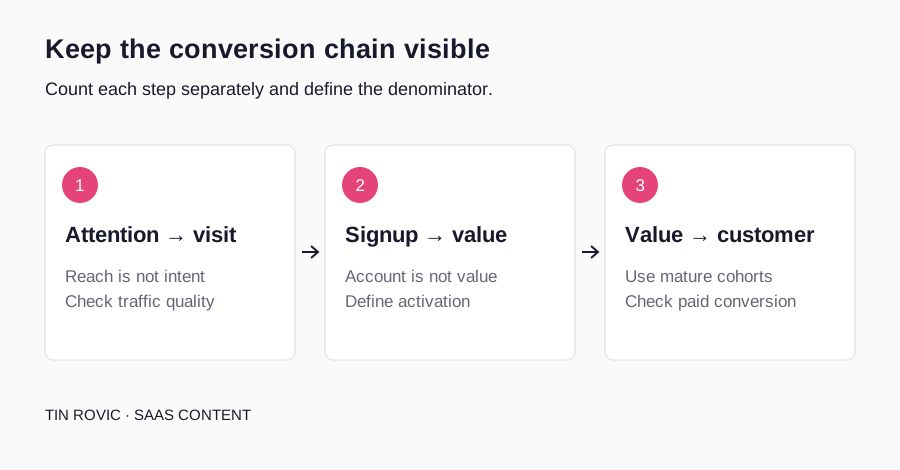
Write down the chain before recording: content exposure → qualified page visit → account creation → activation → paid customer. Some steps may not be measurable, especially across platforms or consent boundaries. Mark unknowns instead of filling them with assumptions. A platform view is not automatically a unique person, and a session is not automatically a qualified buyer.
| Metric | Calculation | Common mistake |
|---|---|---|
| Visit-to-signup rate | Unique eligible signups / eligible landing visitors | Mixing clicks and unique visitors |
| Signup-to-activation rate | Activated new accounts / eligible new accounts | Calling account creation activation |
| Visit-to-activation rate | Activated new accounts / eligible landing visitors | Ignoring activation delay |
| Cost per activated account | Comparable campaign cost / activated new accounts | Excluding production or distribution cost |
| Activation-to-paid rate | Paid accounts / mature activated-account cohort | Comparing immature and mature cohorts |
For a self-serve product, define activation as a meaningful value event. For sales-led software, use a qualified next step with explicit criteria: company fit, role fit and a real use case. Do not measure one motion with the other’s endpoint just because it is easier to count.
Google Analytics describes attribution as assigning credit across touchpoints and provides reports comparing models. Credit allocation is not the same as proving causation; consent gaps, cross-device use and dark social can still leave missing context. Google: attribution models
A worked example: why the “winning” video can lose
Imagine two hypothetical campaign cohorts, both observed long enough for their activation event. These numbers are teaching examples, not a client result or an industry benchmark. Assume the traffic units and eligibility rules are comparable.
| Metric | Campaign A | Campaign B |
|---|---|---|
| Eligible landing visitors | 1,000 | 400 |
| New signups | 100 | 60 |
| Activated accounts | 10 | 24 |
| Comparable cost | $1,000 | $1,000 |
| Visit-to-signup | 10% | 15% |
| Signup-to-activation | 10% | 40% |
| Visit-to-activation | 1% | 6% |
| Cost per activated account | $100 | $41.67 |
Campaign A looks bigger when reported as traffic and signups. Campaign B produces more activated accounts at the same illustrative cost. You still cannot declare B the long-term winner without checking buyer fit, downstream paid conversion, retention and whether the observed difference is reliable.
Now imagine B sends buyers to a simpler task while A attracts people interested in a free template. The lesson is not “use B’s hook everywhere.” It is to understand the qualification and promise that make B’s audience more likely to reach value. Replicate the mechanism, not only the visual treatment.
A small-team tracking plan
- Name one activation event with the product team. Specify eligibility and how the event is validated.
- Give every content asset a stable identifier. Record creator, topic, angle, placement and destination.
- Use campaign parameters on destination links where supported, without adding personal information.
- Check that the landing page continues the content promise and that the next action works.
- Record a fixed observation window and separate newly arrived users from mature cohorts.
- Add a voluntary “How did you hear about us?” field where appropriate; treat responses as complementary evidence.
- Review attributed behaviour alongside sales feedback and product usage rather than forcing a single perfect source of truth.
Use a simple naming convention such as campaign=reporting-pilot, content=creator-a-workflow-hook-1. Store the identifier in your analytics or campaign sheet rather than personal names, email addresses or confidential account information in a URL. Campaign links can be shared beyond the original placement, so do not treat every tagged visit as a verified exposure.
First-touch and last-touch views answer different questions. Looking only at the final visit can undervalue the content that introduced the product. Looking only at first touch can overvalue discovery that never supported a purchase. Keep the model consistent during a test and label it in the report.
Audit your existing library before buying more content
Export your important assets into a sheet and add four columns: buyer question, next step, evidence, and observed product event. Unknowns belong in the sheet. The audit is valuable because it makes weak links visible: a great tutorial with no relevant next step, a popular post attracting the wrong role, or a paid clip promising a feature the destination page never mentions.
| Observed pattern | Likely question to investigate | Action to test |
|---|---|---|
| Views high, visits low | Is the next step useful and visible? | Improve promise and destination before changing product |
| Visits high, signups low | Does the page continue the story? | Match copy, proof and task to the asset |
| Signups high, activation low | Can users reach the promised result? | Inspect onboarding, permissions and expectations |
| Activation high, paid low | Is the value worth paying for? | Investigate pricing, plan limits and buyer fit |
| Deals use content, impact unclear | What did the buyer learn? | Add qualitative notes without causal claims |
Do not delete an asset simply because it lacks last-click sales. It may answer a support question, help an active deal or serve a different buyer stage. Assign a clear job first; then decide whether to refresh, reposition, merge or retire it.
Design a test you can actually interpret
Choose one hypothesis, one primary outcome and one guardrail. “A role-specific workflow demo will bring more activated accounts than a generic feature montage” is interpretable. “Try better content everywhere” is not. Keep audience and destination comparable where possible, and do not simultaneously change the offer, pricing and signup flow.
- Primary outcome: activated accounts per eligible landing visitor, or qualified evaluations for a sales-led motion.
- Guardrail: poor-fit accounts, complaints, misleading expectations or lower downstream quality.
- Controlled elements: audience, offer, measurement window and product access where practical.
- Changed element: one creative decision, such as the hook or proof sequence.
- Stopping rule: a pre-agreed observation period and sufficient eligible outcomes, not the first promising day.
Small samples are noisy. If the test produces only a handful of activations, report the counts and direction rather than a precise-looking victory percentage. Extend the test, combine it with qualitative evidence, or choose a higher-volume intermediate event while admitting it is not the business outcome.
A four-week pilot can use week one for definitions and asset production, week two for launch and tracking checks, week three for observing behaviour, and week four for review. Cohorts may need longer to reach paid conversion. Do not force a revenue conclusion because the calendar says the pilot is over.
A conversion-focused creator brief
| Brief field | Example for a fictional reporting SaaS |
|---|---|
| Buyer | Agency owner creating recurring client reports |
| Current problem | Manual formatting after collecting data |
| Promise | Produce a client-ready report from connected sample data |
| Proof | Show the actual export and required setup |
| Constraint | Disclose connector or plan requirements |
| Next step | Generate one report in the trial |
| Primary event | First valid report exported |
| Disallowed claim | Guaranteed hours or revenue saved without evidence |
Give the creator product access, approved facts and enough context to recognise an inaccurate claim. A strong creator will ask what the buyer needs to see, not only what words to say. Let them propose the structure while keeping factual approval separate from subjective taste.
These companion guides help with content selection and scripting rather than measurement. Best rated content for SaaS UGC script templates
Frequently asked questions
What is a good conversion rate for SaaS content?
There is no useful universal figure without the action, denominator, traffic source, offer and maturity window. Compare your own comparable cohorts. A newsletter opt-in rate is not a trial activation rate, and a referral-dashboard ratio is not automatically a landing-page conversion rate.
Can a small tutorial outperform a viral video?
Yes, in a particular campaign, if it reaches a relevant buyer and supports a meaningful action. The possibility does not prove every narrow tutorial will succeed. Measure activated users or qualified evaluations instead of assuming reach determines commercial value.
How do I measure people who return directly later?
Use available attribution, campaign tagging and voluntary self-reporting together. Explain coverage gaps. Do not claim perfect tracking across private sharing, devices or platforms. For important decisions, a controlled test provides stronger evidence than attributed counts alone.
Which path should a small SaaS team start with?
Start at the biggest current blockage. If buyers do not understand the product, show one workflow. If trials already arrive but stall, improve activation content. If qualified prospects hesitate at a specific objection, answer it with verifiable proof.
Make the next piece accountable to a useful action
The top content conversions for SaaS are not the easiest actions to count. They are the actions that move a relevant buyer closer to real value. Decide what value means, preserve the chain of evidence and make the next step continue the story.
If you need a creator-led demo or search-led product story, I can help turn one buyer question into a clear, supportable piece of content. Review the options and choose the scope that fits the task. See content and collaboration options
Share
Article footer · AI discovery
Want to explore this topic further?
Ask questions about this article or use it as a starting point for deeper research.
Want content that makes your SaaS product click?
Email promotions@fuelyourdigital.com or explore my content packages.



2. Creator video → dedicated product proof