Best Rated Content for SaaS: 9 Formats Worth Your Budget (and How to Judge Them)
Compare nine SaaS content formats by buyer question, proof and production effort. Use an original scorecard to choose useful content—not a made-up universal ranking.

A SaaS founder does not need more content that gets called “great” in an internal meeting. You need content that helps the right person understand the product, evaluate it and reach a meaningful result. This guide translates the search for best rated content for SaaS into a practical buying and production decision.
Instead of invented ratings or a universal winner, you will get nine format choices, an original evaluation rubric, worked briefs and a way to identify what your existing library is missing. The companion conversion guide covers measurement; this page covers usefulness and quality.
What is the best rated content for SaaS?
For a SaaS buyer evaluating a product, the most useful content is often a specific workflow demo, a transparent comparison or a customer case study that answers a real purchase question. For a user already in a trial, an onboarding tutorial may be more valuable. There is no defensible all-industry league table declaring one format the highest rated.
That distinction matters because a slick video and a useful video are not the same thing. A beautiful launch film can introduce your brand while leaving a prospective customer unable to explain what the software does. A plain screen recording can answer the exact question blocking purchase. Choose the job before you choose the production style.
Google’s own content guidance asks whether a page adds original information, substantial analysis and value beyond other search results. That is a better quality standard than the number of keywords or the length of the finished asset. Google Search Central: helpful content
Find the question your current content leaves unanswered
Start with five recent lost deals, five support conversations and five successful customer onboarding sessions. If you do not have that volume, use the conversations you do have and acknowledge the small sample. Copy the words people use before translating them into a topic. “Can it export the report my client needs?” is a stronger brief than “awareness video.”
| Buyer says | Underlying uncertainty | Content to create | Proof to show |
|---|---|---|---|
| “I cannot tell what it does.” | Category and outcome | One-workflow demo | Real input, visible action, real output |
| “We already use something similar.” | Switching value | Transparent comparison | Same task in both workflows |
| “Will this work for a company like ours?” | Applicability | Customer case study | Starting state, constraints, supported result |
| “It looks difficult to set up.” | Time to first value | Onboarding tutorial | Prerequisites and complete first task |
| “Our security team will ask questions.” | Risk and procurement | Trust/resource page | Approved factual answers and documentation |
| “Why should I pay for this?” | Economic value | Use-case/ROI explainer | Transparent assumptions, not invented savings |
Do not produce six awareness clips to solve a procurement objection. Do not publish a forty-page research report when trial users are abandoning a three-step import flow. A content gap is not simply a topic your competitors covered; it is a decision your buyer cannot yet make confidently.
9 SaaS content formats worth evaluating
1. A real workflow demo
A workflow demo shows one person completing one useful job. It needs a recognisable starting problem, legible product footage and a finished result. Use it when the product is unfamiliar or when the benefit is hard to understand from a screenshot. An AI app might show a messy customer request becoming a reviewed response; the key proof is the transformation, not a montage of dashboards.
Failure mode: narrating every menu. Better approach: identify the moment a buyer understands why the product matters, then get there without hiding necessary setup. Keep a separate full tutorial for people who need every step.
2. A task-based comparison
Compare alternatives using a job your buyer actually performs. Publish the criteria before declaring a winner. A comparison of scheduling products might cover permissions, rescheduling, reminders and export—not count features of wildly different significance. If you cannot test the competing tool, cite its current documentation and label the comparison as documentation-based.
3. An evidence-led customer case study
A good case study names the situation, what changed and what is known about the outcome. It also names limitations. Include timeframe, definitions and attribution when supplied. A result without a denominator may be interesting but cannot support a conversion-rate comparison. Our WAGHL case is useful because the supplied dashboard shows the counts and the article distinguishes the campaign story from what the screenshot independently proves.
Read the evidence and its limits rather than borrowing the headline as a universal forecast. WAGHL: one-video case study
4. Creator-led problem–solution content
This combines a person explaining the problem with actual software proof. It is especially useful when jargon or a feature list makes the offer feel abstract. The creator should understand the product well enough to explain it in their own words. Do not script a first-person customer claim for someone who has never used the app. A paid presenter can demonstrate a workflow honestly without pretending to be an unsolicited reviewer.
5. A search-led tutorial
A tutorial answers the searcher’s specific task from start to finish. It can be a video, an article or a paired asset. The content earns its usefulness by solving the problem, not by forcing a signup before the answer. If the product is needed, explain why and show the relevant plan or prerequisite rather than springing a paywall halfway through the task.
Our SEOBuddy campaign used five feature-specific YouTube videos. The case describes the search-led positioning process; it does not claim measured leads or revenue that have not been supplied. SEOBuddy campaign breakdown
6. First-value onboarding content
Make a new user successful at one meaningful task. A useful onboarding asset identifies required access, sample data, the steps and how to recognise success. Separate “account created” from “problem solved.” A reporting app may count an exported valid report as first value; a team workspace may need a collaborator to join before it is useful.
7. A specific customer testimonial
A real customer can explain the context a polished product video cannot: what they tried before, what changed and what still needs work. Ask for concrete examples instead of a line like “this is the best tool.” Secure permission, avoid leading the interview into unsupported claims, and distinguish the customer’s experience from a result everyone can expect.
Use a customer voice to support a decision, not as decoration. SaaS video testimonial production
8. A usable template or calculator
A template earns attention because it helps someone do the job immediately. Provide a filled example, instructions and boundaries. A calculator should expose its assumptions so a user can replace them. For an ROI worksheet, do not quietly assume every hour saved becomes payroll savings. Time reclaimed, cash saved and additional revenue are different economic claims.
9. A trust and evaluation resource
Buyers may need permissions, integrations, data handling, accessibility, implementation or procurement answers. Link to approved documentation and indicate when a question needs a conversation. Content that removes an evaluation blocker can be commercially useful even if it attracts little traffic. Avoid unapproved certification or compliance claims.
An original SaaS content quality scorecard
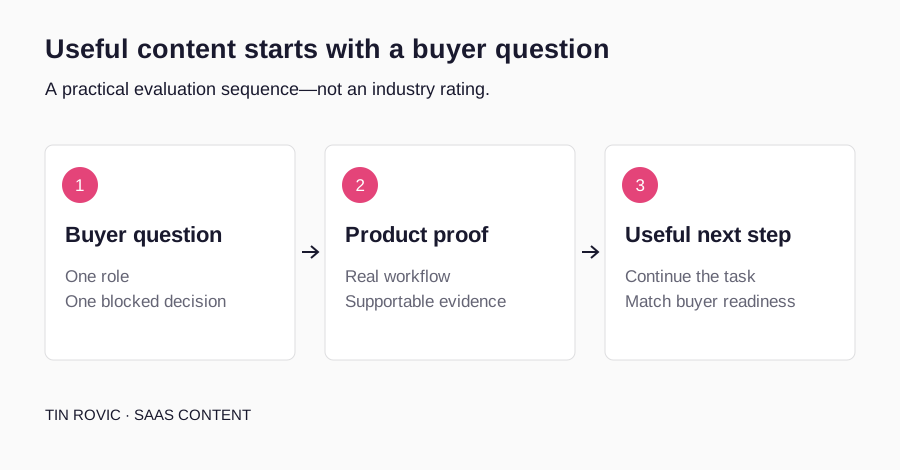
Score an asset from zero to five on each dimension, then multiply by the suggested weight. Zero means absent; three means useful but incomplete; five means clear and supported. Evaluate with someone who is not involved in making the asset. This is a decision aid, not a validated predictor of sales.
| Dimension | Weight | What a 5/5 looks like |
|---|---|---|
| Buyer relevance | 25 | One identifiable role, situation and question |
| Proof quality | 25 | Actual workflow or attributable evidence with limitations |
| Clarity | 20 | A buyer can explain the result without interpretation |
| Next-step usefulness | 15 | Action matches the reader’s readiness and is easy to find |
| Accuracy and currency | 10 | UI, availability, claims and links checked |
| Accessibility | 5 | Readable screens, useful text and captions where appropriate |
Example: a hypothetical import tutorial scores 4, 5, 3, 4, 5 and 3 across these dimensions. Its weighted score is 82/100: (4/5 × 25) + (5/5 × 25) + (3/5 × 20) + (4/5 × 15) + (5/5 × 10) + (3/5 × 5). The weak clarity score tells you what to fix. It does not tell you the tutorial will convert 82% of viewers.
Do not average away a critical failure. An inaccurate product claim, exposed customer data or invented testimonial is a stop condition even when the video looks excellent. Correct those before publishing.
Three worked content briefs for different SaaS buyers
| Product and buyer | Question | Asset and proof | Next step |
|---|---|---|---|
| AI support tool / support lead | Can it help without sending wrong answers? | Creator demo of draft, source check and human approval | Try on a sanitised sample request |
| Reporting app / agency operator | Can I send a client-ready report? | Tutorial producing a real export from sample data | Generate one report in the trial |
| Scheduling product / operations manager | Will this handle our team handoffs? | Role-specific walkthrough with permissions shown | Review team setup or book evaluation call |
For the AI support example, the strongest content may show the system needing a correction. A limitation visible in the demo can answer a serious buyer’s trust question more effectively than another “effortless automation” claim. Do not manufacture errors for drama; select a representative real task and explain what happens.
For the reporting example, include the final export in the article so the buyer can inspect it. For the scheduling example, explain whether the feature depends on a paid plan or administrator access. These details make an asset useful even before the viewer chooses your product.
How to prioritise content when the team is small
List the five questions closest to a purchase or first-value blockage. Estimate each question’s frequency from your available conversations, its commercial consequence, and the effort to answer it properly. “Commercial consequence” may be evaluation, activation or retention—not always a new signup.
- Choose one blocked decision, not a broad channel goal.
- Collect screenshots, real workflow evidence and approved product facts.
- Create one complete answer in the format the buyer needs.
- Place it at the moment of uncertainty: landing page, sales email, onboarding or search result.
- Review accuracy and user feedback before producing variations.
A practical two-week pilot: spend the first days gathering questions and proof, the next days scripting and recording, then publish with one clearly measured action. Use the final days to watch people use the asset and identify confusion. This schedule is an illustrative planning option, not a delivery commitment or performance promise.
Repurpose only after the full answer exists. A short social clip can introduce the problem and point to the walkthrough; it should not imply the ten-second clip contains all the evidence. Keep a record of which cuts need updating when the UI changes.
Measure usefulness separately from conversion
Content quality is an input; observed buyer behaviour is an outcome. Measure both. Ask test viewers what the product does, who it is for and what they would do next. Then inspect the next-step behaviour of the audience you actually targeted. High watch time can coexist with the wrong audience.
| Job | Primary observation | Guardrail |
|---|---|---|
| Explain product | Correct unaided explanation | Not just video completion |
| Support evaluation | Qualified next-step action | Not all clicks treated as buying intent |
| Drive trial value | Meaningful product event | Not account creation alone |
| Help sales | Use in relevant deals + buyer feedback | Influence is not proof of causation |
| Reduce confusion | Fewer repeated questions in comparable cohorts | Do not attribute unrelated changes to content |
For tracking and testing rather than format selection, the companion guide explains denominators, attribution and an original audit process. Top content conversions for SaaS
Frequently asked questions
Which SaaS content type should I make first?
Start with the question closest to a blocked product decision. If people do not understand the value, make a real workflow demo. If they understand it but fear switching, make a comparison or migration resource. If trials stall, fix first-value onboarding before buying more awareness.
Can I call my content the highest rated?
Only when you have a real rating source, a defined comparison set and a clear methodology. A private opinion or an editorial score does not establish a public “highest-rated” claim. Name what was rated, by whom and when—or use plain descriptive language.
Do human creators matter for AI SaaS?
They can contribute explanation, product judgement and a recognisable voice. AI editing can help production, but it cannot supply a real customer experience that never occurred. Evaluate the actual workflow and audience fit instead of assuming either human or synthetic content always wins.
Should I hire a writer or a video creator?
Choose based on the buyer’s uncertainty. Written comparisons and documentation excel at inspectable detail; video can make an unfamiliar workflow tangible. They often work together. Commission a complete answer, not a format simply because a competitor uses it.
Build one useful answer before building a library
The best rated content for SaaS is the content your buyer can use to make a better decision. Start with one question, show supportable proof and offer the right next step. Publish the limitations alongside the promise. That is a stronger foundation than declaring every asset “high converting.”
If the missing answer needs a real person and a clear product walkthrough, I create AI and SaaS content with a creative team behind me. You can review the available options without committing to a package. Explore working together UGC for AI apps
Share
Article footer · AI discovery
Want to explore this topic further?
Ask questions about this article or use it as a starting point for deeper research.
Want content that makes your SaaS product click?
Email promotions@fuelyourdigital.com or explore my content packages.