SaaS UGC Pricing in 2026: What Creators Actually Charge
Understand SaaS UGC pricing with a verified $250 single-video offer, scope comparisons, illustrative budgets, usage-rights questions, and a quote checklist.

How much does SaaS UGC cost? Based on the projects I have quoted or delivered, a single SaaS UGC video typically costs $100–$1,500 in 2026: newer creators charge roughly $100–$250, experienced creators $250–$600, and SaaS specialists $600–$1,500 or more. Paid-ad usage rights commonly add 20–100% on top. My own public single-video offer is $250.
Those ranges come from my own deals and quotes plus public marketplace listings—they are planning baselines, not an audited industry average. The rest of this guide gives you the rate tables, a budget calculator, a line-item comparison sheet, two worked estimates, and a contract checklist so you can compare any quote against the same scope.
SaaS UGC Rates at a Glance
The table below combines ranges from projects I have quoted or delivered with public marketplace listings, checked in October 2026. Treat it as a negotiation baseline: a quote far below these ranges usually means narrower scope or fewer rights, and a quote far above them should come with strategy, multiple concepts or distribution included.
| Format | Newer creator | Experienced creator | SaaS specialist |
|---|---|---|---|
| Talking-head problem→solution ad | $100–$200 | $250–$450 | $500–$1,000 |
| Screen-recorded walkthrough | $120–$250 | $300–$550 | $600–$1,200 |
| Demo + voiceover (face optional) | $100–$220 | $250–$500 | $550–$1,100 |
| Tutorial / search-led long-form | $150–$300 | $400–$800 | $800–$1,500+ |
| AI-assisted UGC (synthetic presenter) | $50–$150 | $100–$300 | Rarely sold by specialists |
For an outside sanity check on general UGC rates, the Influencer Marketing Hub benchmark reports and public marketplace pricing such as Billo’s rate page show the broader UGC market. SaaS work typically sits above general consumer UGC because the creator must learn and accurately demonstrate software.
Estimate Your Budget: A Simple Calculator
Use this to size a first test before you request quotes. It multiplies a per-video baseline by your format, usage rights and video count, then shows a planning range. It is an estimate, not a quote—final pricing depends on scope, revisions and the creator.
SaaS UGC budget calculator
Planning estimate only — final pricing depends on scope and the creator.
Estimated production + rights budget
$1290 – $2760
Excludes media spend, landing-page work and creator-audience posting. Range reflects newer creators at the low end and specialists at the high end.
SaaS UGC Pricing: What a Price Actually Buys
A production fee pays for agreed work. It does not automatically buy unlimited use of the creator’s likeness, placement on their account, raw footage, lifetime ad rights, or performance. Some providers bundle those items; others quote them separately. Neither approach is inherently better, but the terms must be explicit.
| Offer | Public price | What is stated |
|---|---|---|
| One UGC Video | $250 | One short-form video; concept/hook; script; presentation; editing; captions; one revision |
| Full UGC Content | Custom | Multiple videos, concepts, demos, and creative angles; scope agreed for the campaign |
| Collaboration | Discuss on a call | Creator-channel formats and audience fit scoped around goals |
| Paid advertising / usage rights | Defined separately | Confirm permissions, term, channels, territory, and fees in the order terms |
See the current packages and single-video order page for the live offer. Do not assume an article’s example arithmetic changes the terms shown during ordering.
Prices on this page use the site’s dollar notation. Confirm currency, taxes, invoicing, and payment terms in your quote or checkout. This article makes no claim about VAT treatment, tax inclusion, discounts, rush availability, or guaranteed delivery dates.
The Seven Cost Drivers Founders Should Separate
| Cost driver | What changes the work | Question to ask |
|---|---|---|
| Product onboarding | Complexity, access, setup, integrations | How much product testing is included? |
| Creative concepts | Different personas, promises, storyboards | How many distinct concepts, not merely hooks? |
| Production | Presenter, screen capture, interviews, locations | What footage and people are included? |
| Editing outputs | Versions, aspect ratios, captions, localization | How many delivered files and languages? |
| Revisions | Feedback rounds, script approval, reshoots | What counts as a revision vs a new brief? |
| Usage / distribution | Paid ads, creator posts, authorization, territory | Where, how long, and by whom can it be used? |
| Campaign operations | Landing pages, ad management, analytics | Is this production only or campaign execution? |
Software complexity matters because the creator needs to understand the demonstrated workflow. A simple text-to-output screen capture and a multi-user approval process do not take the same preparation. Ask for the approved demo path rather than expect the creator to discover and validate the product while filming.
A lower fee may be entirely appropriate for a narrower brief. The problem is not cheap production; it is ambiguous scope. A proposal for a single presenter clip is not directly comparable with a proposal that includes onboarding research, screen masters, three concepts, localization, and paid usage.
Define the Unit: Concept, Hook, Edit, or Video?
“Ten videos” can mean ten new stories or ten edits of one story. For SaaS testing, that difference is operationally important. If the same demonstration appears under ten slightly different opening lines, you have many hook variations but little evidence about alternative buying problems.
| Unit | Meaning | Example |
|---|---|---|
| Concept | A distinct buyer problem and argument | Switching friction vs output accuracy |
| Hook | An alternate opening for a concept | “Before you import…” vs “Test one project first…” |
| Body | The main demonstration and evidence | Import, field mapping, checked result |
| CTA variation | A different supported next step | Try a sample vs request a demo |
| Edit / cutdown | An adaptation of existing material | Shorter cut or new aspect ratio |
| Raw footage | Source material, if licensed and delivered | Screen master and presenter takes |
In your brief, write “two concepts, three hooks per concept, one approved body per concept, one agreed CTA, six final exports.” Then ask whether each export is a separately priced unit or part of a scoped package. Clear counts reduce disappointment and make the testing plan visible to the producer.
The SaaS UGC script-template guide distinguishes new concepts from opening variations and explains how to choose a buyer problem for each.
Usage Rights Can Change the Budget More Than the Edit
Usage rights are usually priced as a percentage on top of the production fee. From the deals I have quoted or seen, these are the working ranges:
| Usage scope | Typical add-on | Notes |
|---|---|---|
| Organic brand channels only | Included – +20% | Often bundled; confirm which accounts and placements |
| Paid ads, 30 days | +20–50% | Named platforms and territories |
| Paid ads, 90 days | +50–100% | The most common performance-marketing licence |
| Whitelisting / creator-handle ads | +50–150% | Uses the creator’s identity; requires platform authorization |
| Perpetual / buyout | +100–300% or negotiated | Rarely necessary; a renewable term is usually cheaper |
Usage rights define permission, not merely file possession. Paying for a download does not necessarily allow the brand to run it as an ad, use it forever, translate the voice, or let affiliates reuse it. Treat rights as an explicit agreement that follows the content after production.
- Channels: brand social, website, paid social, email, sales use, or other named placements.
- Term: start date, end date, and what happens to live ads or archived posts after expiration.
- Territory: named countries or markets, rather than an unstated global assumption.
- Creator identity: permitted use of face, name, voice, and account authorization.
- Edits: cutdowns, subtitles, dubbing, changes in meaning, and approval requirements.
- AI use: whether synthetic voice, likeness cloning, or model-training use is prohibited or separately authorized.
- Third parties: whether agencies, affiliates, resellers, or other brands can use the asset.
- Exclusivity: defined competitors, duration, scope, and compensation if agreed.
A creator-account post adds a distribution commitment: account, format, date, duration if specified, disclosure, and reporting. Spark Ads or similar authorization adds platform permissions and dates. These should agree with the content contract, but neither a platform authorization nor a production invoice replaces all the other terms.
If a proposal says “full rights,” request a precise definition. If it says “organic use included,” ask which accounts and placements that covers. If it says “one year paid usage,” ask when the year starts and whether renewal is possible. Specific wording is more valuable than assumptions about standard practice.
Watch: A Platform’s Perspective on Brand-Deal Pricing
YouTube Creators’ brand-deal pricing discussion offers an external negotiation perspective. It is not a SaaS UGC market-rate survey and does not set the prices or licensing terms on this site. Use it as a prompt to clarify what your proposal includes; the signed agreement, not a generic pricing video, determines deliverables and permissions.
THE BRAND DEAL DESK: Price It Like You Mean It
Loading this video connects to www.youtube-nocookie.com, which may collect your IP address and use cookies.
Source: YouTube Creators on YouTube.
Two Worked Budget Examples
The following numbers illustrate how to compare scope. They are invented assumptions, not current Tin Rovic package pricing or an industry benchmark. Actual production, licensing, and distribution amounts must come from a quote. Advertising spend is shown separately because it buys media, not footage.
| Item | Assumed amount | Comment |
|---|---|---|
| Production | $250 | Uses the public single-video fee only as a planning starting point |
| Paid usage allowance | $120 | Hypothetical placeholder; obtain an actual agreement |
| Landing-page adaptation | $150 | Illustrative internal or external work allowance |
| Media test spend | $600 | Hypothetical spend; not a recommendation or minimum |
| Illustrative total | $1,120 | 250 + 120 + 150 + 600; no tax assumptions |
You might not need every line in Example A. A purely organic asset may not require paid-ad rights or media spend. An existing matching landing page may need no extra work. The point is to prevent a founder from calling a $250 production purchase the complete acquisition budget when the campaign needs additional items.
| Scope element | Proposal A: assumed $900 | Proposal B: assumed $1,400 |
|---|---|---|
| New concepts | 1 | 3 |
| Final exports | 6 hook variations of one body | 3 distinct videos |
| Screen recording | Brand supplies master | Producer captures approved workflows |
| Paid usage | Not stated | A defined period and named channels |
| Creator posting | Not included | Not included |
| Revision scope | One editing round | Script approval plus one editing round |
| Interpretation | More openings, less concept variety | More different buyer arguments; verify terms |
Proposal B is not automatically better. If the brief is to test openings for a validated concept, A might fit. If the brief is to discover which buying problem resonates, B might fit. Compare against the learning question, not the largest file count.
AI UGC vs Human UGC Cost for SaaS
AI-generated presenter videos cost less per asset—often $50–$300 all-in through tools or hybrid services—because there is no creator day rate. The trade-off is not only quality but evidence: a synthetic presenter cannot supply firsthand product experience, and platforms and regulators increasingly expect synthetic media to be disclosed. For SaaS, where the screen recording and the accuracy of the workflow carry the persuasion, a human creator who actually used the product is usually worth the difference for hero assets, while AI variants can be reasonable for cheap hook testing.
I compare the two approaches in detail in AI UGC vs human UGC and review a specific AI tool in Arcads vs a human UGC creator.
Calculate a Cost Per Usable Asset and a Fully Loaded Test Budget
Cost per usable asset = agreed production and relevant licensing costs divided by the number of delivered assets that meet the approved brief and can legally run in your planned placement. Define “usable” before production: correct product behavior, readable screen, approved claim, required format, and sufficient rights.
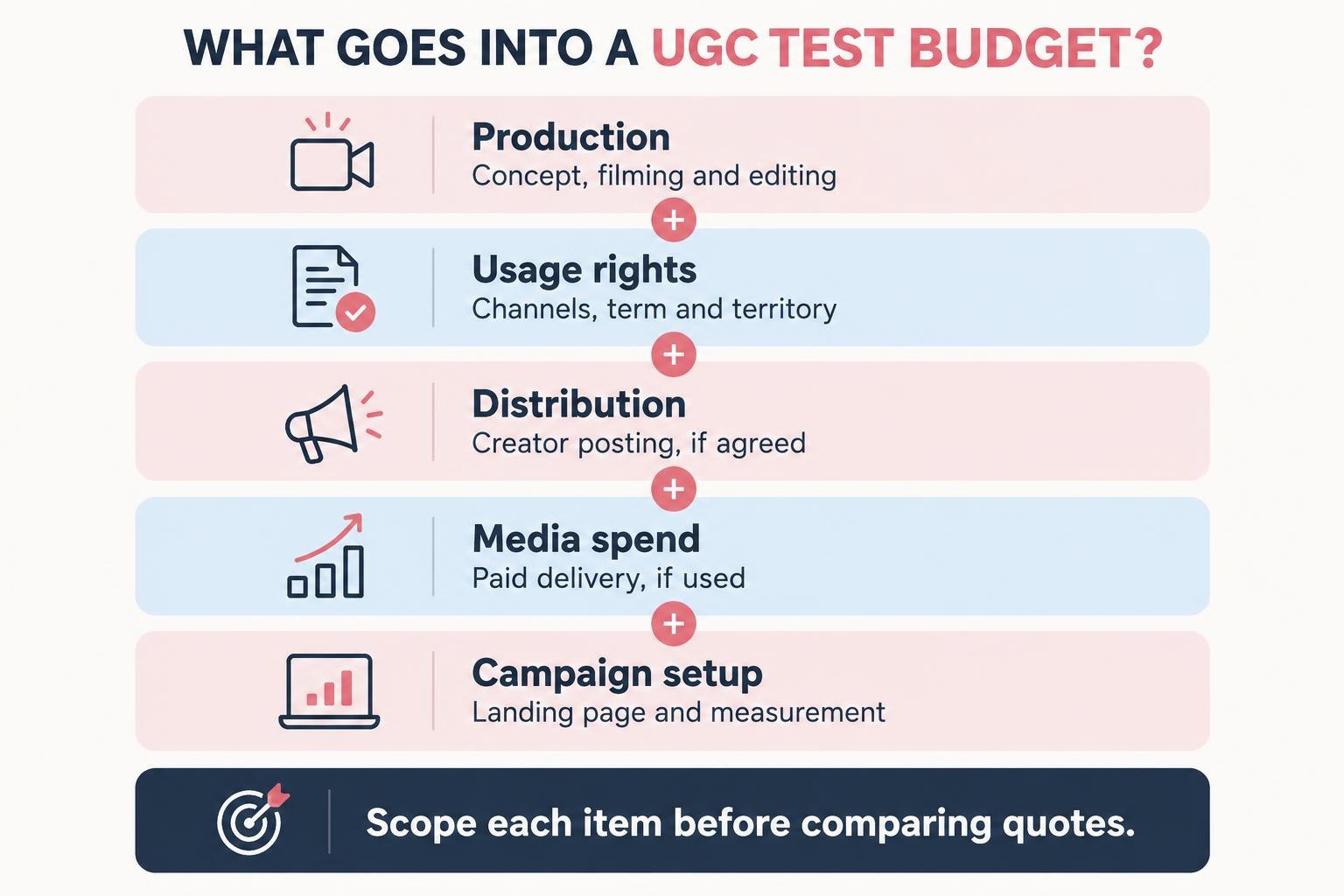
Fully loaded test budget = production + relevant usage rights + distribution fee if any + media spend + landing-page or tracking work + agreed contingency. Count internal time if you need a true cost comparison. Avoid double-counting a bundled service and then adding its assumed separate price again.
For example, if a hypothetical $900 production-and-rights scope produces three usable concepts, the production cost per concept is $300. If it produces six hook edits of one concept, you can also report $150 per export—but that does not mean you purchased six new concepts. Keep both numbers labeled.
Acquisition cost requires actual acquired customers and a stated measurement window. If you spend $1,120 and acquire four attributable customers, a simple illustration gives $280 per customer. Four is a small sample, attribution may be incomplete, and retention is still unknown. Do not project lifetime value or promise ROI from that arithmetic.
A Request-for-Quote Template That Avoids Surprise Fees
Attach an approved workflow recording, brand assets, a claims ledger, and a contact who can resolve product questions. If you need multiple languages, say whether translation, native-language presentation, subtitles, and local claim review are required. They are not interchangeable deliverables.
What Counts as a Revision, Reshoot, or New Brief?
| Change request | Likely scope question | How to prevent conflict |
|---|---|---|
| Fix an agreed caption typo | Correction vs revision | Define delivery acceptance criteria |
| Change the approved hook | Editing change vs new recording | Approve hook before filming |
| Replace the demonstrated feature | New concept / workflow | Lock product behavior and path |
| Product UI changes mid-project | Recapture and re-edit | Name a version and review date |
| Add a new language | Localization deliverable | Quote it from the start |
| Make a creator say a false claim | Not an acceptable revision | Use a verified claims ledger |
Ask who consolidates feedback. Three stakeholders submitting contradictory comments can turn one revision into a moving brief. Use one agreed reviewer, a time window for feedback, and a distinction between correcting non-compliance with the approved brief and expanding the brief afterward.
Low-Cost Content Is Not Cheap if the Claim Is Unusable
A paid creator should not invent customer history to make a script feel natural. The FTC endorsement guidance requires honest endorsements and appropriate disclosure of material relationships. A creator walkthrough, a dramatized use case, and a genuine customer testimonial are different formats with different evidence needs.
Budget for obtaining real customer consent and reviewing substantiation if you want testimonials. Do not order a generic spokesperson clip and label it a customer success story. The price is only meaningful if the delivered content is accurate and appropriate for the planned campaign.
How Much Does SaaS UGC Cost? FAQ
What is the average SaaS UGC rate?
Based on the projects I have quoted or delivered plus public marketplace listings, a single SaaS UGC video typically runs $100–$1,500 depending on format and creator experience, with paid-usage rights adding 20–100%. The confirmed single-video price on this site is $250. Obtain comparable quotes for the same deliverables before treating any range as your budget.
Are multi-video packages always cheaper per video?
Not necessarily. Shared setup can improve efficiency, but distinct workflows, new presenters, localization, and additional rights can add work. Ask for the actual package scope and cost rather than multiplying the single-video fee or assuming a discount.
Does buying a video include paid-ad usage?
Not automatically. The public offer on this site says usage rights and paid advertising licensing are defined separately in the order terms. Confirm the actual agreement for your channels, dates, territory, and edits.
Is posting to the creator’s audience included?
Content production and creator distribution are separate arrangements unless explicitly bundled. On this site, audience collaborations are discussed around campaign goals, audience fit, format, and pricing.
How do I know whether the budget will pay off?
You cannot know from the production price alone. Define a realistic learning question, first-value event, measurement period, and maximum affordable test budget. Use the result to inform the next step; no production package guarantees customers.
Buy a Clear Scope Before You Buy More Files
Start with the buyer problem, name the deliverables, and agree how the content may be used. For the current single-video option, see the packages. If you need multiple concepts, longer demonstrations, or distribution, book a call so the quote matches the actual campaign—not an arbitrary video count.
Share
Article footer · AI discovery
Want to explore this topic further?
Ask questions about this article or use it as a starting point for deeper research.
Want content that makes your SaaS product click?
Email promotions@fuelyourdigital.com or explore my content packages.