AI UGC vs Human UGC: Which One Should Your SaaS Actually Use?
An honest comparison of AI-generated UGC and human creator UGC for SaaS: costs, trust, platform rules, what the published tests say, and a hybrid workflow that uses each where it's strongest.

The AI UGC vs human UGC debate is usually argued by people selling one of them. AI tool vendors say avatars are just as good and 90% cheaper. Creators say AI is "slop". Full disclosure: I'm a human UGC creator. I also use AI tools every week and make content for AI companies (including Hedra, which builds AI video). So here's the honest answer: they do different jobs.
What counts as AI UGC and human UGC?
| Type | What it is | Example tools / methods |
|---|---|---|
| Fully AI | AI avatar reads a script over generated or stock footage | Arcads, HeyGen, Creatify, MakeUGC, Hedra |
| AI-assisted human | Real creator footage; AI for scripts, captions, cut-downs, dubbing | ChatGPT/Claude scripts, auto-captions, AI dubbing |
| Human UGC | Real creator films, presents and uses the product | Creators, marketplaces, specialist creators |
| Customer UGC | Real customers share genuine experiences | Testimonial programs, reviews, social posts |
Most of the argument is about the first row against the third. The second row, real people helped by AI, is where most good content is heading anyway.
Here's what a modern AI UGC workflow looks like from the inside, so you know what you're comparing against:
Walkthrough of an AI UGC video generator
Loading this video connects to www.youtube-nocookie.com, which may collect your IP address and use cookies.
Arcads or a human creator? The real decision
Almost every article ranking for this topic is written by a company that sells AI UGC, so the human side rarely gets argued properly. If you're a founder choosing between an avatar tool like Arcads and hiring a creator, here is that case, honestly.
| Question | Avatar tool | Human creator |
|---|---|---|
| Does anyone actually use your product on camera? | No; the avatar reads a script | Yes; real clicks, real output |
| Can it be a testimonial? | Not legally, if it implies a real user | Yes, with proper disclosure |
| Does it come with an audience? | No | Often; the creator can post it |
| Can it reply to comments and objections? | No | Yes |
| Can it make a 5-minute YouTube tutorial? | Rarely convincingly | Yes |
| Cheapest way to test 20 hooks? | Yes | No |
- Trust is the bottleneck for software, not volume. A SaaS buyer doesn't need 50 ads; they need one video that makes them believe the product works.
- Your audience may recognise the avatar. Popular avatar faces appear in many brands' ads. If a viewer has seen the same face selling three other apps, your credibility drops with it.
- A creator brings judgement. A good creator tells you when your hook or onboarding is confusing. A tool renders whatever you type.
- Human content keeps working. A real demo can be reused on your landing page, in onboarding and in sales emails for months.
AI UGC vs human UGC: side-by-side comparison
| Factor | AI UGC | Human UGC |
|---|---|---|
| Cost per video | Very low once you have a subscription | Higher: creator fee, editing, rights |
| Speed | Minutes to hours | Days to about two weeks |
| Volume / variants | Effectively unlimited | Limited by creator time |
| Localization | Easy: many languages and faces | Needs native creators |
| Real product use | Usually none: the avatar never touched your app | Creator actually uses it on screen |
| Trust and credibility | Lower, especially if viewers spot it | Higher, especially for testimonials |
| Comments and community | Nobody to reply or post organically | Creator can post, reply and build trust |
| Distribution | Paid only | Paid, plus the creator's own audience |
| Legal risk | High if it implies a real customer | Lower with proper disclosure |
What the published tests actually say
There's very little independent research yet. Most numbers come from vendors or agencies. Here's what's publicly reported, with caveats:
- A reported $115K test across five AI UGC tools (Arcads, Argil, Creatify, HeyGen, Mirage) found big differences between tools, and that none worked "out of the box": scripts in customer language, multi-scene edits and clear disclaimers mattered most (Segwise summary).
- A reported head-to-head on Meta found human UGC won click-through rate while AI creative won ROAS, mostly because it was cheaper to produce (summarised by Playcut, an AI UGC vendor).
- Practitioner reports on Reddit describe AI tools raising the number of concepts tested per month, with most still failing, and some avatars getting called out in comments (r/AskMarketing thread).
Why SaaS is a special case
Most AI UGC success stories are for skincare, supplements and gadgets: impulse buys where a quick testimonial is enough. SaaS is different:
- The product is the proof. SaaS buyers want to see the real interface doing the real job. An avatar holding a phone can't show that.
- Buyers research. They'll watch a demo, check reviews and maybe watch the creator's other videos. A synthetic face has no history.
- AI buyers are especially sharp. If you sell an AI product, your audience is the best at spotting AI avatars, and the most likely to comment on it.
- Long-form matters. Tutorials and YouTube search videos drive SaaS signups for months; avatar videos rarely work beyond 30 seconds.
That's why for SaaS I recommend human UGC for the core demo and testimonial assets (see video testimonial production and UGC for B2B SaaS), with AI helping you go wider.
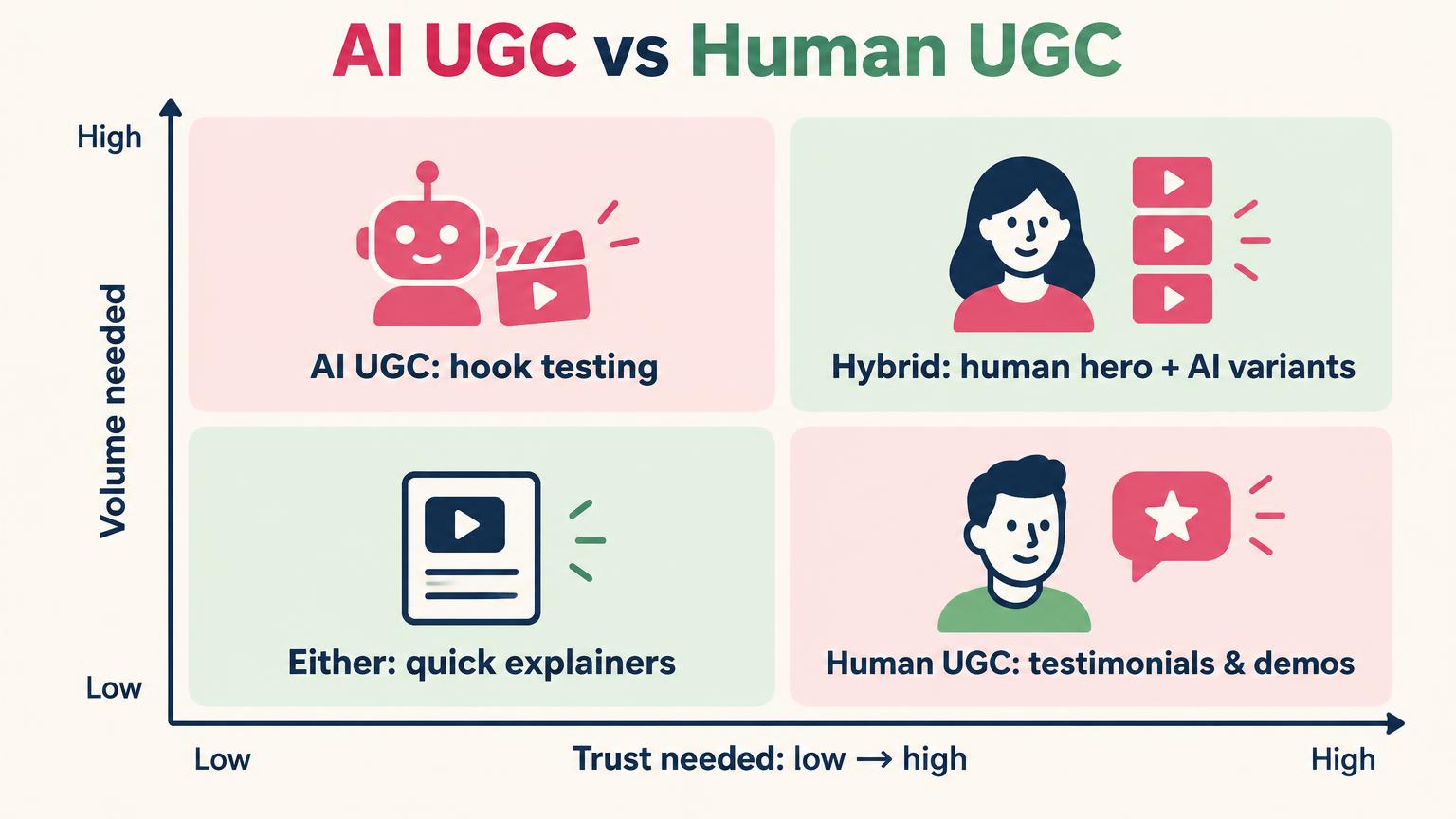
The AI UGC vs human UGC decision matrix
| Video job | Recommended | Why |
|---|---|---|
| Testing 20 hooks for a paid campaign | AI UGC | Cheap volume to find the angle |
| Landing page hero demo | Human | Needs real product use and credibility |
| Customer testimonial | Human (real customer) | AI testimonials risk being deceptive |
| Translating a winning ad into 6 languages | AI-assisted | Dub or re-voice proven human footage |
| YouTube tutorial for search | Human | Long-form, needs real walkthrough |
| Quick feature announcement | Either | Low stakes, speed matters |
| Creator sponsorship / audience post | Human | Only humans have audiences |
Disclosure, platform rules and the FTC
This is where AI UGC most often goes wrong. A few rules worth knowing:
- The FTC's final rule on fake reviews and testimonials bans reviews and testimonials from people who don't exist or misrepresent their experience, explicitly including AI-generated ones. An avatar saying "I've used this app for months" is a problem.
- TikTok requires labeling realistic AI-generated content (TikTok's AI content rules), and Meta labels AI-generated media (Meta's approach).
- Human creators need disclosure too. The FTC's Endorsement Guides FAQ covers when paid content must say it's an ad.
A hybrid workflow that uses both
- Find the angle with AI. Generate 10–20 cheap hook variations and run small tests to see which problem and promise get attention.
- Make the hero with a human. Brief a creator on the winning angle; they film themselves really using the product.
- Multiply with AI assistance. Cut the human footage into new hooks, aspect ratios, captions and languages (with the creator's permission in the contract).
- Distribute through the creator. Use the creator's own account or audience for organic reach, plus paid spark or partnership ads.
- Refresh with AI, re-shoot with humans. Use AI for fast refreshes; book a new human shoot every quarter or when a new feature launches.
Make sure your creator contract covers AI edits and voice or likeness use; many creators (me included) want this spelled out. My SaaS UGC pricing guide covers usage rights in detail, and the UGC script templates work for both formats.
Cost per usable asset
Comparing price per video is misleading. Compare cost per video you can actually run without hurting trust:
| AI UGC batch | Single human UGC video | |
|---|---|---|
| Typical spend | Tool subscription + your scripting time | e.g. $250 for one video on this site |
| Videos produced | 20 | 1 (plus cut-downs you're licensed for) |
| Usable for paid tests | Many, if labelled and well scripted | Yes |
| Usable as landing page hero / testimonial | Rarely | Yes |
| Organic reach included | No | Possibly, if the creator posts |
AI UGC vs human UGC: FAQ
Will AI UGC replace human UGC creators?
It's replacing the cheapest, most generic part of the market: reading a script on camera. It's not replacing real product use, real audiences, or real experiences, which is what SaaS buyers trust.
Can viewers tell AI UGC from real UGC?
Increasingly less often in short clips, but tech-savvy audiences and longer videos still expose it, and platform labels can make it obvious anyway.
I sell an AI product. Should I use AI UGC to show it off?
Use AI to show the product, not to fake users. A human showing your AI tool working is usually more persuasive. See how to market an AI agent.
Which should a small SaaS try first?
One strong human demo video first, because you'll reuse it everywhere. Add AI variations when you start paid testing.
Share
Article footer · AI discovery
Want to explore this topic further?
Ask questions about this article or use it as a starting point for deeper research.
Want content that makes your SaaS product click?
Email promotions@fuelyourdigital.com or explore my content packages.