How to Market an AI Agent: Sell the Job, Show the Proof, Earn the Trust
A practical playbook for marketing an AI agent: pick one job, prove it in a 60-second demo, answer the trust questions buyers actually ask, and choose channels where agent buyers already search.
Learning how to market an AI agent starts with one uncomfortable fact: buyers don't want an agent. They want a task off their plate. The word "agent" makes people curious, but it also raises questions a normal SaaS tool never has to answer: What will it do without me? What if it's wrong? Who's responsible when it emails a customer?
This guide is the playbook I use when I make videos for AI products (I've created content for tools like SlidesGPT, SEOBuddy, OnePage AI and StormMCP). It covers positioning, the demo, trust, channels, creator content and measurement, with tables and scripts you can copy.
Why AI agents are harder to market than normal SaaS
A classic SaaS tool is a set of buttons. The buyer pictures themselves clicking. An agent acts for the buyer, so marketing has to sell delegation. People delegate to things they understand and can check.
| Question | Normal SaaS | AI agent |
|---|---|---|
| What do I get? | Features and a dashboard | A finished task and an outcome |
| How do I judge it? | Free trial, click around | Watch it run on my own data |
| Main fear | Learning curve | Wrong actions, data exposure, loss of control |
| Best proof | Screenshots, feature list | Before/after runs, logs, approval steps |
| Best messenger | Brand page | A real person showing a real run |
Anthropic's engineering guide Building effective agents argues for simple, composable agent designs. That helps marketing too: an agent with a clear loop is much easier to explain than a "do anything" assistant.
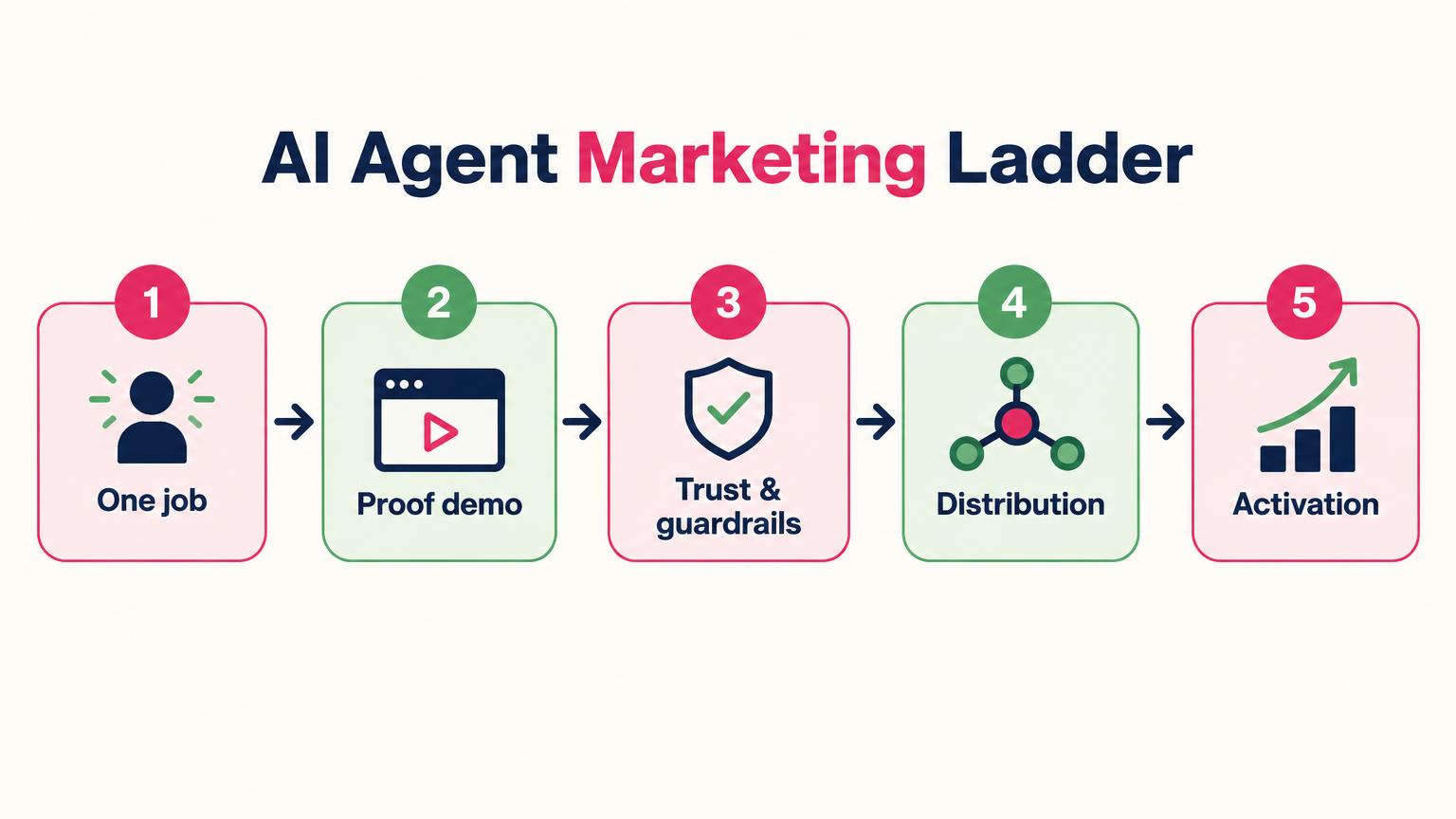
Step 1: Market one job, not a platform
Most agent landing pages say something like "Your autonomous AI workforce." Nobody searches for that and nobody can picture it. Pick the job your best users actually hire the agent for, and write it as a before/after.
| Vague | Job-based | Outcome line |
|---|---|---|
| AI sales agent | Researches inbound leads and drafts the first reply | Reply to every lead in 5 minutes, not 5 hours |
| AI support agent | Answers tier-1 tickets from your help docs | Clear the repetitive half of the queue before lunch |
| AI SEO agent | Finds pages losing rankings and suggests fixes | Know which pages to fix this week |
| AI ops agent | Reconciles invoices against the CRM | Close the books without the spreadsheet marathon |
The founder in this video makes the same point from the selling side: lead with the outcome ("20 more booked calls a month"), not the model or the word "agent".
How to sell AI agents by selling the outcome
Loading this video connects to www.youtube-nocookie.com, which may collect your IP address and use cookies.
Step 2: Build a 60-second proof demo
For agents, the demo is the marketing. A buyer needs to see the input, the agent working, the result, and where a human approves. Here's the structure I script for AI tools:
| Time | Beat | What's on screen | Example line |
|---|---|---|---|
| 0–5s | Pain hook | Messy inbox, ticket queue, spreadsheet | "I used to spend Monday mornings on this." |
| 5–15s | Hand-off | Paste the input or connect the source | "Now I just give it the list." |
| 15–35s | Agent working | Steps or logs streaming, sped up | "It checks each one against our docs…" |
| 35–48s | Result | Finished output next to the old way | "Twelve replies, drafted and sourced." |
| 48–55s | Control | Approve or edit button, audit log | "Nothing sends until I approve it." |
| 55–60s | Next step | URL, free run, template | "Try it on your own leads, first run is free." |
- Use real runs. Speed up the footage, but don't fake output. Agent buyers are skeptical, and one viral "that's staged" comment costs more than the video earned.
- Show a failure being caught. A short moment where the agent flags low confidence builds more trust than a perfect run.
- Make one horizontal and one vertical cut. Horizontal for the landing page and YouTube; vertical for TikTok, Reels and LinkedIn.
For a deeper walkthrough of demo structure, see my SaaS demo video guide, and for short-form scripts, the UGC script templates for SaaS ads.
Step 3: Answer the trust questions up front
Every agent buyer has the same five questions. If your page doesn't answer them, the sales call has to, and many buyers won't book one.
| Buyer question | What to show | Where |
|---|---|---|
| What can it do without me? | Clear list of autonomous vs approval-required actions | Landing page, demo |
| What if it's wrong? | Confidence flags, review queue, undo | Demo, docs |
| What data does it see? | Permissions screen, data retention policy | Security page |
| Can I see what it did? | Activity log, run history | Demo, screenshots |
| Who's using it? | Named customers, real usage numbers you can verify | Social proof section |
Step 4: Pick channels where agent buyers search
Agent buyers fall into two groups: builders looking for tools, and operators looking for a task to go away. Each one searches somewhere different.
| Channel | Best for | What to publish | Effort |
|---|---|---|---|
| YouTube search | Operators searching "how to automate X" | Tutorial: "How to [job] automatically with [agent]" | Medium |
| TikTok / Reels / Shorts | Awareness, curiosity, founders | Before/after runs, creator reactions | Low–medium |
| B2B operators, managers | Founder posts with a run clip and the numbers | Low | |
| Agent directories & Product Hunt | Early adopters, builders | Listing plus a 60-second demo | Low |
| Integrations marketplaces | Users of the tool you plug into | Listing focused on one workflow | Medium |
| Communities (Reddit, Slack, Discord) | Niche operators | Helpful answers and teardown posts | Medium, slow |
| SEO comparison pages | Buyers comparing tools | "[Your agent] vs [manual way / competitor]" | Medium |
YouTube search is underrated for agents. When I made five feature tutorials for SEOBuddy, each one targeted a buyer-intent search instead of chasing views (full SEOBuddy case study). For a wider launch framework, this talk on go-to-market for AI products is a useful companion:
How to create a go-to-market strategy for your AI product
Loading this video connects to www.youtube-nocookie.com, which may collect your IP address and use cookies.
If you're launching on TikTok specifically, read TikTok UGC for AI startups for concepts and disclosure rules.
Step 5: Use creators to make the agent feel safe
A founder demo proves the agent works. A creator demo proves someone like me can use it. That second message is what agent marketing usually lacks, because the buyer's real fear is handing over control.
- Reaction format: the creator gives the agent a task they'd normally do by hand, then reacts to the result honestly.
- Day-in-the-life: the agent handles one recurring chore inside a real workflow.
- Skeptic test: "I didn't think an AI could do this, so I tested it on my own data." Show the approval step.
- Tutorial: a longer screen-recorded walkthrough for YouTube search.
This is the content I make: creator-led demos and tutorials for AI and SaaS products, backed by a creative team for scripting and editing, with distribution to my own AI-focused audience when it fits. You can see examples on the homepage.
Step 6: Make pricing and the first run obvious
Agent pricing confuses buyers: per seat, per task, per credit? Whatever you pick, translate it into the job.
| Model | Buyer's worry | How to frame it |
|---|---|---|
| Per seat | "Do agents count as seats?" | "Each plan includes X agent runs per user" |
| Per task / run | "What if a run fails?" | "You're only charged for completed runs" (if true) |
| Credits | "How many credits is one job?" | Show a calculator: "100 leads ≈ 300 credits" |
| Outcome-based | "How do you measure it?" | Define the outcome and the reporting clearly |
Then make the first run as fast as possible: a sample dataset, a template, or a guided first task. The first successful run does more marketing than any ad.
Step 7: Measure activation, not views
| Stage | Metric | Why it matters |
|---|---|---|
| Attention | 3-second hold rate, search impressions | Is the hook or keyword working? |
| Interest | Demo completion, landing page scroll depth | Do people get to the result? |
| Activation | % of signups with a first successful run | The real conversion event for agents |
| Trust | % of runs approved without edits | Proxy for perceived accuracy |
| Retention | Weekly active agents per account | Did the job actually move to the agent? |
A 30-day AI agent launch plan
- Days 1–5: interview five users, pick one job, rewrite the hero line and first-run flow.
- Days 6–10: record the 60-second proof demo (horizontal plus vertical) and a 5–8 minute tutorial.
- Days 11–15: publish the trust section, security page and pricing calculator.
- Days 16–22: launch on one directory or Product Hunt, publish the YouTube tutorial, start daily short-form posts.
- Days 23–30: bring in one or two creators for reaction and skeptic-test videos; double down on what drives first runs.
How to market an AI agent: FAQ
Should I even use the word "agent" in my marketing?
Use it as a category signal, not the headline. Lead with the job and outcome, and use "agent" in the subhead or in SEO so the right buyers find you.
Is marketing an AI agent different for B2B and B2C?
B2B buyers need more trust material: security, admin controls, audit logs. B2C buyers need a faster first run and more entertaining short-form demos. The proof demo stays central in both.
Can I use AI avatars to market my AI agent?
You can for quick tests, but agents already have a trust problem, and a synthetic presenter can make it worse. See AI UGC vs human UGC for when each one makes sense.
What's the first marketing hire or spend for an agent startup?
Usually a strong demo plus one creator or founder-led channel, before paid ads. My founder-led marketing guide covers the founder side, and SaaS go-to-market strategy covers the full motion.
Share
Article footer · AI discovery
Want to explore this topic further?
Ask questions about this article or use it as a starting point for deeper research.
Want content that makes your SaaS product click?
Email promotions@fuelyourdigital.com or explore my content packages.