TikTok UGC for AI Startups: Turn Product Demos Into a Measurable Launch
A practical TikTok UGC playbook for AI startups: four original concepts, real product proof, creator contracts, disclosure checks, and an activation-led launch plan.
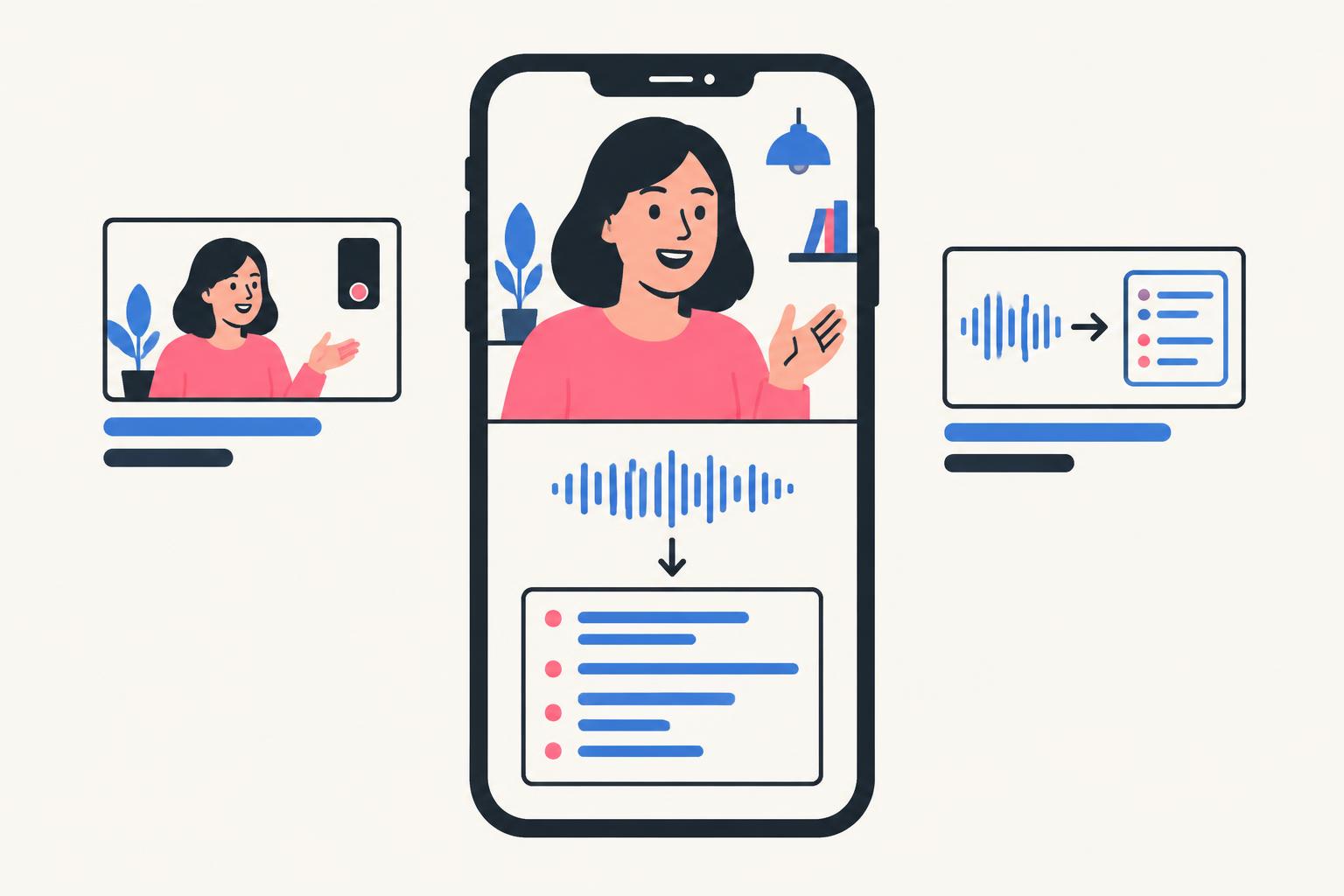
An AI startup can get a lot of views by showing a surprising output. The harder job is helping the right person repeat a useful task after the video ends. TikTok UGC for AI startups works best when the creator makes the input, product action, output, and human check visible—not when a face appears beside a list of “insane AI tools.”
This guide is a workflow-led launch system for founders selling AI software. It separates organic creator content from paid creative and creator distribution, provides four original campaign concepts, and shows how to connect a short video to activated users. The worked example is a hypothetical voice-note-to-action-items tool. It is not a client case study or a performance claim.
Is TikTok the Right Channel for Your AI Startup?
Start with the user’s behavior rather than the size of the platform. A solo consultant turning voice notes into follow-ups has a task you can demonstrate quickly. A procurement-led model-governance platform might need a deeper evaluation process and a professional buying context. Both are AI products, but their routes to purchase are different.
| Signal | Stronger short-form fit | Reason to reconsider |
|---|---|---|
| Task | Visually understandable in one scene | Value is mostly abstract architecture |
| Buyer | Individual can try the tool | Several departments must approve access |
| Input | Safe sample can produce useful output | Sensitive customer data is required immediately |
| First value | One low-friction workflow | A long integration precedes any result |
| Demonstration | Output can be inspected | Quality cannot be judged from the screen |
| Economics | You can afford a measured learning test | Budget relies on one viral post to work |
A weak fit does not mean never use TikTok. It may mean use it for category awareness while search-led tutorials, professional communities, or sales demonstrations handle evaluation. Do not claim that “founders are on TikTok” settles your distribution decision. The question is whether your actual prospective users can recognize and act on the demonstrated problem there.
If your buyer needs a longer product explanation, pair short-form discovery with the SaaS video marketing framework rather than forcing the entire evaluation into a vertical clip.
Choose Which Kind of Creator Engagement You Are Buying
| Arrangement | What you buy | What you still need to agree |
|---|---|---|
| Content-only production | A finished creator-led video for your channels | Deliverables, revisions, licensing, aspect ratios |
| Creator distribution | A post on the creator’s own account | Audience fit, placement, date, analytics access, disclosure |
| Paid amplification / Spark Ads | Advertising using an authorized creator post | Authorization, term, rights, ad account, spend, measurement |
A creator’s follower count is not a media plan. Before buying distribution, ask which audience regularly watches relevant software workflows, what past posts demonstrate that fit, and what reporting the creator can provide. Before buying content-only production, judge clarity, credibility, and product handling. The best person for one arrangement may not be the best person for another.
Contract separately for production, publication, and paid use. Authorization to run a platform ad does not replace an agreement about likeness, term, territory, edits, music, or reuse elsewhere. A brand account upload and an authorized creator-post campaign also differ operationally; confirm who controls each asset and how rights expire.
Position the Product Around a Task, Not “AI”
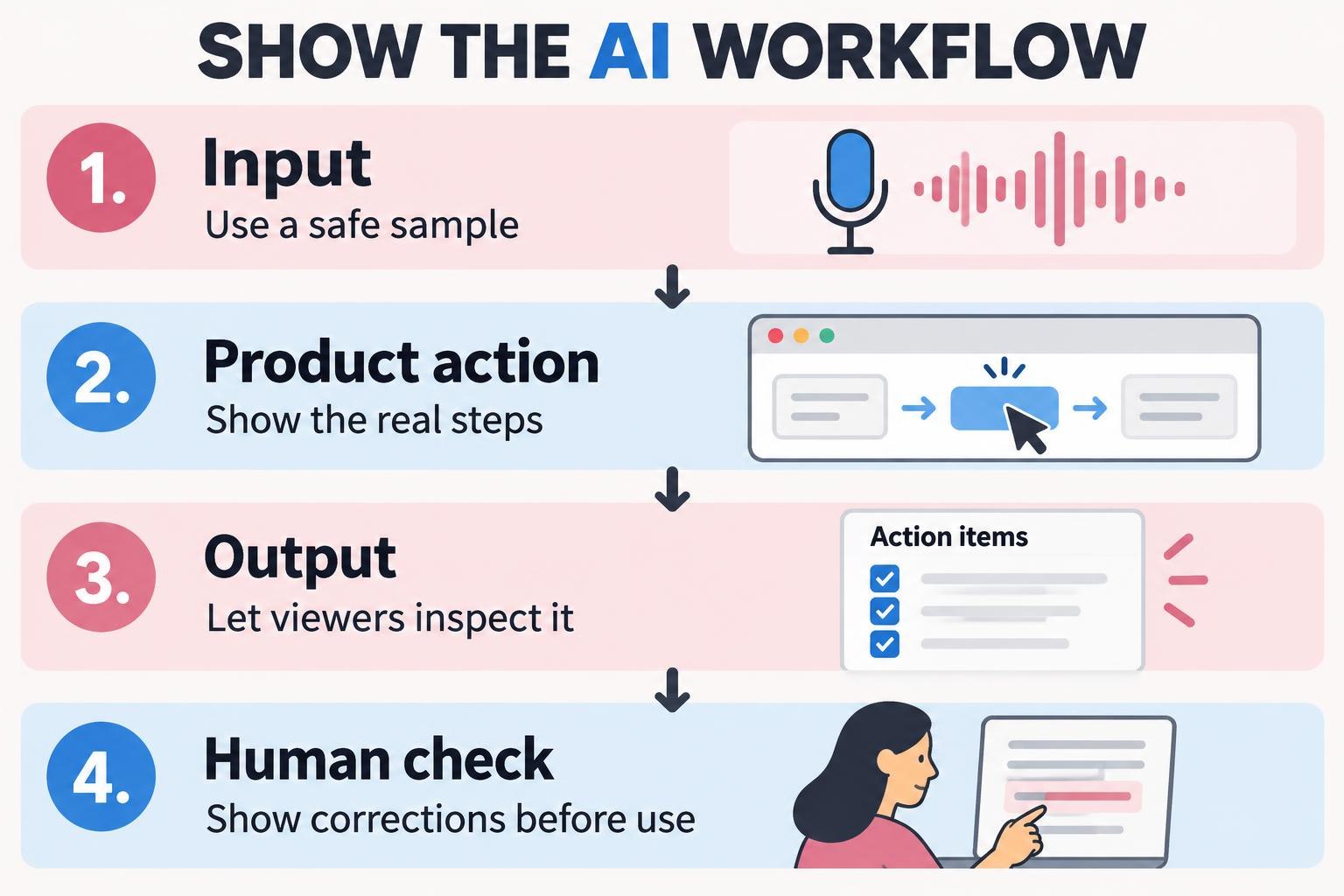
“AI-powered productivity” could describe hundreds of tools. A useful creative sentence is more specific: “Turn a consultant’s rough voice note after a call into editable follow-up actions.” It identifies a person, an input, a moment, and an output. That is the smallest story the creator needs to tell.
- Person: independent consultant who follows up with several clients.
- Trigger: finishes a call and records a rough voice note before the next meeting.
- Current workaround: replays the note and writes action items manually.
- Product action: uploads the sample note and selects a follow-up template.
- Visible outcome: an editable list with owner and next step.
- Boundary: a person checks names, missing details, and client-sensitive information.
- First-value event: creates and saves a reviewed list, not merely signs up.
Write the boundary before the hook. It will prevent the campaign from selling automation the product does not deliver. If the tool drafts rather than sends follow-ups, show the review step. If integrations require a paid plan, do not imply a new free account can reproduce the entire recording.
Four Original TikTok UGC Concepts for an AI Startup
Concept 1: The Messy Input Test
Open with a brief, synthetic voice note that contains natural hesitation and an incomplete sentence. Show the real input and the draft, including the correction. The point is not to make the tool look broken; it is to let someone judge the usefulness of the result under a realistic condition. Do not manufacture an error merely for theater.
| Scene | Visual | What the viewer learns |
|---|---|---|
| Recognition | Presenter plays a short sample note | This is my kind of task |
| Action | Upload and choose the template | How the product is used |
| Proof | Compare one source sentence with its action item | Where the output came from |
| Human check | Correct the owner and save | What still requires judgment |
| Next step | Sample workflow landing page | How to repeat the test |
Concept 2: Same Input, Different Constraints
This concept teaches a product mechanism instead of merely announcing an output. Use only controls the product actually supports. Hold the input constant and change one setting. If you compare against a general-purpose assistant, name the exact setup and do not present one convenient example as proof of universal superiority.
Concept 3: The Almost-Useful Result
This angle qualifies users who care about accuracy. It is particularly useful when the market is crowded with “no human needed” promises. Show a real review decision, but avoid disclosing a client’s actual conversation. If the output was deliberately seeded for teaching, label the scenario clearly as a sample.
Concept 4: The Handoff Test
The handoff concept is for users who already understand AI drafting but do not see how your tool fits into work. Spend less time on the generate button and more time on the destination. If a specific integration is not ready, demonstrate the supported export honestly rather than substituting a mockup.
Make the Software Readable in a Vertical Feed
Record a clean screen master before adding the presenter. Crop around the task, not the whole dashboard. A cursor should show an intentional action; zooming cannot rescue a screen full of unreadable text. Use large enough UI framing for the viewer to identify one input and one output without pausing.
- Begin with a recognizable task or result; avoid a long logo animation.
- Move between face, input, action, and output when the story changes—not simply every two seconds.
- Keep subtitles away from the controls and the result the viewer needs to inspect.
- Check the export inside the intended placement, including its interface overlays and caption preview.
- Keep a real demonstration distinct from an illustrative mockup. Label mocked or pre-prepared output.
- Use music licensed for the intended commercial use; a trending track is not automatically cleared for ads.
Fast editing should remove waiting that does not change the argument, not hide setup that changes the promise. If a model took time to generate, a clearly signposted cut is better than a false real-time impression. When exact speed is part of the claim, show the relevant measurement conditions.
Watch: An AI Feature Explained Through a Familiar Task
Notion’s own product introduction provides a concrete AI-workflow example: meeting input, transcription, summary, and action items. It is brand-produced content—not a Tin Rovic campaign or independent customer UGC, and not necessarily a TikTok ad. Watch how the presenter names a recognizable task before moving into the product. Adapt that input-to-output clarity, while keeping your own demo’s consent, accuracy checks, and limitations visible.
Introducing AI Meeting Notes
Loading this video connects to www.youtube-nocookie.com, which may collect your IP address and use cookies.
Source: Notion on YouTube.
AI-Generated Labels and Paid-Partnership Disclosures Are Different
TikTok requires the commercial-content disclosure setting when promoting a brand, product, or service. That includes compensated third-party promotion and promotion of your own business. Follow TikTok’s promotion guidance; the settings depend on the type of relationship.
An AI software demo is not automatically the same thing as synthetic media. TikTok describes AI-generated content and labeling requirements in its AI-generated content guidance. Check what is actually in the video: synthetic voices, realistic generated people, or significantly AI-altered imagery can create separate obligations. Promoting an AI company alone is not a reason to conflate the two labels.
For US-facing promotion, review the FTC endorsement guidance as well. A commercial relationship should be understandable to a viewer in the content; do not rely on an obscure caption or treat a platform label as sufficient in every circumstance. Also check TikTok’s rules on misleading claims before approving guaranteed accuracy, income, speed, or “best tool” statements.
Build a Landing Page That Repeats the Video’s Task
Do not send a voice-note workflow video to a homepage that says “The future of work is here.” Carry the same input, output, and next action onto the landing page. Show a small sample the visitor can try and state whether an account, payment method, integration, or paid plan is required.
| Video promise | Landing-page element | Product event to observe |
|---|---|---|
| Turn a sample note into actions | A sample recording and visible output example | Sample processed |
| Review before use | Editable result with review instructions | Draft edited |
| Export a checked list | Supported export and plan requirement | Reviewed list exported |
| Try on a safe input | Clear privacy guidance and test path | User completes an appropriate first workflow |
The shortest signup form is not necessarily the shortest path to value. If a visitor cannot find a safe sample or understand the next step, the first session can still fail. Watch where people stop with consent-respecting analytics and qualitative feedback, then fix that step before ordering a larger creative batch.
A Four-Week Learning Plan Without a Viral Assumption
| Week | Work | Decision |
|---|---|---|
| 1: Verify | Record one workflow, review claims, define activation, create matching landing path | Is the task ready to promote? |
| 2: Produce | Make three concepts for the same persona; approve screen and disclosure | Which buyer problem is each concept testing? |
| 3: Distribute | Publish or run agreed paid tests; keep context and changes logged | Which concept attracts relevant users? |
| 4: Diagnose | Compare activations, quality feedback, and recurring objections | Improve creative, onboarding, or channel fit before expanding |
Keep organic and paid results separate. An organic post has a different delivery context from an ad with specified targeting and spend. Do not compare their raw view counts as if they were identical experiments. If an account has limited link features, define an available, honest route to the product rather than promise every viewer can click a bio link.
Measure Users Who Do Something Useful, Not Just Views
Name one first-value event that matches the campaign. For the hypothetical tool, it is saving a reviewed action list. Track qualified visits, account creation, completed first workflow, and later paid conversion where available. Add source parameters to links you control and retain consent and data-minimization requirements.
A simple diagnostic: high views with little relevant traffic may indicate entertainment without fit; traffic with few first workflows may indicate onboarding or message mismatch; first workflows with no continued use may indicate a product-value or audience-fit problem. None of these patterns proves a cause by itself. Use a follow-up interview or a narrowly scoped experiment before deciding.
Do not invent a TikTok CAC benchmark for AI startups. Calculate your own fully loaded acquisition cost with the stated attribution window, include production and paid distribution, and acknowledge that some later conversions will have multiple influences. Tiny conversion counts should remain inconclusive rather than become a case-study headline.
TikTok UGC for AI Startups: FAQ
Should we hire a real creator or use an AI avatar?
Choose based on the story and the required credibility, not only output volume. A real creator can visibly test and explain a workflow; a synthetic presenter needs appropriate labeling and must not imply an actual personal experience. Neither option removes the need for real product proof.
How many videos should we make first?
Start with a small set that tests distinct buyer problems and that you can afford to evaluate. Three concepts are a practical planning example, not a statistically sufficient sample or a promise. Define what each concept will teach before increasing volume.
Can TikTok work for B2B AI tools?
Potentially, especially when a user can recognize and try an individual workflow. A security-sensitive or committee-led purchase may need a separate evaluation channel. Choose the channel around the buying process, not the word AI.
Should we also make long-form videos?
Use a longer walkthrough when viewers need to see setup, limitations, integrations, or evaluation criteria. A short clip can introduce the task and point toward a genuinely useful tutorial; it should not overstate what the short clip proves.
Start With One Demonstrable Task
Use the SaaS ad script templates to write your first concept and the SaaS go-to-market guide to connect it to a clear buyer and offer. If you want creator-led production or an audience collaboration, explore my packages or book a call. The right starting point is a task your product already handles—not a promise to go viral.
Share
Article footer · AI discovery
Want to explore this topic further?
Ask questions about this article or use it as a starting point for deeper research.
Want content that makes your SaaS product click?
Email promotions@fuelyourdigital.com or explore my content packages.