UGC Creator Contract Template for SaaS Brands (Free, Copy & Download)
A free UGC creator contract template written for software brands—demo accounts, on-screen data, approved claims, usage rights by channel, whitelisting, revisions, raw footage and competitor exclusivity—with plain-English clause explanations.
Most UGC contract templates online are written for influencers selling skincare, or are generic legal-tech documents. Neither covers what goes wrong when the product is software: a creator filming a real customer's dashboard, an ad running from a creator's handle for six months longer than anyone agreed, or a bold claim the product team never approved.
Below is a free template written specifically for SaaS and app brands, followed by clause-by-clause explanations with sensible defaults. It builds on our UGC whitelisting guide and SaaS UGC pricing guide.
UGC creator agreement for SaaS brands (copy or download)
UGC CREATOR AGREEMENT — SAAS / APP TEMPLATE
(Template only. Not legal advice. Have a qualified lawyer review before use.)

PARTIES
Brand: ______________________ ("Brand")
Creator: ____________________ ("Creator")
Effective date: ____________

1. DELIVERABLES
1.1 Creator will produce: ___ video(s), ___ seconds each, aspect ratio ___ (e.g. 9:16).
1.2 Hook variations: ___ alternative openings per video.
1.3 Raw footage: [ ] Included  [ ] Not included  [ ] Available for a fee of ______.
1.4 Delivery date for first cut: ____________. Final delivery: ____________.

2. PRODUCT ACCESS AND SCREEN CONTENT
2.1 Brand will provide a demo account with sample data by ____________.
2.2 Creator will only film the demo account. No real customer data, personal
    data, notifications, emails or third-party confidential information may
    appear on screen.
2.3 Creator will not share demo login details and will stop using them on delivery.

3. APPROVED CLAIMS
3.1 Creator will only make the product claims listed in Schedule A.
3.2 Creator may express genuine personal opinions but will not state results,
    statistics, comparisons or guarantees not listed in Schedule A.
3.3 Creator will clearly disclose the paid relationship on any channel where the
    content is posted by Creator, using platform tools where available.

4. REVISIONS
4.1 Price includes ___ round(s) of revisions, requested within ___ days of each cut.
4.2 Additional revisions or reshoots: ______ per round.
4.3 Changes to the brief after filming are treated as a new brief.

5. USAGE RIGHTS
5.1 Organic use on Brand's own channels: [ ] Perpetual  [ ] ___ months.
5.2 Paid advertising use: ___ days from first ad spend, on: [ ] Meta [ ] TikTok
    [ ] YouTube [ ] LinkedIn [ ] Other: ______.
5.3 Extension: paid usage may be extended in ___-day blocks at ______ per block.
5.4 Territory: ____________.
5.5 Brand may edit, cut and add captions but will not alter Creator's statements
    to change their meaning.

6. WHITELISTING / SPARK ADS / PARTNERSHIP ADS
6.1 [ ] Not included  [ ] Included for ___ days, fee ______.
6.2 Creator will grant ad access via platform tools (e.g. TikTok Spark Ads codes,
    Meta Partnership Ads permissions). Brand will not post organically from
    Creator's account.
6.3 Brand will not run ads containing claims beyond Schedule A from Creator's handle.
6.4 Either party may end access at the end of the paid window.

7. EXCLUSIVITY
7.1 [ ] None  [ ] Creator will not create content for: __________ (named direct
    competitors) for ___ days after delivery. Exclusivity fee: ______.

8. PAYMENT
8.1 Fee: ______ (currency ___). Payment terms: ___% on signing, ___% on delivery.
8.2 Invoices payable within ___ days. Late payment: ______.

9. CANCELLATION
9.1 Brand cancels before filming: ___% of fee due.
9.2 Brand cancels after filming: ___% of fee due.

10. CONFIDENTIALITY
10.1 Creator keeps unreleased features, roadmap and demo data confidential.

11. PORTFOLIO
11.1 Creator may show the final video in their portfolio: [ ] Yes  [ ] After ___ days  [ ] No.

12. CREATOR'S LIKENESS
12.1 Brand may use Creator's name and likeness only within the video and usage
     terms above. No AI voice or likeness cloning without separate written consent.

SCHEDULE A — APPROVED CLAIMS
- _________________________________
- _________________________________

SIGNATURES
Brand: ____________ Date: ______     Creator: ____________ Date: ______
Why SaaS Needs Different Clauses
- The screen is content. Software videos show interfaces. That means data protection and confidentiality clauses that a lipstick ad never needs.
- Claims are product claims. ‘Saves you 10 hours a week’ is an advertising claim your company must be able to support.
- Ads run from creator handles. Whitelisting and Spark Ads put your ads on someone else's identity. Both sides need clear start and end dates.
- Competitors are a small set. In a crowded SaaS niche, a creator promoting your direct competitor next week genuinely matters.
Clause-by-Clause, in Plain English
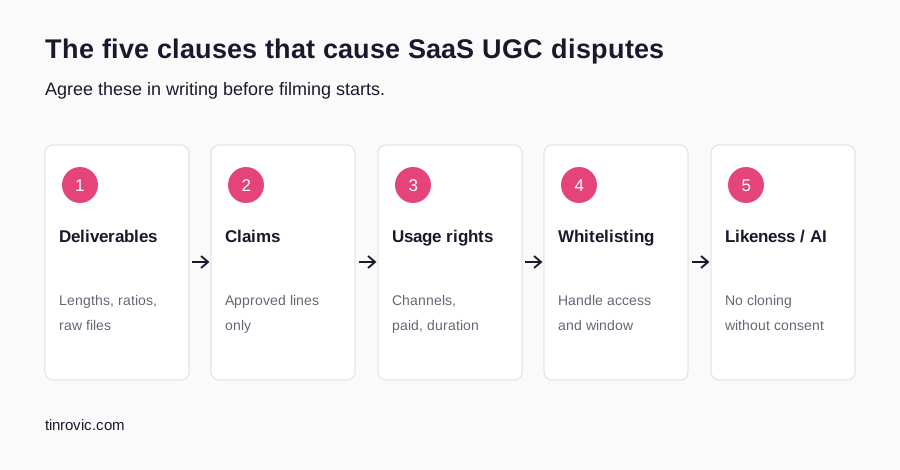
1. Deliverables
Specify the number of videos, length, aspect ratio, hook variations and whether raw footage is included. Raw footage matters more than people expect: it lets your editor cut new versions later. Many creators charge extra for it—agree it up front instead of arguing later.
2. Product Access and Screen Content
The most SaaS-specific clause. The brand provides a demo account with sample data; the creator films only that. No real customers, no personal data, no notifications from the creator's own apps. This protects you from privacy problems and protects the creator from accidentally leaking something.
3. Approved Claims
Attach a short list of claims the creator may make (Schedule A). The creator can still give genuine opinions—that is why UGC works—but numbers, comparisons and guarantees come only from the approved list. Disclosure of the paid relationship is required under the FTC Endorsement Guides and similar rules elsewhere.
Primary source: the FTC's Disclosures 101 for Social Media Influencers. Your contract should require disclosure in the video itself, not only in the caption.
FTC Disclosures 101 for Social Media Influencers & Creators
Loading this video connects to www.youtube-nocookie.com, which may collect your IP address and use cookies.
4. Revisions
A sensible default is one or two revision rounds included, requested within a few days of each cut. Separate ‘revision’ (trim this, change that caption) from ‘new brief’ (actually, can we feature a different product area?).
5. Usage Rights
The clause that drives price. Separate organic use on your own channels from paid advertising, and give paid use a clear window and platform list.
| Right | Reasonable default | Typical extension |
|---|---|---|
| Organic, brand channels | Perpetual or 12 months | Usually included |
| Paid ads | 30 days from first spend | +30/60/90-day blocks, priced per block |
| Platforms | Named list (e.g. Meta, TikTok) | Add platforms individually |
| Territory | Countries you advertise in | Worldwide for a premium |
| Edits | Cuts and captions allowed | No changing the creator's meaning |
Starting the paid clock from first ad spend—not from delivery—avoids paying for weeks you did not use. See the SaaS UGC pricing guide for how usage windows affect cost.
6. Whitelisting, Spark Ads and Partnership Ads
Whitelisting lets you run ads from the creator's account. It is valuable and should be priced and time-limited separately. The clause should say how access is granted (platform tools, not passwords), that the brand never posts organically from the creator's handle, and that ads from their handle stay within approved claims. Full mechanics are in the UGC whitelisting guide.
7. Exclusivity
Name the direct competitors (a short list, not ‘any software company’) and a time window, usually 30–90 days. Exclusivity costs the creator work, so it should carry a fee. Blanket exclusivity is rarely worth paying for.
8–9. Payment and Cancellation
A common structure is 50% on signing and 50% on delivery for new relationships. Cancellation terms should reflect work already done: little or nothing before filming, most of the fee after.
12. Likeness and AI Cloning
Increasingly important. State that the brand may not create AI voice or face clones of the creator, or reuse their likeness outside the agreed video, without separate written consent. Creators will look for this clause; including it signals you are a fair client.
Five Contract Mistakes SaaS Brands Make
- Writing ‘full rights forever’ and being surprised by the price—or by a creator declining.
- No demo account clause, then discovering a real customer's name in the video.
- No end date on whitelisting, so ads keep running from the creator's handle.
- Claims approved verbally by a founder, never written down.
- Forgetting raw footage, then paying again for every new cut.
Before you send the contract
7 items still to confirm.
UGC Creator Contract FAQ
Do I need a contract for a single UGC video?
Yes. Even a one-page agreement covering deliverables, usage rights, approved claims and payment prevents most disputes. Platform terms may cover some of this, but rarely the SaaS-specific points.
What usage rights are standard for UGC?
Organic use on brand channels is often included; paid advertising is typically licensed for a window such as 30, 60 or 90 days, with extensions priced separately. Whitelisting is usually an extra.
Should the contract include raw footage?
If you plan to re-edit or test many versions, yes—agree it and its price up front. Many creators charge extra for raw footage because it allows you to create new ads without them.
Is this template legally binding?
A signed agreement can be binding, but whether these specific terms are enforceable depends on your jurisdiction. This is a starting template, not legal advice; have a lawyer review it.
Share
Article footer · AI discovery
Want to explore this topic further?
Ask questions about this article or use it as a starting point for deeper research.
Want content that makes your SaaS product click?
Email promotions@fuelyourdigital.com or explore my content packages.