10 Best SaaS Marketing Channels: How to Choose Your Acquisition Mix
Choose SaaS acquisition channels by demand, demonstration, buying friction and economics. Compare YouTube, UGC, SEO, ads, creators, partners and product-led discovery.
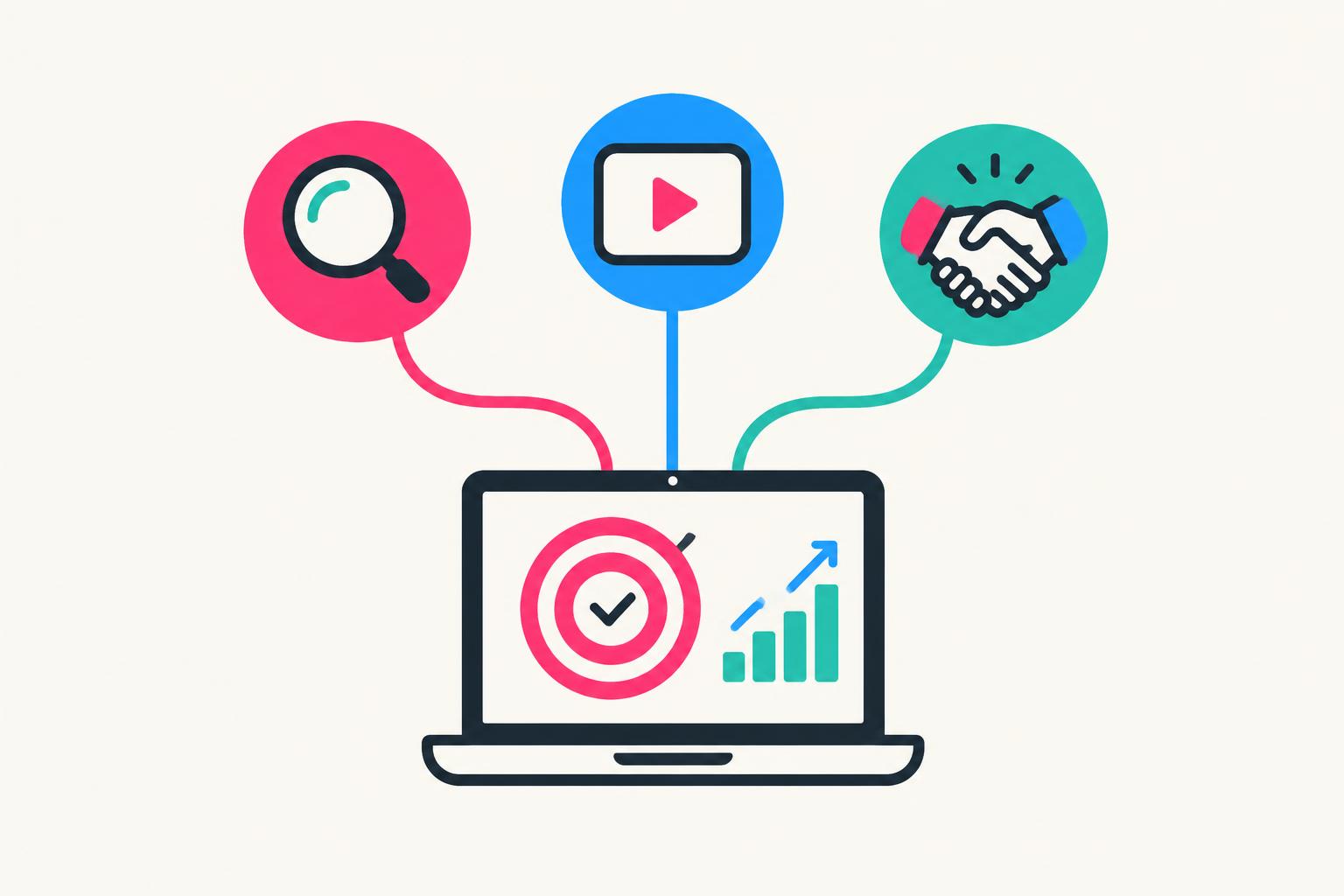
The best SaaS marketing channels are not the same for every product. My shortlist includes buyer-intent SEO, YouTube, UGC-powered paid social, organic social, paid search, creator partnerships, affiliates and referrals, outbound, ecosystem discovery and communities. The right acquisition mix depends on whether demand already exists, how much demonstration the product needs, how people buy and what a retained customer is worth.
If I were helping a founder choose today, I would not start by asking which platform is growing fastest. I would ask where suitable customers already look for answers and what proof they need before using the software. That is why YouTube and creator-led UGC deserve consideration alongside search and partnerships: they can make an otherwise abstract product visible.
This guide is the cross-model decision framework. The B2B SaaS channel guide goes deeper on qualified pipeline and buying groups; the B2C customer acquisition guide focuses on individual purchases, first value and retained subscribers. Choose the specialist guide after you identify your motion.
Ten SaaS Acquisition Channels Compared
| Channel | Main acquisition job | What you need | What to measure |
|---|---|---|---|
| Buyer-intent SEO | Capture active research | Useful pages tied to real product tasks | Relevant visits, activated users and customers |
| YouTube | Capture task intent and demonstrate software | A clear workflow and a relevant next step | Qualified visits and product outcomes |
| UGC-powered paid social | Introduce and test product stories | Credible creative, distribution and a matching journey | Activation or qualified opportunities, then economics |
| Organic social | Build discovery and familiarity | Repeatable useful ideas and audience fit | Relevant conversations, visits and assisted outcomes |
| Paid search | Capture existing commercial demand | Query discipline and a suitable landing experience | New customers and attributable cost |
| Creator partnerships | Reach a relevant trusted audience | Audience fit, an honest demo and clear scope | Referred cohorts, not follower counts |
| Affiliates and referrals | Reward relevant recommendations | Real product value and sound tracking rules | Customers who activate and stay |
| Outbound | Reach identifiable suitable accounts | Relevant account research and a credible reason to engage | Qualified replies, meetings and pipeline |
| Ecosystem discovery | Meet users inside stores and existing tools | A useful listing or integration and smooth setup | Installs or connections that become active customers |
| Communities and workshops | Earn trust through practical help | Expertise and permission-based follow-up | Meaningful evaluation and resulting customers |
These recommendations are editorial, not a performance leaderboard assembled from comparable campaigns. There is no credible universal conversion rate that lets you rank all ten for an unknown product. A marketplace listing and an enterprise workshop are also different investments, so compare their jobs before comparing their numbers.
For a concrete company example, Ahrefs describes its own SaaS marketing tactics, including content, free tools and community. Treat that as one company's operating experience rather than a template to copy unchanged. Your audience and economics still need their own test.
Four Filters for Choosing SaaS Marketing Channels
Filter 1: Does the customer already search for the problem?
If people already search for a workflow, comparison or integration, search-driven acquisition has an identifiable starting point. Use the language customers use, then inspect the actual results and the intent behind the query. If the product solves a problem people do not yet recognize, educational creators and social demonstrations may be better initial tests than waiting for a category keyword to become popular.
Filter 2: How much proof does the product need?
A simple utility may be understood from a screenshot. A multi-step workflow often needs a demonstration. A high-risk purchase may need customer evidence, technical documentation and a pilot as well. Match the proof burden to the asset: a short clip for recognition, a complete tutorial for understanding, and a more detailed evaluation path where necessary.
Filter 3: Who buys, and how much friction is involved?
An individual with a card can try a subscription immediately. A team may need a champion, budget approval and a security review. The acquisition channel must lead to an appropriate next step. Sending every visitor to ‘book a demo’ can create needless friction for a self-serve product; sending enterprise buyers to an unsupported trial can create a different kind of failure.
Filter 4: Can you fund the acquisition and follow-up?
Count the work as well as the media. A free social account still needs concepts, recording, editing and responses. An affiliate commission still affects margins. A search library needs maintenance. Compare the cash and effort you can sustain with observed gross profit and retention, rather than assuming unpaid distribution means zero acquisition cost.
1. Buyer-Intent SEO: Build Pages That Continue a Real Task
SEO is a candidate when customers actively research a problem your product solves. Start with pages where you can add real evidence: workflow instructions, verified integration details, useful comparisons and honest limitations. Avoid another generic ‘what is’ article if it does not help a suitable buyer make progress.
For a hypothetical appointment tool, a page about handling rescheduled bookings could show the actual steps, notification settings and edge cases. A relevant trial link continues that task. This is a better product bridge than a broad article about business success that happens to mention scheduling in the last paragraph.
Google's people-first content guidance is the standard I would use. Ranking is not guaranteed, and a ranking alone does not establish acquisition value. Watch whether relevant search users become active customers.
2. YouTube: Combine Discovery With Product Evaluation
YouTube is useful when someone can learn a task and inspect your software in the same video. It supports both B2B workflows and consumer tasks. The acquisition advantage is not simply reach: viewers can see enough of the product to decide whether it suits them before clicking.
A scheduling tutorial could show creating a booking page, setting availability and changing an appointment. The opening shows the finished result; the demonstration explains the constraints. A consumer creative app could use the same principle with a different task. The structure stays proof-led, while the audience and desired outcome change.
Use a destination that matches the demonstrated workflow and a clear next action. Track the path from relevant visits to first value or a qualified opportunity. For production and search execution, read YouTube SEO for SaaS. YouTube's audience-retention guidance can diagnose the video, while your own product data must diagnose acquisition.
3. UGC-Powered Paid Social: Make the Product Recognizable in the Feed
UGC is not a standalone channel. It is creator-led content that can run on your accounts, in ads or through a separate creator collaboration. Paid social supplies distribution. Keep that distinction visible when planning costs and responsibilities: a production fee does not buy media, and a video delivery does not guarantee an audience placement.
For SaaS, a strong creative usually joins a human explanation with visible software proof. The creator names the problem, shows the task and helps the viewer decide what to do next. Test genuinely different angles—problem, workaround, result—rather than making small caption changes and calling them a new acquisition strategy.
My flAim AI case study shows 669 destination clicks from $51.13 in spend. It is evidence of a specific attention test, not a guaranteed customer-acquisition result. With no established tracked conversions, the data cannot prove signup volume, subscriber cost or return on spend.
A paid creator should not present invented customer results. Agree on usage rights and disclose the relationship. For US campaigns, review the FTC's disclosure guide; requirements vary across markets.
4. Organic Social: Turn Useful Knowledge Into Repeat Discovery
Organic social fits when you have repeatable knowledge or demonstrations that your audience wants. LinkedIn may suit a professional workflow; short-form platforms may suit visually clear individual tasks. Choose from audience behavior rather than a blanket rule that one platform is only B2B or only B2C.
Build a narrow series. Each post should solve a small problem, explain a trade-off or show a result. Repeated relevance is more useful than unrelated viral moments. Capture the questions suitable users ask and use them to improve your product pages, tutorials and onboarding. Measure assisted discovery carefully instead of assigning every branded visit to the latest post.
5. Paid Search: Buy Intent Without Buying the Wrong Expectation
Paid search can produce fast feedback where demand already exists. It also makes mismatched positioning expensive. Inspect queries, negative keywords, ad promises and the actual destination. Separate branded demand capture from non-brand acquisition, and separate informational searches from queries suggesting a purchase or trial.
Agree on what counts as a meaningful conversion. For self-serve software that might be a paying customer; for sales-led software, a qualified opportunity is an intermediate step that needs later reconciliation. Include refunds and failed trials when assessing the cohort. Platform conversion totals do not replace your business records.
6. Creator Partnerships: Fit the Demonstration to a Trusted Audience
A creator partnership combines relevant distribution with a person the audience already listens to. The key questions are who watches, which problem they have and whether the creator can use the product credibly. Inspect real examples and comments, not only a media kit's headline numbers.
Define whether the engagement includes a sponsored placement, production for your own channels, an affiliate arrangement or several pieces. Give the creator product access, truthful claims and room to explain limitations. Use tracked links and follow the referred cohort. The SaaS influencer marketing guide covers the contracting and pilot details.
7. Affiliates and Referrals: Let Recommendations Follow Value
Affiliates and customer referrals share a recommendation mechanism but need different support. A professional affiliate may need demo access, teaching material and commercial terms. A customer referral should follow actual product value and a genuine reason to recommend the tool. Neither improves simply because you add a dashboard and a commission rate.
Recruit partners whose audience or clients can use the product. For product-sharing loops, protect private data and make sharing intentional. Set clear eligibility and attribution rules, and watch for low-quality or abusive signups. Measure whether referred customers activate and stay rather than celebrating program membership.
My GoHighLevel affiliate playbook explains how problem-led content, a relevant offer and support resources worked together. The dashboard figures in that case study are affiliate payouts, not a benchmark for what another founder will earn.
8. Outbound: Use It Where Account Fit Justifies the Work
Outbound is most plausible when you can identify suitable accounts and the potential contract supports research and follow-up. Start with a real account hypothesis and a concise explanation of why the workflow matters. A tailored video can support the message, but it should not imply access to private company information or invent a diagnosis.
Judge relevant replies, held meetings and sales-accepted opportunities. Respect applicable outreach, privacy and opt-out requirements. If you cannot explain why a recipient should care, automation will scale the weakness rather than repair it. Consumer software with a very low contract value often needs a different distribution model.
9. Ecosystem Discovery: Reach Users in Stores, Integrations and Shared Outputs
Ecosystems can include app stores, extension marketplaces and integration directories. The opportunity is contextual: users are already looking for something that fits an existing device or workflow. A listing needs a specific benefit, clear requirements, accurate screenshots and a reliable first-use path.
Track meaningful setup after discovery. An integration connection that never syncs data is not a successful acquisition. An install that never reaches first value is not equivalent to a paying customer. The next improvement might be onboarding or permission explanations rather than another promotional asset.
10. Communities and Workshops: Teach Before You Ask
A focused community or practical workshop can reach buyers who value specialist knowledge. Contribute a real answer, demonstrate a workflow and explain where the tool is not suitable. Learn from questions that expose objections or missing capabilities. Do not treat membership as permission to send unsolicited promotional messages.
Measure appropriate opt-in follow-up, useful evaluations and later customers. A workshop can also supply material for a tutorial or short explanatory clip, provided participants' privacy and permissions are respected. The value is the expertise and relevance, not the event's attendance count alone.
Choose a Complementary Pair Instead of Ten Separate Experiments
| Situation | Primary route | Supporting route | Why the pair fits |
|---|---|---|---|
| Known problem, self-serve software | Buyer-intent SEO | YouTube workflow demo | Capture research and remove uncertainty about using the product |
| Visually clear consumer task | UGC-powered paid social | Task-specific landing and onboarding content | Test recognition while keeping the promise consistent through first use |
| Narrow high-value B2B category | Targeted outbound | Role-specific demo or workshop | Reach suitable accounts with proof they can evaluate and share |
| Product attached to another platform | Integration marketplace | Partner tutorial | Find users in context and teach the joint workflow |
| Emerging category with weak search demand | Relevant creator education | Useful organic follow-up | Introduce the problem and continue explaining it |
The supporting asset is not always a second discovery channel. Sometimes the most useful next investment is a landing page or onboarding video that improves the users already arriving. If you change audience, channel, offer and destination simultaneously, you may get a result but learn little about which choice caused it.
A SaaS Channel-Readiness Checklist
Before you invest in the next acquisition channel
7 items still to confirm.
Find the Weak Link Before You Change the Channel
| Observed pattern | What it might indicate | Next investigation |
|---|---|---|
| Attention, but few relevant visits | Weak audience fit or unclear next step | Inspect who watched and how the offer was presented |
| Relevant visits, few signups | Mismatch, trust concerns or avoidable friction | Compare creative promise with the destination |
| Signups, little first value | Onboarding or expectation problems | Watch the first task and review user questions |
| First value, little payment | Pricing, packaging or insufficient recurring need | Inspect why people stop before buying |
| Customers, poor retention | Wrong-fit acquisition or weak ongoing value | Follow comparable cohorts and interview departing users |
These are diagnostic hypotheses, not automatic conclusions. Use actual behavior and conversations to check them. Keep click cost, signup cost, customer acquisition cost and cost per retained customer distinct. Do not add customers from different attribution reports together or use affiliate payouts as if they were product revenue.
A useful review names what you know and what you do not. If an ad earned clicks but no conversion event was tracked, you have attention evidence. If a tutorial generated an activated cohort but retention is immature, you have stronger product-use evidence with a remaining business question. Being honest about that gap is how you avoid scaling a misleading dashboard.
Need YouTube and UGC Content for the Channel Mix You Choose?
I help SaaS and AI owners explain their products through UGC, creator-led demos and tutorials, supported by a creative team. I am a creator and spokesperson, not a traditional full-service marketing agency. I can supply the content that makes a product easier to evaluate; distribution, product activation and sales follow-up still need a clear owner.
Tell me the customer, workflow and acquisition job. We can decide whether you need a complete YouTube-style tutorial, short UGC angles, a product demo or a combination. Scope includes the agreed deliverables and usage rights. Promotion to my audience is a separate discussion based on fit, not something assumed in every production project.
SaaS Marketing Channels FAQ
What are the best marketing channels for SaaS?
SEO, YouTube, creator-led paid social, organic social, paid search, partners, referrals and contextual ecosystem discovery are useful candidates. Select the mix by demand, product-demonstration needs, buying friction and retained-customer economics.
Are acquisition channels and marketing channels the same thing?
They overlap. An acquisition channel brings new potential customers into the journey. Marketing also supports evaluation, onboarding and retention. UGC is a creative format that travels through channels, while an onboarding video supports people already acquired.
Should every SaaS invest in YouTube?
No. It deserves consideration when your audience learns through video and the product has a task worth demonstrating. Validate audience fit and a useful next step before committing to a large content library.
How does UGC help SaaS acquisition?
It can make a product story relatable and show visible proof through a creator-led demonstration. It still needs appropriate distribution, accurate claims and a matching product journey. Measure customer quality rather than assuming human-presented content always wins.
How many acquisition channels should a new SaaS test?
Start with a focused primary route and the supporting content needed to make it work. Add another complementary route when you can sustain it and measure the result. Testing every platform at once makes execution and diagnosis harder.
Are organic channels free?
They may not charge for each impression, but research, production, distribution and maintenance take resources. Include that work when comparing channel economics and do not label media-only cost as full customer acquisition cost.
Share
Article footer · AI discovery
Want to explore this topic further?
Ask questions about this article or use it as a starting point for deeper research.
Want content that makes your SaaS product click?
Email promotions@fuelyourdigital.com or explore my content packages.