9 Best B2B SaaS Marketing Channels: Turn Buyer Intent Into Qualified Pipeline
Compare nine B2B SaaS acquisition channels, including YouTube, UGC, search, LinkedIn and partners—with buyer-fit examples, pipeline metrics and a focused testing plan.
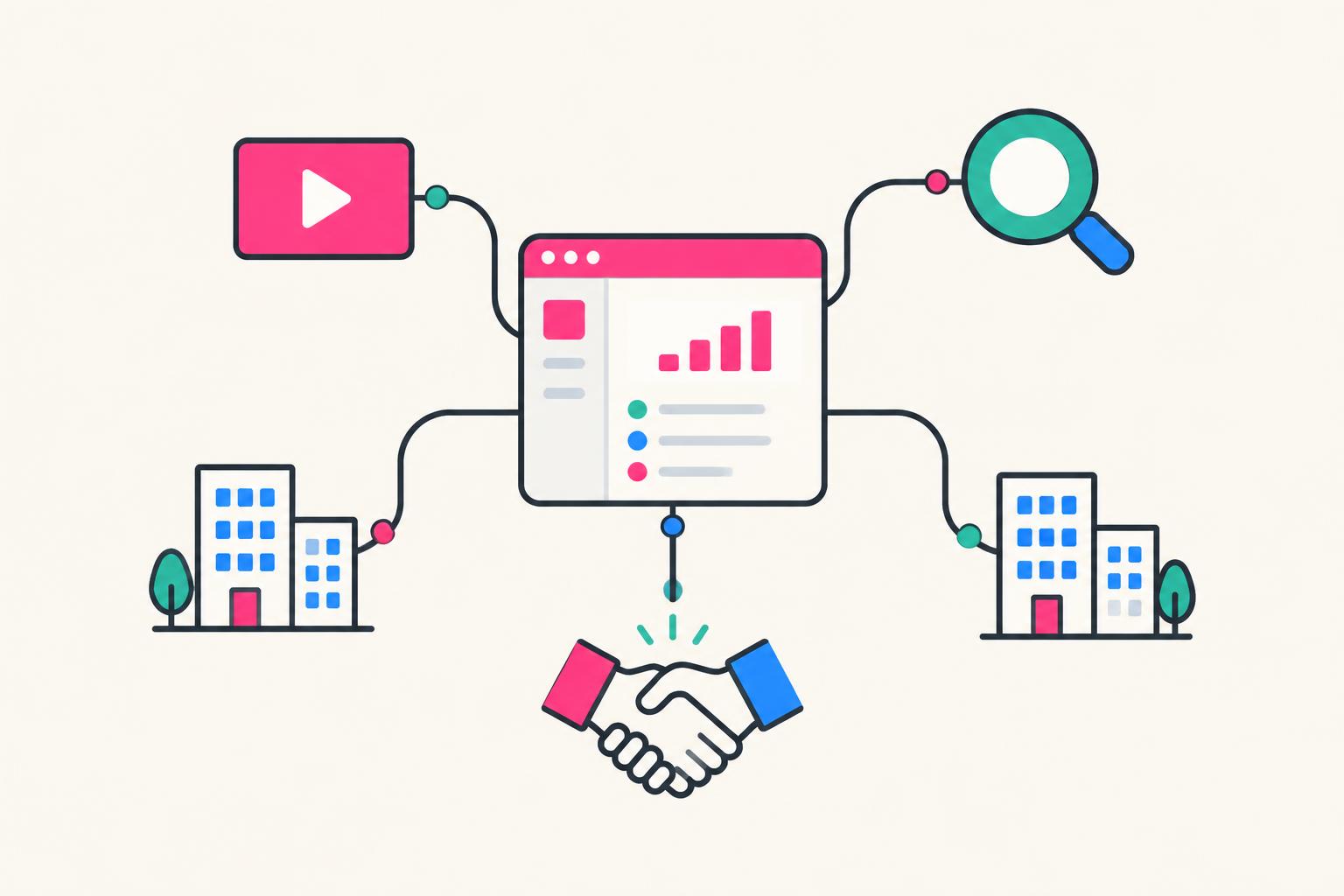
The best B2B SaaS marketing channels are the ones that reach the right company, help a real buyer evaluate the product, and produce customers at a cost your margins can support. My starting shortlist is buyer-intent SEO, YouTube tutorials, founder-led LinkedIn, UGC-powered paid social, paid search, targeted outbound, partners, communities and integration marketplaces. You do not need all nine.
I create videos for SaaS and AI products, so I see acquisition through a practical lens: what does someone need to see before they trust the software enough to try it or bring it to their team? A tutorial can answer that question. A short creator-led demo can answer it too. But neither fixes a bad offer or a product that does not deliver the promised result.
The Best B2B SaaS Acquisition Channels at a Glance
| Channel | Best fit | First useful signal | Main risk |
|---|---|---|---|
| Buyer-intent SEO | Problems and categories buyers already search for | Relevant non-brand visits and activated trials | Publishing generic content that attracts students, not buyers |
| YouTube tutorials | Software with a visible, teachable workflow | Qualified visits after viewers see the workflow | Views without a product-relevant next step |
| Founder-led LinkedIn | Buyers who learn from industry peers | Relevant conversations and assisted opportunities | Engagement from people outside your ICP |
| UGC-powered paid social | Demonstrable use cases and objection testing | Qualified landing visits and trial activation | Mistaking cheap clicks for customers |
| Paid search | Established demand with commercial intent | Sales-accepted opportunities or paying cohorts | Paying for vague or mismatched queries |
| Targeted outbound | A narrow account list and valuable contracts | Qualified replies and held meetings | Scaling irrelevant outreach |
| Partners and affiliates | Trusted specialists serving your buyers | Referred customers who activate and stay | Recruiting partners who never use the product |
| Communities and events | Specialist audiences with shared problems | Opt-in follow-up and meaningful product evaluation | Treating a community as an advertising list |
| Integration marketplaces | Products attached to an existing workflow | Installed integrations that become active accounts | Listing without a compelling use case |
Choose by Buying Motion, Not by What Is Trending
B2B is not a single acquisition model. An individual buying a small productivity subscription behaves differently from a department purchasing a system that needs security approval. Before comparing channels, define the buyer, the user, the approval process and the first meaningful product outcome. If the champion cannot explain your value internally, more reach simply sends more people into the same blocked decision.
| Illustrative product | Likely starting pair | Conversion to judge |
|---|---|---|
| Self-serve reporting tool for freelancers | YouTube tutorials + buyer-intent search | Connected data source and first useful report |
| Sales workflow tool for revenue teams | Founder-led LinkedIn + targeted outbound | Held qualified meeting, then a live pilot |
| Enterprise data-governance platform | Specialist partners + account-focused education | Sales-accepted opportunity with technical fit |
These are hypothetical choices, not results from client campaigns. Your own customer interviews should decide whether the audience actually uses these channels. For the broader positioning and buying-committee work, see my B2B SaaS marketing guide. This article focuses on where to acquire buyers and how to judge each route.
1. Buyer-Intent SEO: Capture a Problem That Already Exists
SEO earns its place when prospects already describe their problem in search. Prioritize workflow questions, integration questions, honest alternatives pages and comparisons you can substantiate. A payroll product might target the practical question of exporting hours from an existing tool, rather than another broad article about productivity. The useful page shows compatibility, limitations and the next step—not just a definition.
Build the page around something your company can demonstrate. Include a real workflow, prerequisites, who it suits and who it does not. Avoid dozens of nearly identical pages targeting minor keyword variations. Google's people-first content guidance is a useful standard: write for the person trying to solve the problem, not just for a ranking opportunity.
The first test is whether the page reaches the right audience and leads to useful product action. A few hundred relevant visits can be more valuable than thousands of generic visits. Link to a trial or demo that continues the same task, then measure the customer's progress after signup.
2. YouTube: Let Buyers Evaluate the Workflow Before a Sales Call
YouTube belongs high on my shortlist when software needs explanation. A buyer can watch the inputs, steps, output and trade-offs before handing over an email or booking time with sales. That makes a tutorial an acquisition asset and a qualification asset: people who dislike the workflow can self-select out, while suitable buyers arrive with better questions.
An original concept for a proposal tool would be: take an anonymized discovery-call summary, create a proposal, change the scope and export the final document. The title promises that task. The opening shows the finished proposal. The demonstration explains what the user still has to review. The link takes viewers to the relevant template, not a generic homepage.
My SEOBuddy case study documents five search-led tutorials built around buyer problems. It supports the workflow and distribution approach; it does not establish verified customer acquisition or revenue. Read the YouTube SEO for SaaS guide for the detailed publishing method rather than repeating that playbook here.
Track discovery and attention separately from acquisition. YouTube's audience-retention report can show where viewers stop watching. Your product analytics must show whether visits become useful trials. Good retention is a content signal, not proof of profitable customers.
3. Founder-Led LinkedIn: Make Expertise Visible to the Buying Group
LinkedIn can work when your founder has useful knowledge and your buyers use the platform professionally. The strongest starting point is not a daily motivational post. It is a specific opinion backed by a demonstration: why an existing workflow breaks, what the team learned from fixing it, or what a buyer should check before purchasing this category of software.
For the proposal example, publish a short breakdown of a scope mismatch that caused rework, then show the software preventing that mistake. The post earns attention through useful judgment. The product appears as evidence, not as a forced sales pitch. Respond to relevant questions and offer the full walkthrough when it helps; do not turn every comment into an unsolicited message.
Measure conversations with suitable accounts and ask prospects what influenced their decision. A founder's post may assist an opportunity later attributed to direct traffic or branded search. Keep that qualitative evidence alongside tracked visits instead of pretending last-click attribution captures the whole relationship.
4. UGC-Powered Paid Social: Test Product Stories, Not Just Hooks
UGC is a creative format, not a distribution channel. It reaches new people through placements such as paid social, organic social or a creator's audience. For B2B SaaS, the useful version is a credible person explaining a role-specific problem while showing the product. A paid spokesperson should not pretend to be a customer with results they never achieved.
Build three different messages around the same workflow: the avoidable mistake, the time-consuming workaround and the clearer result. Change the opening and framing while keeping the audience, destination and offer sufficiently stable to learn from the test. Judge which message attracts suitable buyers, not just which one earns the most reactions.
My flAim AI campaign recorded 669 destination clicks from $51.13 in spend. That is useful evidence about a low-budget attention test. It is not evidence of 669 signups or a profitable acquisition channel: the dashboard did not establish tracked conversions. Keep that distinction when evaluating your own creative.
For a deeper role-based approach, see UGC for B2B SaaS. Agree on paid usage, editing rights and clear sponsorship disclosures before distribution. In the US, the FTC's disclosure guidance explains how material relationships should be communicated; other markets have their own requirements.
5. Paid Search: Pay for Evaluation Intent You Can Serve
Paid search is worth testing when there is established demand and your landing page directly answers it. Separate product-category searches from informational searches, and inspect the actual queries that spend money. An ad for a paid workflow product should not accidentally buy a large audience looking for a free document template you do not provide.
Send each tightly related query group to a relevant destination. Show the workflow, pricing expectations, integration requirements and buying path. Where your sales process is long, use a qualified lead or sales-accepted opportunity as an intermediate measure, then reconcile it with customers later. A cheap lead that sales cannot use is not a bargain.
6. Targeted Outbound: Start With a Reason This Account Should Care
Outbound can fit high-value contracts and a narrow, identifiable audience. Start with a small account list and a genuine reason to reach each company: a relevant workflow, publicly visible expansion or a specific integration need. A short, tailored demonstration can make the message concrete. It should show a plausible solution, not pretend you accessed their internal information.
The test is qualified replies and held meetings, followed by opportunities that progress. Separate positive replies from polite responses and separate booked meetings from attended ones. Follow the applicable rules for the recipient's market, respect objections and opt-outs, and do not assume that a business email address removes privacy obligations.
7. Partners and Affiliates: Borrow Relevant Trust
Partners work when they already help the buyer achieve the outcome your software enables. That could be a consultant implementing the category, a creator teaching the workflow or another product with a complementary use case. The partnership needs product access, a credible offer, useful demonstration material and a clear commercial agreement.
Recruit for fit before reach. Ask a prospective creator which customer problem they would demonstrate and why their audience would care. An impressive follower count does not answer either question. Agree on tracking and attribution windows, and evaluate referred customers by activation and retention—not only referral registrations.
My GoHighLevel affiliate case study explains a combination of problem-led tutorials, an extended trial and support resources. Its dashboard shows affiliate payouts; those figures should not be relabeled as your expected revenue or a guaranteed return.
8. Communities and Events: Earn Permission to Continue the Conversation
A specialist community or small workshop can outperform a broad event for a niche product, but only if you contribute something useful. Teach a workflow people already struggle with, answer implementation questions and be honest about where your tool is not a fit. A live demonstration also reveals objections you might never see in ad metrics.
Get appropriate permission for follow-up rather than adding everyone to a marketing list. Track opted-in conversations and resulting evaluations. A crowded webinar is not enough; the audience must contain buyers who can use the product. If the discussion repeatedly exposes a missing integration, feed that insight back to the product team.
9. Integration Marketplaces: Meet Users Inside an Existing Stack
A marketplace can be an acquisition route when your product adds value to software customers already use. The listing should explain the joint task, required permissions, setup steps and limitations. A short creator-led walkthrough can show the complete combined workflow more clearly than a grid of logos.
Do not treat an install as a customer. Follow the path from listing visit to connection, successful data sync, meaningful use and payment. If installs are plentiful but setup fails, the next acquisition improvement is likely better documentation or onboarding, not more marketplace promotion.
Measure Qualified Pipeline Without Double-Counting It
| Metric | Definition to agree internally | Decision it supports |
|---|---|---|
| Activated trial | A signup that completes your defined first-value task | Which sources bring users who actually use the product? |
| Sales-accepted opportunity | An opportunity that meets agreed fit and buying criteria | Which channels create viable pipeline? |
| Customer acquisition cost | Relevant sales and marketing cost divided by new paying customers | Can you afford this acquisition route? |
| Payback | Time for cohort gross profit to recover acquisition cost | Does growth fit the company's cash position? |
| Retained cohort | Customers still active or paying at a stated follow-up point | Are you buying a durable relationship? |
Label platform-reported attribution, analytics attribution and self-reported discovery separately. Do not add them together as if they represent different customers. A person can see a LinkedIn post, watch a YouTube tutorial, click a search ad and eventually buy. Keep the journey visible while counting the customer once.
Google's guidance on conversion measurement explains how to define valuable actions. Its attribution model documentation explains why different credit models can report the same journey differently. Use these definitions to support your reporting, not to manufacture certainty from incomplete tracking.
A Six-Week B2B Channel Pilot
- 1
Weeks 1–2: Define the buyer and outcome
Choose one role, one workflow, one buying motion and the product event that represents first value. Prepare a safe demo workspace and a matching destination.
- 2
Weeks 3–4: Ship a focused pair of tests
For example, publish a complete YouTube walkthrough and distribute short role-specific edits through one suitable paid or organic channel. Record production effort and media costs separately.
- 3
Weeks 5–6: Read quality before volume
Inspect trial activation, held meetings, objections and early cohort behavior. Continue, change the hypothesis or stop. A long sales cycle may require later follow-up before judging acquisition economics.
Six weeks is a planning cadence, not a promise that SEO will mature or enterprise deals will close within that window. Use early evidence to decide what deserves another cycle. Keep learning notes: audience, message, destination, cost, observed outcome and what remains unknown.
Need the Videos Behind Your B2B Acquisition Plan?
I help SaaS and AI owners turn product workflows into creator-led tutorials, demos and UGC. I work as a creator and spokesperson with a creative team—not as your outsourced sales department or a full-service acquisition agency. My contribution is making the product understandable and giving your distribution plan stronger content to work with.
Bring your buyer, product access and the channel you want to test. We can scope the main demonstration, short hooks, aspect ratios and usage rights around that job. Audience promotion is a separate collaboration to discuss when the fit is right; a content-production engagement does not automatically include distribution.
For a consumer subscription, use the B2C customer acquisition guide. For a cross-model decision framework, see SaaS marketing channels.
B2B SaaS Marketing Channels FAQ
What are the best acquisition channels for B2B SaaS?
Buyer-intent SEO, YouTube, LinkedIn, paid search, targeted outbound, partners and relevant communities are strong candidates. Choose according to your buyer and buying motion. A self-serve trial and an enterprise procurement process need different channel mixes.
Is YouTube useful for B2B SaaS customer acquisition?
Yes, when buyers need to understand a workflow before trying the software. Pair a relevant tutorial with a matching next step, then measure activated trials or qualified opportunities. Views alone do not establish acquisition performance.
Can UGC work for B2B SaaS?
Creator-led demonstrations can help buyers recognize a problem and evaluate the product. Distribute them through a suitable channel, identify paid relationships clearly and measure buyer quality. Do not disguise a paid spokesperson as a customer.
Which channel should a small B2B SaaS test first?
Start where you can reach a narrowly defined buyer and show a useful outcome. That might be a search-led tutorial for self-serve software or focused outreach supported by a demo for higher-value contracts. Commit to a specific hypothesis rather than launching every channel.
Which B2B SaaS channel gets results fastest?
Paid distribution and relevant outreach can generate feedback sooner than a new organic library, but fast feedback is not the same as fast revenue. Your buying process, audience fit and onboarding determine how quickly that feedback becomes customers.
Share
Article footer · AI discovery
Want to explore this topic further?
Ask questions about this article or use it as a starting point for deeper research.
Want content that makes your SaaS product click?
Email promotions@fuelyourdigital.com or explore my content packages.