Can YouTube Get Your SaaS Recommended by ChatGPT? A Test Method
YouTube is cited in Google AI Overviews for most SaaS searches. Here's what the data says, a repeatable test for ChatGPT, Perplexity and AI Overviews, and how to make videos AI tools cite.
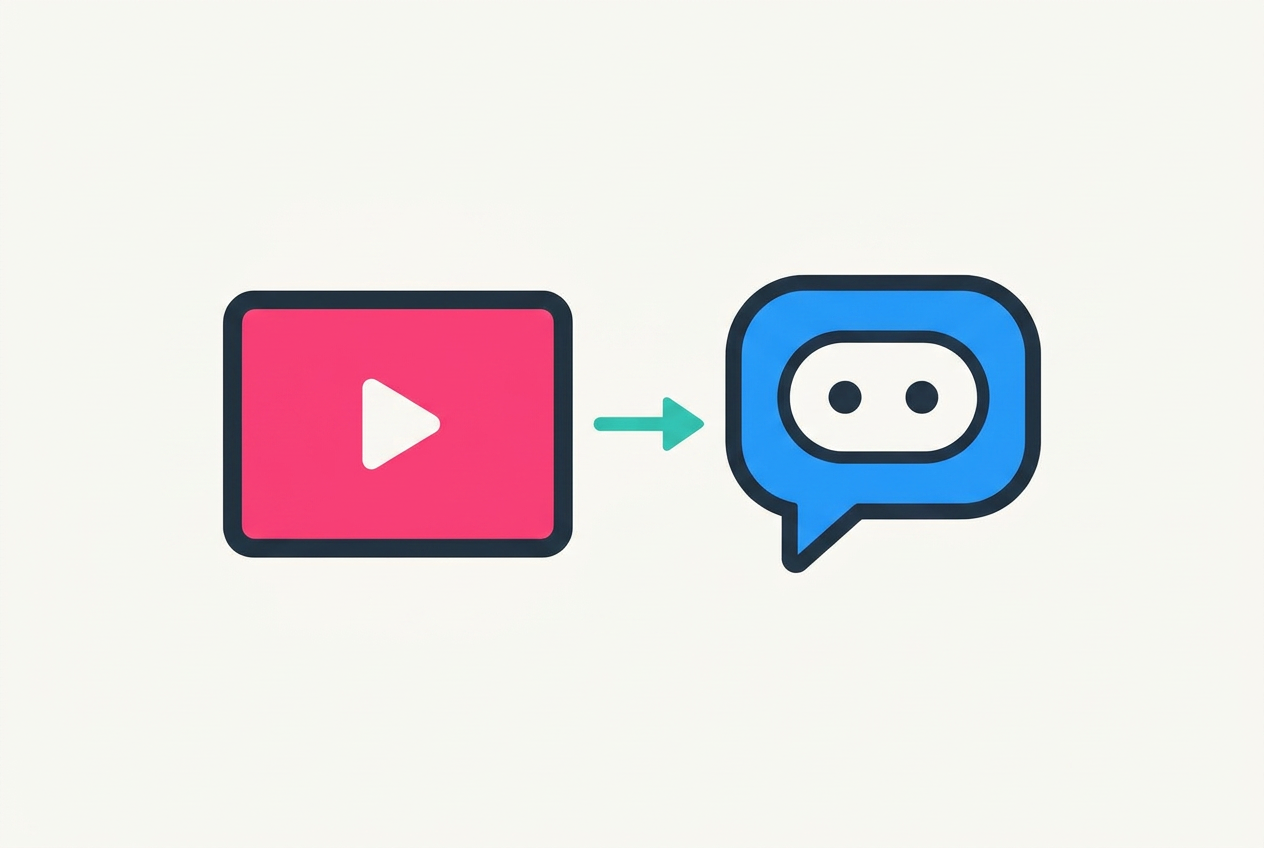
Buyers increasingly ask ChatGPT, Perplexity or Google's AI Overviews "what's the best tool for X?" before they ever visit a website. If your SaaS isn't in that answer, you're not on the shortlist. The question I get from founders is whether YouTube helps, and how anyone can tell.
This guide covers what the published data says, why AI tools lean on YouTube, a step-by-step method to test it for your own product with screenshots, and the specific video and description choices that make a video easier to cite. I'll be clear about what's proven and what isn't.
The Short Answer
What the Data Shows
In September 2026, Grizzle published a study of 3,623 SaaS YouTube videos across 71 B2B SaaS channels and 873 searches. Their findings on AI Overviews are striking:
| Finding | Result |
|---|---|
| Searches that triggered an AI Overview | 95.4% |
| AI Overviews citing a YouTube video | 74.9% (624 of 873) |
| Bottom-of-funnel searches citing YouTube | 75.1% |
| Branded comparison searches citing YouTube | 87% (120 of 138) |
| AI Overviews citing a tracked SaaS brand's own channel | 4.2% |
Read that last row twice. YouTube shows up constantly, but mostly through independent creators and reviewers, not the brands' own channels. AI tools are citing the people who answer buyers' questions, and that's often not the vendor.
The 99signals YouTube AEO playbook reached the same conclusion from that data: the citations go to creators whose videos match the questions buyers ask.
Why AI Tools Cite YouTube
- Transcripts are text. Every captioned video is a long, detailed document an AI system can read.
- Tutorials answer questions directly. "How to do X in Y" is exactly the shape of a buyer's prompt.
- Comparisons contain judgements. AI answers to "best tool" questions need opinions with reasons, which review videos provide.
- Google owns YouTube. For AI Overviews in particular, YouTube is an easy, well-structured source to pull from. Google's own guidance on AI features says the same fundamentals apply: helpful, crawlable content.
ChatGPT vs Perplexity vs Google AI Overviews
| Engine | How sources appear | YouTube in practice | What to test |
|---|---|---|---|
| Google AI Overviews | Linked cards beside the answer | Very common for SaaS queries, per the data above | Bottom-of-funnel and comparison searches |
| ChatGPT (search on) | Inline citations and a sources list | Varies by prompt; web pages often dominate | "Best X for Y" and "X vs Y" prompts |
| Perplexity | Numbered sources above the answer | Often includes videos for how-to queries | Tutorial and setup questions |
ChatGPT only shows sources when it searches the web, which it does for many current or product questions; OpenAI explains this in its ChatGPT search help article. Answers also change between runs, so a single screenshot proves little. That's why the method below repeats every check.
The Test Method: Measure It Yourself
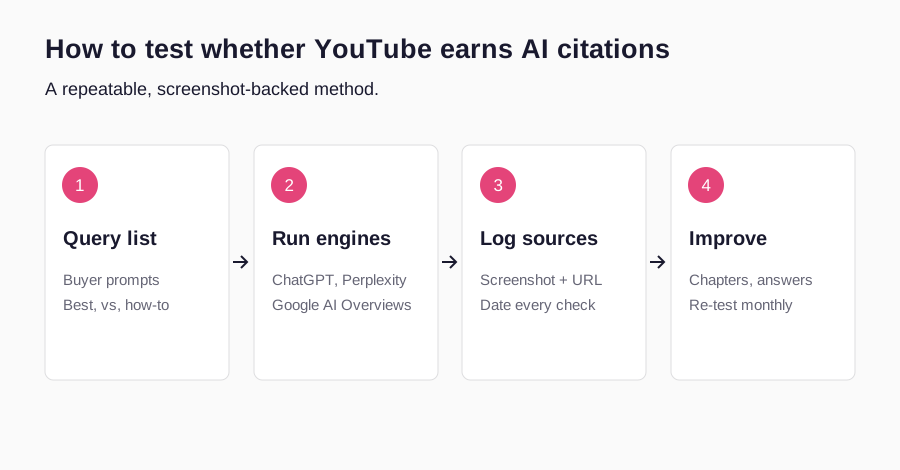
You don't need a tool to start. You need a fixed list of prompts, a spreadsheet and the discipline to rerun it. Here's the method I use for client keywords.
- 1
1. Write 15–20 buyer prompts
Mix "best [category] for [audience]", "[competitor] alternatives", "[A] vs [B]" and "how to [task]".
- 2
2. Run each in three engines
Google (check for an AI Overview), ChatGPT with search, and Perplexity. Use a logged-out or fresh session.
- 3
3. Log every source
Note whether a YouTube video is cited, whose channel it is, and whether your brand is mentioned.
- 4
4. Screenshot and date it
Answers change; a dated screenshot is your evidence.
- 5
5. Publish or improve one video
Target a prompt where YouTube is cited but you aren't.
- 6
6. Re-run monthly
Compare citation rate and brand mentions over time.
| Prompt | Engine | YouTube cited? | Whose channel | Brand mentioned? | Date |
|---|---|---|---|---|---|
| best [category] for [audience] | AI Overview | ||||
| [competitor] alternatives | ChatGPT | ||||
| how to [task] with [category] tool | Perplexity |
Before you trust a result
5 items still to confirm.
Which Kinds of Videos Get Cited
Based on the study above and the shape of buyer prompts, three formats are worth prioritising:
| Format | Matches prompts like | Why it gets picked |
|---|---|---|
| Tutorial | How to [task] in [tool] | Step-by-step answer in the transcript |
| Comparison / best-of | Best [category] for [audience] | Ranked opinions with reasons |
| X vs Y | [Tool A] vs [Tool B] | Direct answer to a decision question |
| Alternatives | [Competitor] alternatives | Lists options with trade-offs |
Notice what's missing: brand videos, webinars and feature announcements. They rarely answer a question someone would type. My YouTube SEO for SaaS playbook explains how to pick the right search for each format.
Transcripts and Chapters
If an AI system reads your video, it reads the transcript. Auto-captions are fine for many videos, but check that product names and key terms are spelled correctly; a misheard brand name means you don't get mentioned. YouTube lets you edit or upload captions.
Chapters help too. They split the video into labelled answers, such as "How to connect Stripe" or "Pricing compared", which mirror how people phrase questions. Add timestamps in the description to create video chapters.
- Say the question out loud. "What's the best CRM for a small agency? Here's my pick." puts the prompt and the answer in the transcript.
- Name things clearly. Say the product names, categories and use cases you want to be associated with.
- Give a verdict. "For agencies under ten people, I'd choose X because…" is quotable. Vague praise isn't.
Write Descriptions as Answers
Most SaaS video descriptions are a link and a list of social handles. Treat yours like a short article instead: the first two lines answer the question directly, then a short summary, then chapters, then links.
| Weak | Answer-style | |
|---|---|---|
| Opening | "Check out our new video!" | "The best CRM for small agencies in 2026 is X if you need Y; here's why." |
| Body | Links only | Three to five sentences summarising the verdict and who it's for |
| Structure | None | Timestamped chapters matching common questions |
| Links | Ten links | One main link, UTM-tagged |
Beyond Your Own Channel
The study's most useful finding is that brand channels are rarely cited. The practical answer is to be featured in the videos that are: independent tutorials, reviews and comparisons. That means working with creators who make honest, search-led videos in your category, and making sure your product appears accurately in them.
That's what I do: dedicated videos built around buyer searches, where the product is shown working. See YouTube sponsorship rates for SaaS for how those deals are priced, the SEOBuddy case study for a search-first example, and SaaS influencer marketing for choosing creators.
What We Can and Can't Claim
Frequently Asked Questions
Does YouTube help AEO?
AEO means answer engine optimisation: getting cited in AI answers. For Google AI Overviews, the data says YouTube is one of the most cited sources for SaaS searches. For other engines, test your own prompts.
Should I start my own channel or work with creators?
Both can help, but the data shows independent channels are cited far more often than brand channels. If you only do one, getting featured in honest creator tutorials and comparisons is likely the faster path.
How long until a video gets cited?
It usually needs to be indexed and ranking first, which can take weeks. Re-run your prompt list monthly to see when it starts appearing.
Do YouTube Shorts get cited?
Short videos have very little transcript to work with. Long-form tutorials and comparisons are a better bet for citations; Shorts are better for reach.
Can I pay to be recommended by ChatGPT?
Not in the organic answer. What you can do is make sure the sources it reads, including YouTube videos, describe your product clearly and accurately.
Share
Article footer · AI discovery
Want to explore this topic further?
Ask questions about this article or use it as a starting point for deeper research.
Want content that makes your SaaS product click?
Email promotions@fuelyourdigital.com or explore my content packages.