YouTube Sponsorship Rates for SaaS (2026): What I Charge and What You Get
Compare SaaS YouTube sponsorship formats, pricing models, quote terms, buyer fit and acquisition economics, with worked examples and an interactive deal checklist.
Most articles about YouTube sponsorship rates are written by agencies or data companies. This one is written from the other side of the deal: I'm a creator that SaaS and AI brands pay to make videos about their products. I'll explain how sponsorships are actually priced, what changes the number, what you get for it, and what I charge.
A quick note on numbers. Sponsorship pricing varies a lot by niche, audience and deal shape, and there's no public price list everyone follows. Where I give example figures below, they're worked examples to show the maths, not market averages. My own starting price is real and listed on my site.
The Short Answer
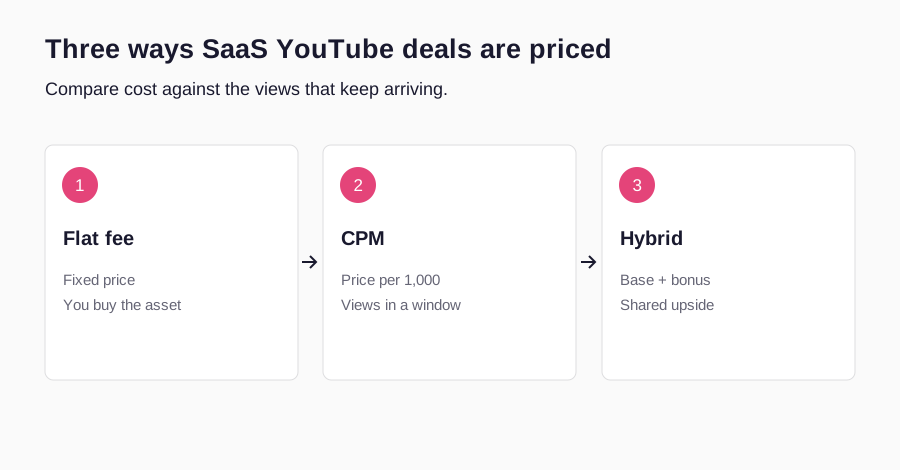
The Three Ways SaaS Sponsorships Are Priced
| Model | How it works | Good for | Watch out for |
|---|---|---|---|
| Flat fee | One fixed price for the video or integration | Search-led videos that keep getting views | Paying for a video that underperforms |
| CPM | Price per 1,000 views, usually counted over 30 days | Large channels with predictable views | Ignores views after the window closes |
| Hybrid | Lower base fee plus a bonus per view, sign-up or sale | Testing a new creator fairly | Tracking disputes; agree attribution first |
| Affiliate only | Commission per paying customer | Products with a strong affiliate program | Most good creators won't make a full video for this alone |
CPM vs Flat Fee: Which Is Better for SaaS?
CPM means cost per mille, the price for 1,000 views. If a creator quotes a CPM and the video gets 20,000 views in the first 30 days, you pay 20 times that rate. It's easy to compare across channels and it feels fair, because you pay for what you get.
The problem for SaaS is the window. A CPM deal usually counts views for a set period, often 30 days. Entertainment videos get most of their views in that period. Search-led tutorials are different: they start slowly and keep collecting views from people searching for the problem for months. Under a CPM deal, those later views are free to you, which sounds great until you realise creators price that in, or avoid making search content for CPM deals at all.
A flat fee fixes the publication cost. Later views may continue to deliver value under the agreed terms, but you do not automatically own the video or its copyright. For a SaaS product with real search demand, a flat fee for a search-led video is often the better deal; for a broad awareness push on a big entertainment channel, CPM can be cleaner.
| CPM deal | Flat-fee deal | |
|---|---|---|
| Price | $25 per 1,000 views in 30 days | $1,000 one-off |
| Views in first 30 days | 20,000 | 20,000 |
| You pay | $500 | $1,000 |
| Views in the following 11 months | 30,000 (not counted) | 30,000 |
| Effective cost per 1,000 views over a year | $10 | $20 |
These numbers are made up to show the logic. The point: compare deals on the total views and sign-ups you expect over the video's life, not just the first month.
Dedicated Video vs a Short Mention
A short mention (often called an integration) is a 30 to 90 second segment inside a video about something else. A dedicated video is entirely about your product or the problem it solves. They're different products and should be priced differently.
| Integrated mention | Dedicated video | |
|---|---|---|
| Length about you | 30–90 seconds | The whole video |
| Can rank for your keywords | Rarely | Yes, if built around a search |
| Shows the product properly | Briefly | Full workflow |
| Lifespan | Tied to the host video | Evergreen if search-led |
| Typical relative cost | Lower | Higher |
| Best for | Awareness on big channels | Signups from people with the problem |
For complex B2B SaaS, a mention often isn't enough time to show why the product matters. A dedicated tutorial that answers a real search is closer to a permanent sales asset. My Lovable case study is one dedicated, search-led video: 161 visitors, 10 leads and 10 conversions, as reported by my affiliate dashboard.
Why Long-Tail Search Views Matter More Than Launch Views
A video titled around a search like "how to scrape Google Maps" or "best CRM for small agencies" doesn't peak in week one. It earns views every time someone types that question, for as long as it stays relevant. Those viewers have a problem right now, so they convert better than people who just happened to see a video in their feed.
That's why, for SaaS, I'd value a sponsorship by three things: expected first-month views, expected views over 12 months, and how closely the viewers match your buyer. My WAGHL case study and GoHighLevel YouTube case study show how search-led videos keep working long after launch. There's also a newer reason: YouTube videos are increasingly cited in AI search answers. More on that in can YouTube get your SaaS recommended by ChatGPT.
What Moves the Price Up or Down
- Audience fit. A small channel watched by your exact buyers is worth more per view than a huge general one.
- Niche. B2B software, finance and developer audiences usually cost more per view than entertainment.
- Format. Dedicated videos cost more than mentions; tutorials take more work than talking-head reviews.
- Usage rights. Using the footage in your own paid ads is a separate licence and should be priced separately.
- Exclusivity. Asking the creator not to work with competitors for a period costs extra.
- Turnaround and revisions. Rush jobs and extra rounds of edits add cost.
- Extras. Pinned comments, community posts, shorts cut from the main video and link placement in the first line of the description.
What I Charge (and What You Get)
I'm a creator and on-camera spokesperson for SaaS and AI products, supported by a creative team for scripting and editing. I'm not an agency, and I don't resell other creators.
| Package | Starting price | What's included |
|---|---|---|
| Single video | $300 | One video about your SaaS or AI product, scripted around a real workflow, filmed and edited, with captions. |
| Additional versions, ad usage, exclusivity | Quoted per project | Short cuts for social, licence to run the video as an ad, competitor exclusivity. |
Current packages and what each includes are always on the services section of my homepage. If you want to see the kind of results a single video can produce, look at the Apify and Numverify case studies.
Estimate Your Sponsorship Budget
Separate the production budget from audience publication, licences and internal campaign costs. The worked example later in this guide shows how to evaluate your own inputs.
What to Negotiate (Besides the Price)
Sponsorship deal checklist
8 items still to confirm.
The most valuable thing to agree is the search target. A video built around a real buyer question is the difference between a one-week spike and a year of qualified traffic.
How to Measure a SaaS YouTube Sponsorship
Use a unique UTM link or promo code so you can attribute sign-ups. Track views at 30, 90 and 365 days. Then measure what actually matters: activated trials and paying customers, not just clicks. Ask new users "how did you hear about us?" too; plenty of YouTube viewers come back later by typing your URL, which looks like direct traffic in analytics. My SaaS video marketing guide covers this in more detail.
Disclosure: Keep It Legal
Paid sponsorships must be disclosed. YouTube requires creators to tick the paid promotion box, and in the US the FTC Endorsement Guides require a clear disclosure of the relationship. EU and UK rules are similar. A clear disclosure doesn't hurt performance with SaaS audiences; hiding it does hurt trust.
When a YouTube Sponsorship Is the Right SaaS Investment
A sponsorship buys a defined collaboration, not a guaranteed stream of customers. It is a good candidate when the creator already teaches a problem your buyers have, your product can demonstrate a meaningful result, and the visitor has a sensible next step after watching. It is a poor first investment when the product’s core workflow is unstable, the target customer is undefined, or the only message is “we are an innovative AI platform.” Paying a creator does not solve those problems.
Separate production from distribution. A UGC creator can make an excellent video for your own channels without posting it to an audience. A YouTube sponsorship normally includes publication or an integration on a specified channel. These may be offered together, but neither should be assumed from a single-video production price. Ask what exactly is being sold, where it appears, and which audience sees it.
| Your objective | Likely starting format | Verify before paying |
|---|---|---|
| Explain a complex workflow | Dedicated tutorial | Creator can demonstrate setup and the result |
| Reach a known relevant audience | Integration in a related video | Segment fits the host video and has a clear CTA |
| Create creative for your own ads | Commissioned UGC or demo | Paid usage licence and editable deliverables |
| Recruit ongoing advocates | Affiliate or hybrid partnership | Tracking, compensation, support, and true product fit |
The outreach process is covered in how to get YouTubers to promote your SaaS. Use this page for evaluating the scope and economics of the deal, rather than treating the two guides as interchangeable.
Evaluate a Quote Without Trusting Subscriber Counts
Ask for recent comparable videos, not the creator’s all-time best upload. A tutorial about software like yours is a more useful comparison than an unrelated viral video. Review the topic, age, duration, format, sponsor placement, and public views. If the creator chooses to share analytics, ask about audience geography and search traffic in aggregate. You do not need viewer identities or private subscriber information to evaluate fit.
Prefer a range of possible outcomes to one precise forecast. A median of several comparable uploads can be a starting point, but it is not a guarantee for the proposed topic. A smaller channel with no comparable uploads has unknown performance, not automatically poor performance. Price that uncertainty into a small pilot and judge the work’s usefulness separately from its immediate reach.
A forecast also needs a time window. “Ten thousand views” is ambiguous without “by when?” A search-led tutorial may keep getting relevant traffic, but it may also stop attracting viewers when the product changes or the topic is no longer useful. Agree how updates, obsolete information, title changes, and removal requests will be handled. A flat fee does not transfer copyright or guarantee permanent availability unless the agreement says so.
Quote-comparison checklist
6 items still to confirm.
When a creator supplies a media kit, use it to ask better questions rather than treat every claim as independently verified. Public comment quality, a legible demonstration, and accurate explanations may matter more for a specialist product than broad demographics alone.
Work Backward From Your Acquisition Economics
Decide what an acceptable experiment costs your business before negotiating the creator down. For a self-serve product, useful inputs include contribution margin per retained customer, expected retention, support cost, and your cash payback tolerance. For a sales-led product, include sales work and the probability that a qualified opportunity closes. Top-line subscription revenue alone overstates what you can sustainably spend.
| Input or calculation | Example |
|---|---|
| Creator fee | $1,000 |
| Internal production and follow-up effort | $200 |
| Total pilot cost | $1,200 |
| Contribution available per acquired customer during chosen payback window | $120 |
| Customers required to cover pilot cost | 10 ($1,200 / $120) |
| Assumed trial-to-paid rate for planning only | 20% |
| Trials required under that assumption | 50 (10 / 0.20) |
These deliberately hypothetical figures show the logic, not what your product will achieve. Replace every input with your own evidence. If your recent trial-to-paid rate is unstable, calculate conservative and optimistic cases. Ten customers might cover the defined contribution window in this example, but it does not establish incrementality: some customers might have signed up without the sponsorship.
Use comparable denominators. Effective CPM is cost divided by views, multiplied by 1,000; cost per activated trial is cost divided by activated trials; observed acquisition cost is cost divided by new paying customers attributed under your stated rules. If there are zero paying customers, do not report a numeric customer acquisition cost as if the campaign succeeded. Record that it has not yet produced a measurable paying-customer denominator.
Attribution and incremental impact are different questions. A tracked link records an observed referral path within your tool’s limits. It does not prove the video caused every attributed conversion. If you run several channels at once, report the limits and compare to an appropriate baseline; larger programs may justify controlled lift studies. For an early pilot, clear uncertainty is more useful than a manufactured ROI percentage.
Write a Scope That Protects Both Brand and Creator
A usable agreement specifies the work and the approval process, not merely a price. Name the platform, video type, intended workflow, approximate length, delivery dates, publication window, number of revisions, and who supplies safe product access. Separate factual review from editorial approval. A brand can correct an inaccurate feature claim without forcing a creator to deliver an opinion they do not honestly hold.
| Term | Question to resolve | Reason it matters |
|---|---|---|
| Paid usage | Which platforms, countries, and dates are licensed? | Ad reuse is not automatic |
| Exclusivity | Which named competitors and for what period? | Broad restrictions can block other income |
| Revisions | What is included and what triggers a reshoot? | Product changes can create additional work |
| View guarantee | Is any minimum agreed and what is the remedy? | A make-good must be defined, not assumed |
| Maintenance | Who handles outdated UI or broken links? | Evergreen does not mean maintenance-free |
| Cancellation | What is payable at each completed milestone? | Protects work already performed |
| Identity and AI reuse | May face, voice, or footage train or generate AI outputs? | Ordinary usage rights do not answer this question |
For a first campaign, a narrow, well-supported pilot is often easier to evaluate than a long exclusive contract. Agree what happens if the product cannot perform the approved demo on filming day. Keep a backup workflow that is also truthful. A creator should not be expected to conceal broken functionality to meet a deadline.
EU advertisers can also consult the European Commission’s Influencer Legal Hub. Disclosure, advertising and contract requirements depend on the audience and jurisdiction; this guide is not legal advice.
Turn the First Video Into a Repeatable Partnership
- 1
Before publication
Test the destination, tagged link, mobile flow, required disclosure, and approved demo.
- 2
After publication
Check the live video, link and offer for errors; record the publication date and final scope.
- 3
First review window
Compare aggregate views, visits, activation, costs, and recurring questions against the agreed pilot objective.
- 4
Later review window
Look for search-led visits, retained customers, and changes in relevance; do not assume all value ends in week one.
- 5
Renewal decision
Repeat the buyer problem that worked, improve a demonstrated weakness, or stop if fit is absent.
A follow-up video should answer a different useful buyer question, not repeat the same pitch with a new thumbnail. If the first tutorial attracts people who cannot use your product, narrower targeting may be the right change. If the audience fits but setup is confusing, an onboarding workflow may be more useful than a second awareness integration. Renewal should follow evidence, not a desire to justify the original purchase.
For concept planning, pair 30 YouTube video ideas for SaaS with the UGC script template. The tutorial and short ad should share product truth but use different pacing.
Frequently Asked Questions
How much does it cost to sponsor a YouTube video for a SaaS?
It depends on the channel, audience, format and rights. Small, focused creators can be very affordable; large channels charge much more. My single-video production offer starts at $300; confirm channel publication and usage rights separately.
What is a good CPM for B2B SaaS YouTube sponsorships?
There's no reliable public benchmark that applies across niches, so be wary of anyone quoting one number. Compare deals on expected sign-ups over the video's life, and remember that CPM deals usually ignore long-tail views.
Are small channels worth sponsoring?
Often, yes. If the audience is exactly your buyer and the video is built around a search, a small channel can outperform a big one per dollar.
Can I use the sponsored video in my own ads?
Only if you agree usage rights. It's usually a separate fee because the creator's face and voice are being used as your advertising.
How long until a sponsored video pays off?
Mentions on big channels show results in days. Search-led dedicated videos often take weeks to gain traction and then keep going for months.
Share
Article footer · AI discovery
Want to explore this topic further?
Ask questions about this article or use it as a starting point for deeper research.
Want content that makes your SaaS product click?
Email promotions@fuelyourdigital.com or explore my content packages.