How to Get YouTubers to Promote Your SaaS: Outreach, Offers & Demo Briefs
Find relevant YouTubers, evaluate buyer fit, write a specific pitch, negotiate sponsorship scope, hand over a safe SaaS demo, and measure activated trials—not just replies.
Getting a YouTuber to promote your SaaS is not mainly an email-writing problem. It is a fit problem. The creator needs a topic their viewers care about, a product they can genuinely demonstrate, and a commercial arrangement that makes the work worthwhile. A founder sending ‘we love your channel’ and a homepage link has left all three decisions to the recipient.
I make creator-led videos for SaaS and AI products, supported by a creative team. This guide looks at the collaboration from both sides: what a brand needs to prepare, and what a creator needs to decide whether the product deserves a video. It includes original outreach examples, an interactive readiness checklist, a shortlist scorecard, a safe demo handoff, negotiation questions and an outcome-focused reporting sheet. The examples are illustrative—not tested templates or promises of reply rates.
How to Get YouTubers to Promote Your SaaS: The Short Answer
The broader search phrase ‘how to get YouTubers to promote your product’ also applies here, but software adds an important extra step: product access and a reproducible workflow. A physical product can sometimes be understood in a short unboxing. A SaaS tool often needs setup, sample inputs, permissions and a result that can be read on screen.
What Are You Actually Buying: Production, Publication or Advocacy?
| Arrangement | What it can include | Do not assume |
|---|---|---|
| Commissioned UGC/demo | A finished video for the brand’s channels | Publication to the creator’s audience |
| Sponsored integration | An agreed segment inside a related YouTube video | A full tutorial or broad reuse rights |
| Dedicated tutorial | A full video demonstrating an agreed task | Guaranteed search rankings or conversions |
| Affiliate partnership | Promotion with tracked compensation under agreed terms | A guaranteed production schedule |
| Hybrid partnership | A base payment plus an agreed commission or bonus | Unlimited work or perpetual rights |
If your goal is a reusable ad for your own channels, hire for production skill and product comprehension. If your goal is reaching a creator’s audience, evaluate the audience and agree publication. If your goal is long-term customer advocacy, the creator needs genuine product fit and an arrangement worth maintaining. The same person may provide more than one of these services, but the scope must say so.
An independent review is also different from a scripted advertisement. Paying for a review does not entitle the brand to an invented positive opinion. Ask the creator how they handle editorial independence, factual corrections and disclosure before sending a product or paying an invoice. A partnership can be commercially useful while making its relationship and limitations clear.
Do not confuse a paid creator partnership with buying YouTube ad inventory. An ad placement, a creator integration and a tutorial live in different viewing contexts and can have different costs, rights and measurement. Comparing their CPMs without accounting for those differences can produce a misleading buying decision.
YouTube also provides Creator Partnerships information. Eligibility and availability can change; use it as a possible relationship channel, not an assumption that every creator is accessible through the same program.
Is Your SaaS Ready for a Creator to Demonstrate?
A creator should not spend the first paid day discovering that the promised feature is unavailable on the account you supplied. Test the workflow, reset the workspace and write down the actual prerequisites. If the demonstration needs a particular plan, integration, browser or region, state that upfront. Preparation makes the product easier to evaluate without asking the creator to conceal its complexity.
Creator partnership readiness checklist
8 items still to confirm.
If you cannot complete these checks, fix the handoff before scaling outreach. A rough but working product may still suit a transparent build-along; it is not suitable for a polished campaign implying that every user will achieve a finished result immediately. Match the format to the actual stage of the product.
If you are still finding the first users, start with how to market a vibe-coded app or the broader SaaS marketing channels guide. Creator outreach works better after you can explain why a specific audience should care.
1. Find YouTubers Already Teaching Your Buyer’s Workflow
Search for the task your customer wants to complete, not only ‘SaaS influencer.’ A scheduling tool might fit an educator teaching freelance client management. A developer API might fit a technical tutorial channel. A reporting tool might fit an operations practitioner. Broad tech enthusiasm is not the same as purchase relevance.
| Your buyer’s job | Search to investigate | What to inspect |
|---|---|---|
| Freelance client handoffs | How to hand off a website to a client | Does the creator explain real project workflows? |
| Support queue reporting | How to categorize support tickets | Do comments come from support practitioners? |
| API input validation | How to validate phone numbers in an app | Is the implementation understandable and accurate? |
| Browser research sessions | How to save and restore Chrome tabs | Does the creator show the installation and actual result? |
| Small-business follow-up | How to automate lead follow-up | Is the audience relevant to your sales motion? |
Review several videos and their publication dates. A useful creator may have a modest channel but consistently answer narrow questions. Another may have large subscriber totals accumulated from a different subject years ago. You need evidence of present fit, not a number that looks impressive in a spreadsheet.
Search competitor tutorials, adjacent-tool workflows and the questions in their comments. A creator who shows an existing tool is not automatically available or interested in replacing it. Check for conflicts and genuine use-case differences. Your pitch should offer a useful addition or comparison, not demand a negative review of a competitor.
Also look among customers, consultants, educators and integration partners who already use your category. Some publish practical videos without describing themselves as influencers. Ask permission before proposing a commercial collaboration, and do not treat a customer’s ordinary support interaction as consent to receive a marketing sequence.
Use YouTube video ideas for SaaS to map tasks to formats, and YouTube SEO for SaaS to plan a useful search-led tutorial. Neither replaces reviewing the actual channel.
2. Qualify the Shortlist With Evidence, Not Follower Hype
Create a small shortlist you can actually review. For each candidate, record the relevant video URLs, why the viewer fits, the proposed workflow, any visible sponsor conflicts and the published business contact. Keep public observations separate from private analytics the creator voluntarily chooses to share. You cannot infer precise buyer demographics or purchase intent from a public view count.
| Criterion | 0: unresolved | 1: partial evidence | 2: stronger evidence |
|---|---|---|---|
| Buyer-task fit | No related workflow | Adjacent problem | Several directly relevant demonstrations |
| Product explanation | Generic praise | Some useful steps | Clear setup, result and limitations |
| Audience questions | No useful context | Some relevant questions | Repeated questions about your buyer’s task |
| Format fit | Requested format not shown | Similar format | Comparable tutorial or integration examples |
| Commercial suitability | Conflicts unknown | Terms need clarification | Scope, conflicts and availability discussed |
The score organizes review; it does not predict conversions. A candidate can score well and still be unavailable, too expensive for your pilot or a poor fit after testing the product. Do not add invented minimum subscriber thresholds. A small relevant audience can be valuable, but small does not automatically mean engaged or affordable.
If the conversation progresses, ask for aggregate geography, relevant traffic sources and comparable performance in a defined period when the creator is comfortable sharing it. Do not demand account logins, viewer identities or private subscriber lists. Shared analytics are useful evidence within their scope, not a warranty that your proposed video will perform the same way.
Treat subscriber/view discrepancies, repetitive comments or inflated claims as reasons for further verification, not instant proof of fraud. Topics, video age and changing audiences can explain differences. Ask calmly for comparable examples and decide whether the uncertainty fits a small pilot.
3. Choose an Offer That Covers the Work You Are Requesting
‘We can give you free access’ can be a helpful way to let someone evaluate a product. It is not equivalent to paying for scripting, recording, editing, publication and the use of their reputation. If you want a defined sponsored deliverable, make that explicit. If you are proposing affiliate-only promotion, say that too and accept that a creator may decline.
| Offer | Useful when | Clarify |
|---|---|---|
| Paid pilot | You need a defined first deliverable | Production, publication, review, dates and rights |
| Affiliate | The product fits an ongoing audience relationship | Commission basis, duration, reversals, tracking and payouts |
| Hybrid | You want to cover work and share upside | Base fee and commission independently |
| Product access for evaluation | You want an honest initial assessment | No promised publication unless separately agreed |
An affiliate proposal needs enough detail to evaluate its economics. ‘High commissions’ is not a usable term. Define what earns a commission, what happens on refunds, how attribution works, and when payouts occur. State whether any commission is recurring and for how long. Do not quote lifetime value or earnings projections without evidence.
For a new product, a paid or hybrid pilot may be more realistic than asking an unfamiliar creator to invest entirely at their own risk. The arrangement should not require false praise or hide compensation. Choose an offer you can support operationally rather than announcing a partner program whose tracking and payouts are not ready.
See YouTube sponsorship rates for SaaS for pricing models, rights and acquisition economics. My homepage single-video production offer starts at $300; that is not a universal sponsorship rate or an automatic promise of channel publication.
4. Use the Creator’s Published Business Contact
Start with the contact method the creator makes available for partnerships: a business inquiry email, website form, management contact or a stated platform process. YouTube explains how to find a creator’s Business Inquiry Email; it is available only when the channel owner supplies one. Respect an instruction to contact their manager rather than a personal account.
A public business address is not blanket permission for bulk marketing. Check the rules relevant to your location, the recipient and the contact method. Keep messages specific to a genuine collaboration, identify the sender, honor objections and avoid collecting unrelated personal information. This is practical guidance, not legal advice about unsolicited outreach.
Do not scrape private addresses, buy questionable lists or message the same person across email, comments and every social account. If you use an outreach tool, it should help keep a respectful record of relevant conversations, not turn the channel into a volume contest. A decline belongs on a do-not-contact list for that campaign.
5. Write an Email That Makes the Proposed Video Easy to Understand
A useful first email answers five questions: who are you, why this creator, what buyer problem would the video address, what commercial arrangement are you proposing, and what small next step do you want? Keep the first message short enough to assess without opening a deck. Link a useful demo rather than attaching large files or demanding immediate account creation.
- Subject: Name the workflow and the type of collaboration, not ‘urgent opportunity’ or a fake reply prefix.
- Relevance: Reference one actual video and the reason its viewer matches your use case.
- Idea: Suggest one outcome the creator can show with the product.
- Offer: State paid, affiliate or hybrid, and be clear about any budget uncertainty.
- Next step: Ask whether they are open to the idea or prefer a different contact—not for a free finished script.
Personalization should demonstrate understanding, not merely insert the creator’s first name. ‘Your CSV import walkthrough addresses the same migration concern our users have’ gives them a reason to consider the fit. ‘Your content is amazing’ could be sent to anybody. Avoid implying you watched or used something you have not actually reviewed.
Offer a direction rather than a finished claim. A creator may suggest a better title, a different audience framing or a limitation your team overlooked. Their ability to improve the idea is part of the service. Preserve factual accuracy while leaving room for their own teaching style.
Three Illustrative Outreach Templates
Paid Workflow Tutorial
Use this when you genuinely intend to pay for a defined deliverable. Name your budget range if you have one; do not invent a budget to get a reply. If you only need a video for your own channels, replace the publication request with a production request so the creator quotes the right service.
Integration Into an Existing Topic
Do not use this template to pressure a creator into interrupting an unrelated video. The integration should help the viewer understand something relevant to the host topic. If showing the workflow takes longer than the agreed segment, choose a dedicated tutorial or reduce the promised scope.
Affiliate or Hybrid Partnership
Keep placeholder terms as placeholders until your actual program is ready. Let the creator evaluate the full conditions before accepting. A true recurring commission, a short initial bounty and a bonus tied to views are economically different offers; do not blur them under the word ‘partnership.’
6. Follow Up Respectfully—and Know When to Stop
There is no reliable universal follow-up schedule that guarantees replies. Creators have different inbox volumes, availability and contact preferences. If follow-up is appropriate and lawful, give the first message time to be considered, then send one short relevant clarification rather than a sequence of guilt-based reminders. Respect any stated policy and stop after a decline or request not to contact them.
An unanswered message can mean poor timing, wrong contact, weak fit or no interest. It is not permission to escalate into personal comments and direct messages. If your shortlist is receiving no useful replies, improve the offer and relevance before increasing the volume. Do not interpret an open-tracking event as proof that somebody wants further contact.
7. Agree the Work, Publication and Usage Rights Before Filming
When a creator replies, the goal is not to immediately bargain over price. First establish that you are discussing the same service. Does the fee include editing? Will the video appear on their channel? Is a description link included? Does the brand need organic embedding, paid ad usage or short cutdowns? These answers can change the quote substantially.
| Term | Write down the agreed answer |
|---|---|
| Deliverable | Dedicated video or integration; platform, approximate length and workflow |
| Publication | Channel, date/window, link placement and minimum public period |
| Review | Factual review owner, deadlines, included revisions and reshoot conditions |
| Usage | Organic embed/reposting versus paid use; platforms, markets and dates |
| Exclusivity | Specific competitors, duration and separate compensation if applicable |
| Reporting | Aggregate metrics, reporting windows and attribution limitations |
| Compensation | Base payment, milestones, taxes and any affiliate terms |
| Cancellation | Payment for completed work and treatment of an unusable product demo |
| AI/identity reuse | Whether any face, voice or footage reuse is permitted; do not assume it |
Avoid vague terms such as ‘all rights forever’ unless both parties understand and explicitly agree to the actual scope. Paid use of a creator’s identity, editing their statements and generating synthetic versions of their voice are distinct permissions. A platform partnership workflow does not answer every contract question automatically.
For worked pricing and customer-acquisition scenarios, use the SaaS YouTube sponsorship guide. This outreach guide deliberately avoids inventing a standard rate card across channels.
8. Give the Creator a Safe, Reproducible SaaS Demo
The handoff is where a software partnership can become easy or frustrating. Provide an isolated workspace with synthetic or properly permissioned data and only the access required for the demonstration. Prefer a creator invitation and normal sign-in over sending a shared production password. Never paste live API keys, customer records or administrator credentials into a script or email thread.
| Field | What the creator needs |
|---|---|
| Workflow | One input, action and output they should reproduce |
| Access | A scoped invitation, supported sign-in method and workspace expiry |
| Sample data | Clearly labelled approved data that can appear in the video |
| Requirements | Plan, integrations, browser, region and preparation steps |
| Claims | Permitted factual claims with sources; explicit claims to avoid |
| Limitations | Known constraints and any human review the workflow needs |
| Reset | How to return the account to a clean recording state |
| Support | One accountable product contact and a reasonable response arrangement |
Ask the creator to complete the task before the recording session. If it fails, identify whether the issue is access, data, a product bug or an unrealistic brief. Do not solve the failure by requesting a fabricated screen or a claim about a feature that is not live. Choose a different truthful workflow or delay production.
A prepared workspace can make a demo easier to follow, but it should not erase essential setup from the story. If a real user must connect an account or import data, explain that step. Viewers need a realistic sense of effort as well as the finished result.
For a hypothetical support tool, the demonstration might start with ten synthetic tickets, group them by a documented category and inspect one source ticket. That output can prove categorization in the example. It cannot prove that the tool reduces churn, saves a fixed number of hours or meets an enterprise security standard.
If you market a browser add-on, include the permission prompt and supported sites. The Chrome extension marketing guide covers that additional trust step. For short-form creator content, the UGC script for SaaS supplies a shot-by-shot evidence framework.
9. Review Product Accuracy Without Manufacturing an Endorsement
Give one reviewer responsibility for consolidating factual feedback. Separate a wrong feature claim from a stylistic preference. ‘This plan does not include that integration’ is a necessary correction. ‘Say it is the best tool you have ever used’ is not a factual correction and may be an untrue endorsement. Clear review boundaries save time for both sides.
Review visuals, captions and the destination too. A spoken qualification can be undermined by an on-screen ‘100% accurate’ headline. A sample account can look like a real customer account if the context is removed. A video promising a sample trial should not link to an offer with different requirements. The final cut needs the same accuracy review as the script.
YouTube requires notification of paid product placements and endorsements. That platform setting does not replace every applicable disclosure obligation. US campaigns should consult the FTC Endorsement Guides FAQ; EU advertisers can consult the European Commission’s Influencer Legal Hub. Get jurisdiction-appropriate advice when necessary.
A sponsored demonstration can still be useful and honest. Make the relationship clear, show what the product actually does and leave appropriate room for limitations. Native presentation should mean understandable content in the creator’s style, not concealed advertising.
10. Measure the Outreach Funnel and the Customer Funnel Separately
| Stage | What to record | What it does not prove |
|---|---|---|
| Shortlisted | Relevant creator and supporting video URLs | Availability or willingness to promote |
| Contacted | Published contact method, date and proposed idea | Interest based on an open event |
| Replied | Actual response and next step | Commercial or audience fit |
| Qualified | Fit, scope and practical availability discussed | Campaign performance |
| Contracted | Agreed deliverables, rights, dates and payment | Successful publication |
| Published | Live URL, final scope and checked destination | Activated users or revenue |
After publication, start a different log for views, visits, trial starts, first-value events and paying customers. Use a campaign link when appropriate, and state your attribution window and consent limitations. Self-reported discovery can add context without proving causation. Do not merge every metric into one ‘influencer ROI’ number.
My Lovable tutorial case study reports 161 visitors, 10 leads and 10 conversions from an affiliate dashboard. That is a link-level result for a specific collaboration, not a controlled test or a prediction for your product. The Apify long-form case study similarly separates early referrals from established revenue outcomes.
For a self-serve product, ask whether referred users complete the task the video demonstrates. For a sales-led product, track qualified requests and the later opportunity stage rather than assuming every form submission is useful pipeline. Account for your own follow-up and support effort when evaluating the pilot.
If a video produces clicks but few completed tasks, inspect the audience, offer and onboarding. If the audience is relevant but the first-use flow is unclear, more outreach may multiply the same problem. If the video has little reach but strong product comprehension, its value as a reusable asset still depends on the rights you agreed—not on your ability to download and republish it without permission.
A Four-Week Pilot You Can Run With a Small Team
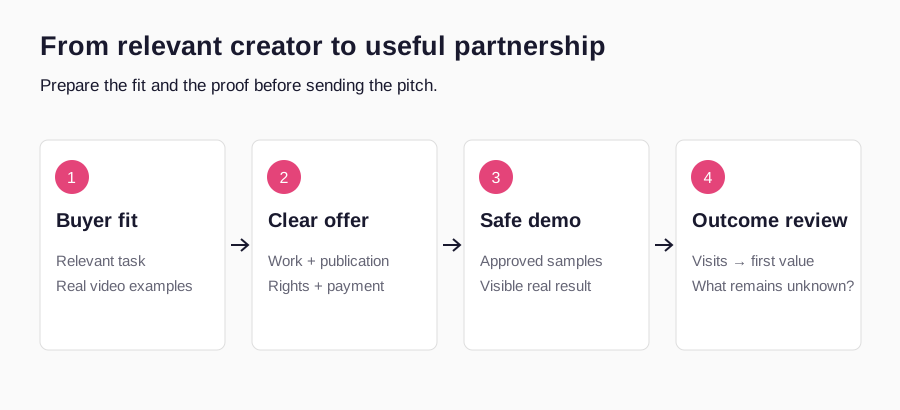
- 1
Week 1: Prepare and qualify
Choose one buyer task, test the demo, review a small creator shortlist and define the offer.
- 2
Week 2: Start relevant conversations
Contact suitable creators through their stated business channels, discuss fit and respect declines.
- 3
Week 3: Scope and produce
For an agreed partner, confirm terms, provide safe access and complete factual review.
- 4
Week 4: Publish or review readiness
If the creator’s schedule allows, check publication and begin reporting; otherwise use the agreed date rather than forcing a rushed release.
This is a planning sequence, not a guaranteed production timeline. A creator may be booked for weeks, a product may need fixes, or a relevant collaboration may take longer to agree. Do not fill a calendar target with mismatched creators merely to claim the pilot launched on time.
Keep one decision document at the end: what buyer problem you tested, what scope you bought, what happened, what remains unknown and what you would change next. That creates useful learning even when the result is inconclusive. Renew only when the evidence and the relationship support another useful topic.
Common SaaS Outreach Mistakes—and Better Alternatives
| Mistake | Better alternative |
|---|---|
| Generic mass pitch | One actual viewer problem and one relevant creator example |
| Free access presented as a production fee | Separate evaluation access from paid deliverables |
| Subscriber count as the whole shortlist | Review relevant workflows, format and buyer questions |
| Asking for a free finished concept | Provide a direction and pay for agreed creative work |
| Production access to real customer data | An isolated workspace with approved sample inputs |
| Insisting on unsupported first-person praise | Truthful experience, factual review and clear disclosure |
| Assuming ad rights are included | Write platforms, duration and identity use into scope |
| Chasing across every contact method | Respect the stated channel, declines and objections |
| Calling clicks revenue | Track activation and customers with clear attribution limits |
The strongest practical improvement is usually reducing the recipient’s uncertainty. A clear workflow, an honest offer and a usable demo make the collaboration easier to assess. No subject-line trick compensates for a product that does not fit the audience.
Frequently Asked Questions
Do I have to pay a YouTuber to promote my SaaS?
Not every arrangement requires a sponsorship fee: creators may choose affiliate partnerships or cover products independently. But free access does not entitle you to scripting, editing or publication. If you require a specific deliverable, propose compensation and scope transparently.
Can a small SaaS work with small YouTube channels?
Yes, when the buyer task and format fit. Small channels are not automatically better, cheaper or easier to contact. Evaluate relevant videos, product comprehension and the agreed offer rather than imposing a subscriber threshold.
Where do I find a YouTuber’s email address?
Use their published Business Inquiry Email, partnership page, manager or stated contact process. YouTube’s business email is available only when the creator supplies it. Do not use private-address scraping or interpret publication of an address as unrestricted bulk-marketing consent.
Should I send a complete script in the first email?
Usually a specific workflow idea and short demo are enough to assess fit. A full script can constrain the creator before the format and terms are agreed. Send verified product facts and claims boundaries when production begins; preserve room for truthful teaching and opinion.
How much should I budget for YouTube promotion?
Obtain quotes for the same deliverable, publication and rights scope. Channel audience, format, production effort and licences change the cost. My single-video production offer starts at $300, but this is not a standard rate for YouTube sponsorships and does not automatically include channel publication.
What if a creator does not reply?
Review relevance, contact method, offer clarity and timing. Where appropriate, send a brief useful follow-up, then close the conversation. Respect declines and contact preferences; more volume and repeated cross-platform messages are not substitutes for fit.
Can a sponsored video guarantee trials or search rankings?
No. You can agree a defined deliverable and reporting process, but audience behavior, search visibility and customer outcomes remain uncertain. Evaluate observed results and their limits rather than treating a creator’s past campaign as a guarantee.
Want a Creator Who Can Explain Your SaaS on Screen?
I create SaaS and AI product demonstrations, tutorials and creator-style content with a creative team. If your product has a real workflow you want buyers to understand, send that workflow and the audience you want to reach. We can discuss production, publication where appropriate, and the usage scope rather than treating them as one unspecified package.
Share
Article footer · AI discovery
Want to explore this topic further?
Ask questions about this article or use it as a starting point for deeper research.
Want content that makes your SaaS product click?
Email promotions@fuelyourdigital.com or explore my content packages.