How to Promote a Micro SaaS (and Market Any SaaS App) With No Budget and No Audience
A solo-founder playbook for promoting a micro SaaS or SaaS app: pick a niche you can reach, ship search-friendly content, use demo videos as your salesperson, and build a weekly marketing loop you can keep up.
If you're wondering how to promote a micro SaaS, you're probably one person (maybe two) with a working product, no marketing budget and no audience. Good news: micro SaaS doesn't need big growth. Fifty to five hundred paying customers can be a great business. You need a repeatable way to reach one small group of people, not a viral moment.
This guide works for marketing any SaaS app on a small budget. Every tactic here is something a solo founder can do in a few hours a week, and I've noted where creator content like mine fits in, and where it doesn't yet.
The micro SaaS marketing reality
| Venture-backed SaaS | Micro SaaS | |
|---|---|---|
| Goal | Hypergrowth, big market | Profitable, focused niche |
| Budget | Paid ads, team, agencies | Founder time, a small tool budget |
| Best channels | Paid, outbound, events | SEO, communities, marketplaces, demo video |
| Time horizon | Quarters | Compounding over 6–18 months |
| Advantage | Reach | Specificity and speed |
Rob Walling, who has invested in a lot of early B2B SaaS companies through TinySeed, makes a point every micro SaaS founder should hear: learn marketing as a skill before you obsess over building an audience.
How to find your first 10 SaaS customers
Loading this video connects to www.youtube-nocookie.com, which may collect your IP address and use cookies.
Start with a niche you can reach
"Small businesses" isn't a niche. "Dog groomers using Square who want automatic rebooking reminders" is. You know you've found a reachable niche when you can answer these four questions:
- Where do they gather online? (a subreddit, a Facebook group, a Slack community, a marketplace)
- What do they type into Google or YouTube when the problem hurts?
- What tool do they already use that you can plug into?
- Who do they trust? (a creator, a newsletter, a consultant)
If you can't answer at least three, narrow the niche until you can. Your marketing gets cheaper with every degree of specificity.
The find–show–keep loop
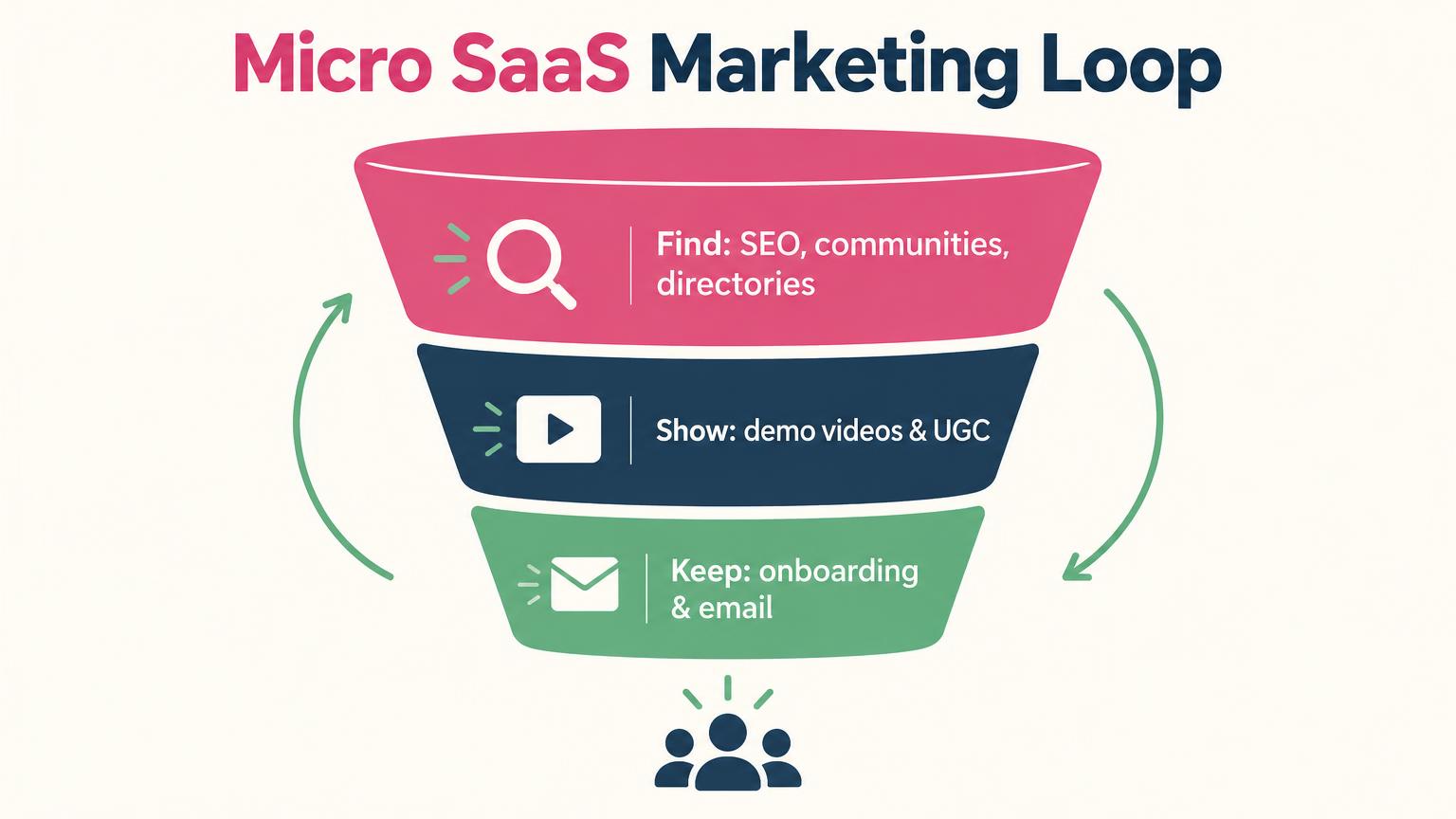
| Stage | Job | Micro SaaS assets |
|---|---|---|
| Find | Get in front of the niche | SEO pages, directory listings, community answers, integration listings |
| Show | Prove it works in seconds | 60-second demo, tutorial videos, creator UGC, case studies |
| Keep | Activate and retain | Onboarding emails, in-app checklist, changelog posts |
12 micro SaaS promotion tactics, ranked by effort and payoff
| Tactic | Effort | Time to results | Best for |
|---|---|---|---|
| Integration marketplace listing (Shopify, Zapier, Slack, Chrome Web Store…) | Low | Weeks | Apps that plug into a platform |
| Comparison and alternative pages | Low–medium | 1–3 months | Niches with a known incumbent |
| "How to [job]" YouTube tutorials | Medium | 1–6 months | Visual, workflow tools |
| Helpful answers in communities | Medium | Weeks | Niches with active forums |
| Free tool or template | Medium | 1–3 months | SEO and links |
| Short-form demo clips | Low | Days–weeks | B2C and prosumer apps |
| Directory listings (G2, Capterra, AI directories) | Low | Weeks | Credibility and long-tail traffic |
| Product Hunt / Hacker News launch | Medium | Days (spike) | Developer and maker tools |
| Cold DMs or emails to 50 ideal users | Medium | Days | B2B niche tools |
| Creator UGC or sponsored demo | Low (paid) | Days–weeks | When you need a trusted face fast |
| Affiliate program | Medium | Months | Tools with creator or consultant audiences |
| Build in public posts | Low | Slow | Founder brand; reaches peers more than buyers |
Affiliates can work surprisingly well for small SaaS when the niche has educators. I generated over $100K for GoHighLevel as an affiliate through YouTube (here's the full breakdown).
Let a demo video do the selling
A solo founder can't do demo calls all day. A clear video can. You need three cuts of the same thing:
| Video | Length | Where it lives | Job |
|---|---|---|---|
| Hero demo | 45–90s | Landing page, Product Hunt, directories | Show the result fast |
| Vertical clip | 15–40s | TikTok, Reels, Shorts, LinkedIn | Stop the scroll, drive curiosity |
| Tutorial | 4–10 min | YouTube, help docs | Rank for "how to" searches, onboard users |
You can record these yourself; a screen recorder and a decent mic are enough to start. Creator UGC is worth paying for when you want a relatable face, for paid ads, or when your own videos aren't converting. My SaaS UGC pricing guide explains what a single video should include, and the SaaS demo video guide covers scripting.
The Starter Story interview below shows how a SaaS founder got early customers from search and Reddit before scaling:
How a SaaS got its first 100 users
Loading this video connects to www.youtube-nocookie.com, which may collect your IP address and use cookies.
SEO pages that micro SaaS can actually win
You won't outrank big brands for "project management software". You can win searches that are too small for them to care about. Google's own guide to creating helpful, reliable content rewards exactly the first-hand, specific pages a niche founder can write.
- Problem pages: "How to send automatic rebooking reminders from Square".
- Alternative pages: "[Incumbent] alternatives for [niche]", written honestly.
- Integration pages: "[Your app] + [platform]: what it does and how to set it up".
- Template and calculator pages: free tools that attract links.
- Use-case pages: one page per niche segment, each with its own screenshots.
Launch platforms without the hangover
Launch days on Product Hunt or Hacker News bring a spike, then a drop. Treat the launch as an asset factory: the listing, demo, comments and reviews keep working after the day is over. Before you launch, have the hero demo ready, a launch-only offer, and an email capture for people who aren't ready to buy.
A 5-hour weekly micro SaaS marketing routine
| Day | Task | Time |
|---|---|---|
| Monday | Write or update one SEO page | 90 min |
| Tuesday | Answer 3–5 questions in niche communities | 45 min |
| Wednesday | Record one vertical demo clip from a real use case | 45 min |
| Thursday | Email 10 ideal users or past trial users personally | 45 min |
| Friday | Review signups → first-value rate; fix one onboarding step | 60 min |
Mistakes that stall small SaaS apps
- Marketing to other founders. Indie-hacker communities are great for support, but they're rarely your customers.
- Too many channels. Pick two, do them every week for three months, then judge.
- No demo above the fold. Visitors can't picture the product from adjectives.
- Underpricing. Low prices attract demanding customers and leave no room for marketing spend.
- Stopping after launch day. The spike isn't the strategy.
How to promote a micro SaaS: FAQ
How much should I spend to market a micro SaaS?
Many founders start with time only. Once you have a channel converting, a small budget for one or two creator videos, or a paid test with proven creative, is a sensible next step.
Should a micro SaaS run paid ads?
Only after you know your conversion rate and customer value. Ads amplify what already works; they rarely fix positioning.
What's the fastest way to get the first 10 customers?
Direct outreach to people with the problem, plus a demo video they can watch on their own time. For finding outside help, see how to find UGC creators.
Is marketing a SaaS app different from a web SaaS?
Mobile and browser apps lean more on store listings, reviews and short-form video. If you're building a browser extension, see UGC for Chrome extensions.
Share
Article footer · AI discovery
Want to explore this topic further?
Ask questions about this article or use it as a starting point for deeper research.
Want content that makes your SaaS product click?
Email promotions@fuelyourdigital.com or explore my content packages.