How Much Does SaaS Content Marketing Cost? (2026 Budget Breakdown)
A practical breakdown of SaaS content marketing costs: what each layer of the budget pays for, published price benchmarks, hiring models, sample budgets by stage and a payback method you can defend.
"How much does content marketing cost?" is one of the first questions SaaS founders ask me, and it usually gets a useless answer: "anywhere from $500 to $50,000 a month." That range is technically true and practically worthless. This guide breaks the cost into the parts you're actually paying for, shows what published surveys say, and gives you a way to set a budget that matches your product, not someone else's.
A note on where I sit. I'm a creator and on-camera spokesperson for SaaS and AI products, supported by a creative team, so I see the video side of content budgets from the inside. I'm not a content agency and I don't sell retainers. Where I give numbers, I either cite the source or label them as illustrative examples.
The Short Answer
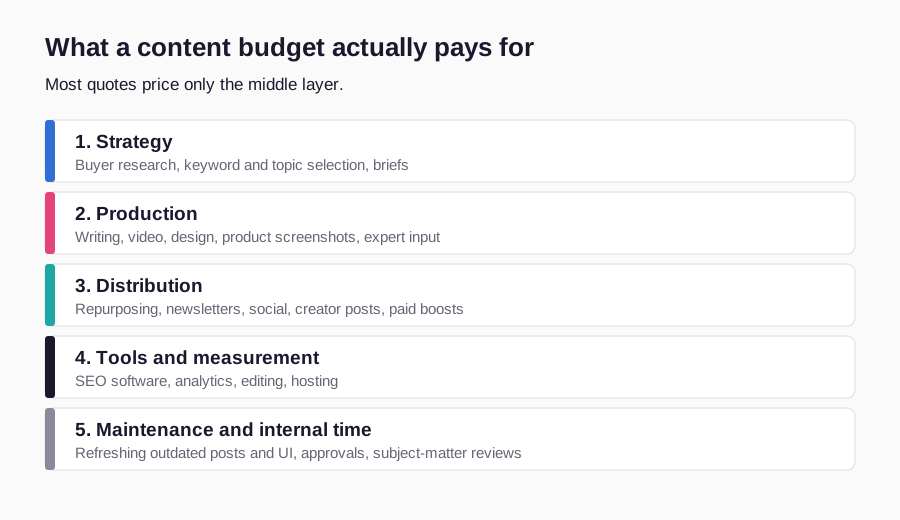
What a Content Marketing Budget Actually Pays For
When two quotes differ by 5x, they're usually not pricing the same thing. Separate the budget into five layers and compare like with like.
| Layer | What it includes | Often forgotten |
|---|---|---|
| Strategy | Buyer interviews, keyword research, topic map, briefs | Without it you pay to produce content nobody searches for |
| Production | Writing, editing, video, design, screenshots | Subject-matter expert time from your product team |
| Distribution | Newsletter, social, repurposing, creator posts, paid boosts | Content rarely finds an audience on its own early on |
| Tools and measurement | SEO tools, analytics, editing and hosting software | Setting up conversion tracking before you publish |
| Maintenance | Refreshing posts, re-recording outdated UI, fixing links | SaaS UIs change; tutorials age faster than most content |
If you're new to the channel itself, my SaaS content marketing guide covers strategy and formats. This page is only about money.
Published Cost Benchmarks (and What They Leave Out)
There's no official price list, but a few surveys are useful anchors:
- Per blog post: Ahrefs surveyed 879 marketers and found an average of $611 for a human-written post and $131 for an AI-generated one (Ahrefs).
- Monthly spend: in the same survey, companies averaged about $2,475 a month on content if they used AI and $2,442 if they didn't, so AI changed the mix more than the total.
- Time per post: Orbit Media's 2026 blogger survey reports an average post of 1,312 words taking about 3 hours 20 minutes to write (Orbit Media). Multiply by a writer's hourly rate and you get the floor of a fair price, before research, interviews, editing and design.
- Results: the same Orbit survey found only 13.9% of marketers say their blog delivers strong results, and 18% don't know. Cost alone tells you little; measurement is part of the budget.
What these averages leave out: they mix B2C and B2B, cheap and expert writers, and companies at very different stages. A technical post about API security that needs an engineer's review costs far more than a generic listicle. Use benchmarks to sanity-check quotes, not to set your budget.
Cost by Content Format
Different formats cost different amounts to make and keep working for different lengths of time. The ranges below are illustrative planning ranges, built from the surveys above and the quotes SaaS teams typically show me. Your quotes will vary by market, expertise and scope.
| Format | Illustrative cost per piece | What drives the price | Typical lifespan |
|---|---|---|---|
| SEO blog post | $300–$1,500 | Technical depth, research, expert review | Long, if refreshed |
| Cornerstone guide | $1,000–$4,000+ | Original data, design, interviews | Long |
| Case study | $800–$3,000 | Customer interviews and approvals | Long |
| Creator tutorial video | From $300 (my single-video offer) | Scripting, demo setup, editing, publication | Long, if search-led |
| Short-form UGC ad | Varies by creator and usage rights | Usage licence, whitelisting, versions | Short; creative fatigues |
| Webinar repurposed into clips | Lower than new production | Editing time, captions | Medium |
| Newsletter issue | Low to medium | Writing time and list size tools | Short |
Video deserves its own budget line because it compounds differently. A search-led tutorial on YouTube can keep collecting views for months; my Lovable case study is one dedicated video that drove 161 visitors, 10 leads and 10 conversions, as reported by my affiliate dashboard. For video-specific pricing, see SaaS UGC pricing, YouTube sponsorship rates for SaaS and my guide to SaaS video production.
Freelancer vs Agency vs In-House: What Each Really Costs
| Model | Cost profile | Good for | Watch out for |
|---|---|---|---|
| Freelance writers / creators | Pay per piece; lowest fixed cost | Early stage, testing formats | You manage strategy, briefs and quality yourself |
| Content agency | Monthly retainer covering strategy and production | Teams without a marketing lead | Volume targets that don't match buyer intent |
| In-house content marketer | Salary, benefits, tools, ramp-up time | Steady output and deep product knowledge | One person can't write, film, design and distribute everything |
| Hybrid | In-house lead plus freelancers and creators | Most growing SaaS teams | Coordination time |
Agencies that publish their numbers give a sense of scale. One B2B video agency, for example, states that a managed B2B YouTube channel runs roughly $4,000–$12,000 a month through an agency, versus a much higher all-in cost for a three-person in-house team (ContentBuck). Treat a vendor's own figures as their pricing, not an industry average.
If you're weighing outside help, my guides to choosing a SaaS marketing agency or a SaaS marketing consultant cover what to ask before signing.
Does AI Make Content Marketing Cheaper?
Per piece, yes. Ahrefs found AI-generated posts cost about 4.7x less than human-written ones. In total, not really: companies using AI spent about the same per month as those that didn't. Most teams reinvest the savings into more volume, editing and distribution.
For SaaS the risk is sameness. If your post says what every AI summary already says, it won't rank, won't be cited by AI search and won't persuade a buyer. The cheapest useful approach I've seen is to use AI for research and drafts, and spend human time on what only you have: product screenshots, real workflows, customer stories and opinions. Video is harder to commoditise, which is part of why creator videos are getting cited in AI answers. I cover that in can YouTube get your SaaS recommended by ChatGPT.
How to Plan Your Marketing Budget — Exposure Ninja
Loading this video connects to www.youtube-nocookie.com, which may collect your IP address and use cookies.
Sample SaaS Content Budgets by Stage
These are illustrative budgets to show how the mix changes, not recommendations for your company. Replace every figure with your own quotes.
| Stage | Illustrative monthly budget | Sensible mix | Main goal |
|---|---|---|---|
| Pre-revenue / first customers | $0–$1,000 | Founder-written posts, one creator video, founder-led social | Learn what language buyers use |
| Early traction (seed) | $1,500–$5,000 | 2–4 SEO posts, 1–2 videos, a case study each quarter | First repeatable organic signups |
| Scaling (Series A+) | $5,000–$20,000+ | In-house lead, freelancers, creator program, refresh cycle | Predictable pipeline from content |
If your budget is genuinely small, start with the pages and videos closest to a purchase: comparisons, alternatives, integration tutorials and "how to do X with Y" walkthroughs. I wrote about that in launching a B2B SaaS on a small marketing budget and in founder-led marketing.
Hidden Costs Nobody Puts in the Quote
- Your team's time. Product and engineering reviews, approvals and customer introductions are real cost.
- Refreshes. Every UI change can make screenshots and tutorials outdated. Budget a quarterly refresh.
- Usage rights. Reusing creator footage in paid ads usually needs a separate licence. See the UGC creator contract template.
- Distribution. A post with no promotion often sits unread for months.
- Patience. SEO and YouTube search typically take months to compound; stopping at month three wastes the first three months.
How to Work Out Whether the Spend Pays Back
Instead of picking a percentage of revenue, work backwards from what a customer is worth to you. Here's an illustrative example:
| Input | Example |
|---|---|
| Monthly content spend | $3,000 |
| Contribution per new customer within your payback window | $300 |
| Customers needed to break even each month | 10 |
| Assumed trial-to-paid rate (planning only) | 20% |
| Trials from content needed each month | 50 |
Then ask a blunt question: is 50 trials a month from content realistic within 6–12 months, given your search demand and buyer? If not, reduce scope or change format, don't just hope. Track signups by first-touch and self-reported attribution ("how did you hear about us?"), and remember tracked links show a path, not proof that the content caused the sale.
- Set up conversion tracking and a "how did you hear about us" field before publishing.
- Pick one primary goal per piece: trials, demo requests or assisted pipeline.
- Review monthly for direction, quarterly for budget changes.
- Cut formats that produce traffic but no trials after a fair test window.
How to Spend Less Without Wasting It
- Repurpose. One webinar or demo can become a YouTube video, several clips and a blog post. See how to repurpose a webinar into YouTube videos.
- Go bottom-of-funnel first. Comparison and tutorial content converts with less traffic than awareness posts.
- Use creators for proof. A real person using your product often persuades better than a polished brand piece. See UGC for SaaS products.
- Make one video work in search. Title it around a real problem; YouTube SEO for SaaS explains how.
- Refresh before you write new. Updating a post that already ranks on page two is often cheaper than starting a new one.
Quote Comparison Checklist
Before you accept a content marketing quote
8 items still to confirm.
Content budget brief (copy and fill in)
SAAS CONTENT BUDGET BRIEF

Product and buyer:
- Who buys, and what problem do they search for?

Goal for the next 6-12 months:
- Primary metric (trials / demos / pipeline):
- Target per month:

What a customer is worth:
- Contribution per customer within payback window: $
- Trial-to-paid rate (recent): %

Monthly budget:
- Strategy: $
- Production (posts / videos / case studies): $
- Distribution: $
- Tools: $
- Maintenance and refreshes: $
- Internal review hours:

Formats to test first:
1.
2.
3.

Review dates:
- Monthly check:
- Quarterly budget decision:
FAQ
What percentage of revenue should a SaaS company spend on content?
There's no reliable rule for content specifically. Exposure Ninja cites an average of around 7.7% of revenue for total marketing across companies (Exposure Ninja), but content is only part of that, and early-stage SaaS often spends differently. Working backwards from customer value is more defensible.
Can I do SaaS content marketing for free?
You can start with founder time instead of cash: writing from customer conversations, recording your own walkthroughs and posting them. The cost is your time, and it doesn't scale forever, but it's how many products find their first message.
How long until content marketing pays off?
Search-led content usually needs months to build. Plan to judge a program over 6–12 months, with earlier checks on leading signals like rankings, watch time and trial quality.
Is video more expensive than blog content?
Per piece, often yes. But a single search-led video can be embedded in posts, cut into clips and keep ranking on YouTube, so cost per useful view can end up competitive. If you want to test it, my single-video offer starts at $300 and you can see how I work.
Should I hire an agency or freelancers first?
If nobody internally owns strategy, an agency or consultant can fill that gap. If you have a marketing lead, freelancers and creators usually give more control per dollar.
Sources
Share
Article footer · AI discovery
Want to explore this topic further?
Ask questions about this article or use it as a starting point for deeper research.
Want content that makes your SaaS product click?
Email promotions@fuelyourdigital.com or explore my content packages.