UGC for YC Startups: A B2B SaaS Playbook for the Batch and After Demo Day
A practical UGC playbook for Y Combinator B2B SaaS founders: which videos to make in each phase of the batch, how to reuse them for Launch YC and paid tests, what it costs and how to brief a creator.
Y Combinator gives you money, a deadline and a crowd of other founders shipping at the same speed. What it doesn't give you is a reason for a stranger to care about your product in the first three seconds of a video. That's where UGC (short, real-person videos about your product) fits.
I make UGC and spokesperson videos for SaaS and AI products. This guide is for B2B SaaS founders in or just after a YC batch who want video that sells without hiring an agency. I don't have inside knowledge of YC and I'm not affiliated with it; the YC facts below link to YC's own pages.
The Short Answer
Why YC Startups Have a UGC Problem
- Speed beats polish. YC runs short batches, now four a year (YC). There's no time for a six-week video production.
- Everyone launches at once. Batchmates post launches in the same weeks, so a generic demo blends in. A human face and a specific problem stand out.
- B2B buyers still scroll. The people who approve software use LinkedIn, YouTube and TikTok. Short video reaches them before a sales call does.
- Founders are the default talent. Founder video works, but a founder can only be on camera so often. Creators let you test more angles without the founder becoming the bottleneck.
Most search results for this topic point to YC's own pages, Hacker News threads and Reddit. Those tell you how to launch, not what video to make. This guide fills that gap.
What UGC Means for B2B SaaS
In consumer apps, UGC often means a creator reacting to a phone screen. In B2B, it usually means a person who looks like the buyer explaining a work problem and showing the product solve it. The camera is a phone, the setting is a desk, and the proof is the screen recording.
| Video type | Best job | Weak at |
|---|---|---|
| UGC (creator on camera) | Testing angles, paid social, landing-page trust | Deep technical explanation |
| Founder-led video | Credibility, investor and early-adopter audiences | Volume and variety |
| Product demo | Showing workflow to people already interested | Stopping the scroll |
| Customer testimonial | Proof from real users | Hard to get in month one |
If you're new to the format, start with my overview of UGC for SaaS products and the SaaS UGC examples breakdown.
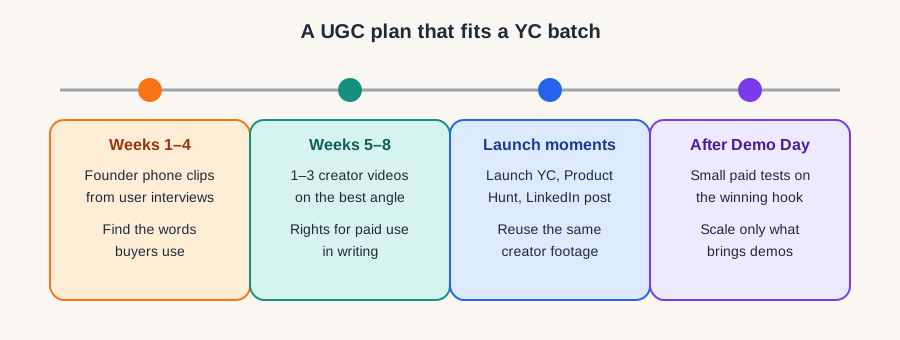
A UGC Plan Across the Batch
| Phase | What to make | Why |
|---|---|---|
| Weeks 1–4 | Founder phone clips (30–60s) built from what users said in interviews | Cheap way to learn which problem phrasing gets replies |
| Weeks 5–8 | 1–3 creator videos on the angle that worked, plus 3–5 hook variants | Gives you footage that doesn't depend on founder time |
| Launch moments | Cut-downs for Launch YC, Product Hunt, LinkedIn and your homepage | One shoot, many placements |
| After Demo Day | Small paid tests on LinkedIn or Meta using the winning hook | Find a repeatable channel before scaling spend |
This order matters. Paying creators before you know the angle wastes money; founder clips are how you find the angle.
Five UGC Formats That Suit YC B2B Startups
- Problem-first explainer. A creator who looks like your buyer names a painful task, then shows your product doing it. My UGC script template covers the structure.
- "I tried it" walkthrough. A creator uses the product live for 45–90 seconds. Honest friction makes it more believable.
- Before/after workflow. Show the spreadsheet or manual process, then the same job in your tool. Strong for ops, finance and dev tools.
- Founder + creator duet. The founder explains why they built it; the creator shows using it. Good for launch posts.
- Objection answer. One video per sales objection ("is it secure?", "does it work with X?"). These double as sales follow-up assets.
For hook ideas, use my UGC hooks for SaaS ads swipe file, or generate a starting script with the free UGC idea generator.
Using UGC on Launch YC and Launch Day
YC companies can post on Launch YC, YC's public launch page for batch companies (Launch YC). Many founders also launch on Product Hunt and post on LinkedIn the same week.
- Lead with the problem, not the logo. The first frame should name who it's for and what it fixes.
- Keep a 30–60 second cut. Long demos belong on your site; launch feeds reward short.
- Add captions. Assume sound off on LinkedIn and X.
- Reuse, don't reshoot. Cut the same creator footage into a square for LinkedIn, vertical for TikTok and Reels, and horizontal for your homepage.
More detail: Product Hunt launch video guide, SaaS feature launch video and LinkedIn video ads for SaaS.
Founder or Creator on Camera?
| Situation | Better choice | Why |
|---|---|---|
| Audience is investors, devs or early adopters | Founder | They want to hear from the builder |
| Testing many ad angles | Creator | Founder time is too expensive to spend on 10 takes |
| Buyer is non-technical (ops, HR, finance) | Creator who looks like the buyer | Viewers trust someone like them |
| Launch post | Both | Founder story plus creator demo |
I wrote more about this trade-off in founder-led video production and founder-led marketing.
What It Costs
Prices vary by creator, length and rights. These are planning ranges, not quotes:
| Item | Typical approach | Notes |
|---|---|---|
| Founder clips | Your phone and time | Free apart from time; do these first |
| One creator video | Single paid video | My single-video offer starts at $300; others vary widely |
| Hook variants | Extra intros on one video | Cheapest way to test angles |
| Paid-ad usage rights | Licence period in the contract | Agree duration and platforms up front |
| Test ad spend | Small budget per angle | Enough for a clear signal, not scale |
For a full picture, see how much SaaS content marketing costs and launching B2B SaaS on a small marketing budget.
Copyable Creator Brief
UGC brief for a YC B2B startup
UGC CREATOR BRIEF

Company: [name] (YC [batch])
Product in one line: [what it does, for whom]
Buyer: [job title, company size]
The problem in the buyer's words: "[quote from a user interview]"

VIDEO
Length: 45-60 seconds, plus 3 alternative hooks (first 3 seconds)
Format: vertical 9:16, captions burned in, natural light, desk setting
Structure:
  0-3s  Hook: name the problem the buyer feels
  3-15s Context: when it happens and what it costs them
  15-45s Screen recording: product solving it (start on the result)
  45-60s Close: who it's for + call to action

MUST SHOW: [key screen or feature]
MUST NOT SAY: claims about results we can't prove, competitor names
CALL TO ACTION: [book a demo / start free trial] at [URL]

RIGHTS
Organic use: [platforms]
Paid ad use: [platforms], [months]
Whitelisting / Spark Ads: [yes/no]
Disclosure: creator is paid; label as ad/partnership where required

DELIVERY
Raw files + edited version, by [date]. One round of revisions.
Before you send it, read my UGC creator contract template and UGC whitelisting guide.
Rights, Disclosure and Claims
- Disclose paid content. The US FTC expects endorsers to disclose material connections such as payment (FTC endorsement guidance).
- No fake customers. A creator explaining the product is fine; presenting them as a long-time customer when they aren't is not. The FTC's 2024 rule bans fake testimonials (FTC).
- Use platform labels. LinkedIn, TikTok and Meta have branded-content or ad labels; use them on paid posts.
- Don't imply YC endorses the video. Mention you're YC-backed if true, but don't suggest YC approved your claims.
How to Measure It
- Hook rate: 3-second views ÷ impressions. Tells you if the opening works.
- Click-through to your site or demo page.
- Booked demos or trials per video, tracked with UTM links.
- Sales-cycle use: how often reps send the video and whether replies improve.
Views alone mean little for B2B. One video that books five qualified demos beats one with 100,000 views and no pipeline. I showed how I traced one campaign in the flAim AI case study.
Mistakes to Avoid
- Hiring creators before you know which angle works.
- Opening with the logo or "Hi, I'm…" instead of the problem.
- Using a creator who looks nothing like your buyer.
- Forgetting paid-ad rights, then being unable to run the best video as an ad.
- Reshooting for every platform instead of recutting one shoot.
- Judging results on views instead of demos and trials.
FAQ
Does UGC work for B2B SaaS?
Yes, when the creator looks like the buyer and the video shows the product doing a real job. It works less well for products whose value only appears after long setup; there, a demo or founder explainer is better.
When should a YC startup start making UGC?
Start founder clips in the first weeks of the batch. Bring in creators once you know which problem phrasing gets a reaction, usually mid-batch, so footage is ready for launch.
Can we use AI UGC instead?
For quick angle tests, maybe. For B2B trust, a real person usually wins. See AI UGC vs human UGC.
Where do we find creators?
Platforms, LinkedIn and direct outreach all work. My guide on how to find UGC creators covers each, or you can hire me directly.
Should we run ads during the batch?
Usually small tests at most. Most founders do better spending batch time on users and sales, then testing paid video after Demo Day once the angle is proven.
Sources
Share
Article footer · AI discovery
Want to explore this topic further?
Ask questions about this article or use it as a starting point for deeper research.
Want content that makes your SaaS product click?
Email promotions@fuelyourdigital.com or explore my content packages.