Podcast-Style UGC Ads: A SaaS Playbook With Scripts
A practical guide to podcast-style UGC ads for SaaS: conversational scripts, filming setups, visible product proof, honest disclosure, usage rights and a copyable production brief.
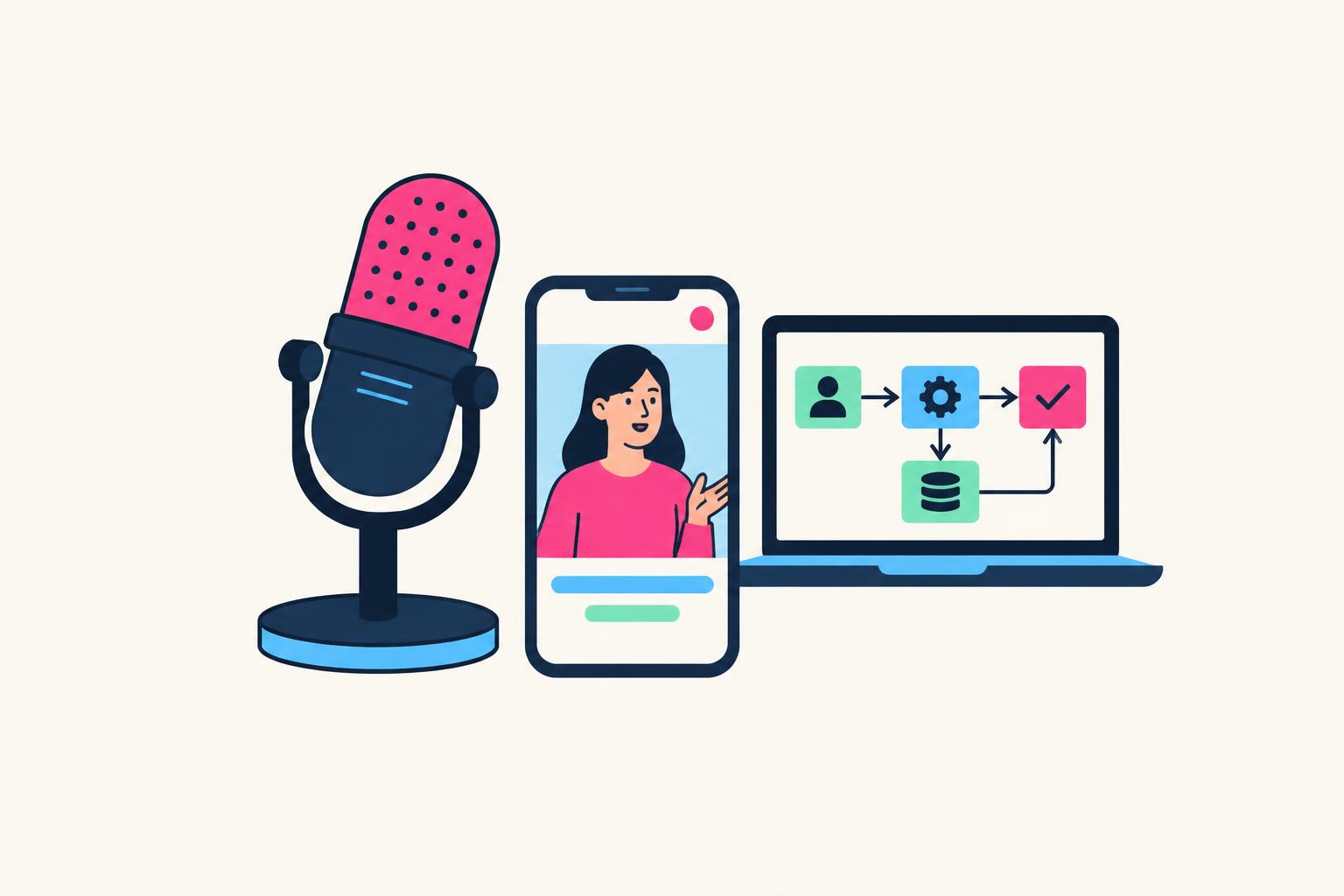
A microphone does not turn a sales script into a conversation. A good podcast-style UGC ad sounds like a useful answer to a question your buyer already has—and then shows enough of the product to make that answer credible. For SaaS, that second part matters: a believable speaker cannot replace a visible workflow.
I create UGC and spokesperson videos for SaaS and AI products, supported by a creative team. This guide explains how I would brief, script, shoot and test the podcast-style format. The scripts below are original illustrative examples, not excerpts from client ads or claims of proven performance. The production timings are starting points, not platform rules.
What Is a Podcast-Style UGC Ad?
A podcast-style UGC ad is a creator-led promotional video filmed and edited to resemble a conversational podcast clip. Common cues include a desk microphone, a slightly off-camera eyeline, a question-and-answer structure and readable captions. It can feature one speaker answering an off-camera question or two people having a short exchange. Usually the brand commissions the footage for its own social channels or paid ads; buying the video does not automatically buy access to a podcast audience.
In this context, “UGC” is industry shorthand for creator-style content. Commissioned spokesperson footage is not necessarily unsolicited user-generated content, a real customer testimonial or an excerpt from an independent show. Be honest about which of those you have. The format should make the explanation easier to follow, not manufacture independent approval.
Related foundations: UGC for SaaS products SaaS UGC examples
| Format | What you are buying | Important distinction |
|---|---|---|
| Podcast-style creator ad | Purpose-shot footage with a podcast visual language | No existing show or audience is required |
| Real podcast excerpt used as an ad | An authorised cut from an actual episode | Confirm episode, recording, speaker and paid-use permissions |
| Host-read sponsorship | A paid placement read by an actual podcast host | Distribution and sponsorship terms are part of the purchase |
| Audio podcast ad | An audio placement delivered within listening inventory | No visual product proof or caption layer |
When the Format Fits SaaS—and When It Does Not
The strongest starting point is a buyer question, not “we need a podcast ad.” A meeting-notes tool can answer what happens after the transcript. A reporting tool can explain how a team checks the source behind a summary. A scheduling product can address handoffs between teams. These questions give the speaker something useful to unpack, and each answer can lead into a visible product action.
Treat the conversational setup as a hypothesis about attention and comprehension. It may help a creator deliver an objection naturally, but there is no reliable universal conversion lift attached to putting a microphone in frame. Your existing direct-to-camera or screen-first creative is the benchmark. Compare qualified trials, demos and acquisition cost, not how expensive the set looks.
- Good candidate: the buyer needs one misconception corrected before the product makes sense.
- Good candidate: a clear before-and-after workflow can be shown with approved demonstration data.
- Good candidate: the audience recognises the presenter’s professional context without invented credentials.
- Weak candidate: the main value is visual and obvious, so a long conversation delays the proof.
- Weak candidate: the claim needs complex security, medical, legal or financial caveats that a short clip cannot communicate accurately.
- Weak candidate: success depends on pretending an actor is an independent expert or satisfied customer.
For another creative direction, compare this with silent UGC UGC for B2B SaaS
Three Podcast-Style Formats Worth Testing
1. Solo Answer to an Off-Camera Question
One creator answers a short prompt from behind the camera. Record the interviewer’s actual question, even if the finished edit begins with the answer. This is the simplest production option and usually easiest to crop vertically. Start with the answer’s sharpest useful line, not a fake “welcome back to the show.” Leave the microphone visible without letting it hide the speaker’s mouth.
2. Two-Person Objection and Demonstration
The interviewer voices the objection; the second speaker explains and demonstrates. Give the interviewer a real job: ask what the product changes, what still requires review or who should not use it. Avoid an exchange where one actor simply agrees with every product claim. Two people add scheduling, releases and editing complexity, so the extra voice should improve clarity, not just decorate the shot.
3. A Licensed Clip From a Real Interview
A genuine podcast clip can become an ad if the rights permit it. Keep the original meaning and include enough context to avoid turning a nuanced discussion into a blanket endorsement. Permission to appear on a show is not necessarily permission for either party to run paid ads. Get written approval for the specific cut, platforms and duration; do not lift clips just because the episode is public.
My two podcast appearance recaps are examples of actual interviews, not evidence that a staged ad has an independent host: UGC Clarity interview Vova Even interview
A 35-Second Podcast-Style UGC Ad Structure
Use this as a draft editing map. Thirty-five seconds is not a required length, and a shorter accurate explanation beats a longer scripted exchange. Time the read with the actual creator. If it only fits when spoken unnaturally fast, remove a secondary feature rather than speeding up every sentence.
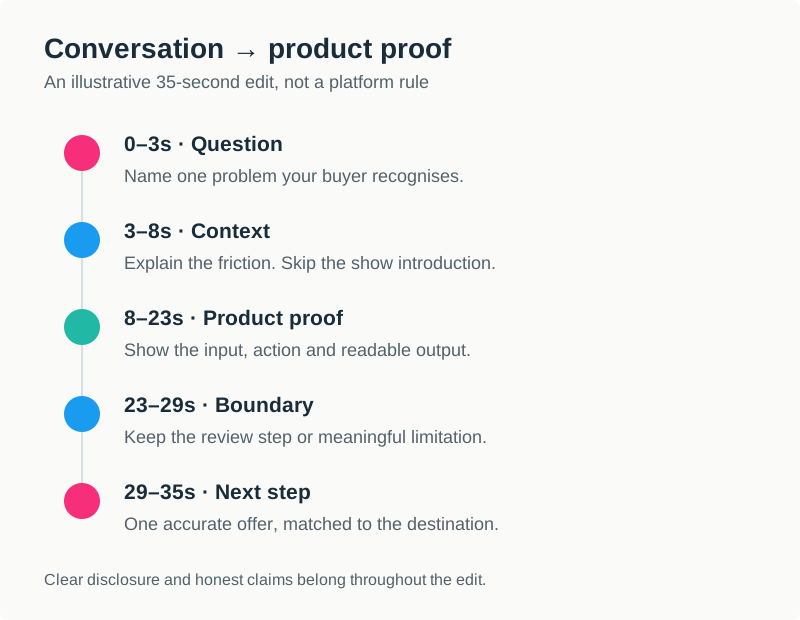
| Time | Communication job | Picture and sound |
|---|---|---|
| 0–3s | Question or useful answer | Speaker plus a clear buyer-specific caption; appropriate ad disclosure |
| 3–8s | Explain the friction | One concrete situation, not a list of complaints |
| 8–23s | Demonstrate the answer | Show input, action and output using an approved product recording |
| 23–29s | Address the boundary | Explain review, setup, eligibility or a meaningful limitation |
| 29–35s | Offer one next step | Match the CTA to the destination and the viewer’s readiness |
The spoken question can overlap the first product shot. The limitation can play over the finished output. These are communication jobs, not five mandatory camera cuts. If an interface needs more time to understand, hold it longer and cut an ornamental reaction. Show enough context that a close-up still makes sense, but do not shrink an entire desktop dashboard into a phone-sized frame.
For broader timing guidance and more script patterns: How to structure a UGC ad for SaaS UGC script template for SaaS ads
Original Podcast-Style UGC Scripts for SaaS
These fictional product examples are starting points. Replace each feature and offer with what your product actually does, then verify the screen recording and claims. They intentionally avoid revenue promises, fake customer histories and invented time-saving statistics. A spokesperson can describe a capability; personal experience must genuinely belong to the person delivering it.
| Product type | Opening question | Answer and proof | Boundary and CTA |
|---|---|---|---|
| Meeting follow-up tool | “What is missing from a meeting transcript?” | “A transcript records what was said. Here is how this tool turns that into a draft follow-up.” Show a sample meeting and draft tasks. | “Check the owners and deadlines before sending. Try it with a sample meeting.” |
| Reporting dashboard | “What if the AI summary gets a number wrong?” | “The number needs a source you can inspect.” Show a summary linked to its underlying approved data. | “The team still reviews the interpretation. Explore the reporting demo.” |
| Scheduling product | “Why is booking one meeting still a team project?” | “The handoff is the part to look at.” Show availability rules and the resulting booking page. | “Set the routing rules for your team first. See the setup walkthrough.” |
Copyable podcast-style SaaS script
PODCAST-STYLE SAAS AD — ILLUSTRATIVE SCRIPT
Product: fictional meeting follow-up tool
Adapt and verify every feature before filming.

INTERVIEWER: What is missing from a meeting transcript?
CREATOR: A transcript tells you what was said. The next step is deciding what to do with it.
[Show a labelled sample meeting.]
CREATOR: Here, the tool drafts a follow-up with tasks and owners from those notes.
[Show the input, generate the draft, then hold the result.]
INTERVIEWER: Would you send it straight away?
CREATOR: No. Check the owners and deadlines first. The draft is a starting point.
[Show the review step.]
CREATOR: Try the demo with a sample meeting and see whether that workflow fits your team.

PRODUCTION NOTES
Time the actual read; do not promise an exact runtime.
Include clear paid-ad disclosure appropriate to placement and jurisdiction.
Use approved sample data and an offer that exists on the destination page.
Do not describe the actor as a customer unless that is true.
Notice that the interviewer asks a question with consequences. “Would you send it straight away?” creates space for a meaningful caveat and a review step. That is more useful than inserting “wow” after a feature list. A good exchange also survives audio-only listening: the words should explain what the viewer is seeing without narrating every cursor movement.
How to Film Without Overproducing the Conversation
Start with an intelligible recording, not a studio booking. Use a quiet room, stable camera support and soft light on the speaker. Record a short test and listen on headphones for hum, clipping, desk knocks and room echo. If the visible microphone is only a prop, make sure a separate microphone actually captures clean speech. A dramatic podcast set with poor audio undermines the format.
For two people, capture each voice separately where practical, then sync the tracks with a clap or another clear marker. Keep camera positions on a consistent side of the conversation so cuts do not reverse where the speakers appear to be looking. A second camera is optional. A clean single angle plus a useful product recording is often enough for the first test.
- Eyeline: let the speaker address the real interviewer just beside the lens; do not have them stare at an empty chair while claiming there is a host.
- Framing: leave space for captions and avoid a microphone crossing the mouth or covering the product overlay.
- Delivery: use short prompts, record several honest takes and preserve natural pauses; do not request a fabricated emotional reaction.
- Screen footage: hide notifications and real customer data; capture the current approved product flow with readable sample content.
- Edit: cut repeated setup, not caveats that change the meaning; keep reactions relevant to the actual exchange.
- Captions: correct product names, numbers and terminology manually; test the result muted at normal phone playback size.
Deliver a vertical version when the placement calls for it, but check the specific platform’s current specifications and preview tools before exporting. Square and landscape placements may need a different composition rather than a blind crop. Keep essential captions, disclosures and interface controls clear of platform overlays. Avoid presenting a single pixel-based safe-zone rule as universal across every app.
YouTube documents vertical short-form publishing in its own guidance: YouTube Shorts creation guidance
A Public B2B Podcast-Advertising Reference
The video below is published by MultiVision Digital as “B2B podcast advertising video.” It is a podcast-adjacent B2B reference, not a verified SaaS UGC campaign or evidence that this creative format converts. Use it as a starting point for your own viewing, not as a source of claims about its advertiser, production budget or results. No scene-by-scene performance breakdown is asserted here.
B2B podcast advertising video — MultiVision Digital
Loading this video connects to www.youtube-nocookie.com, which may collect your IP address and use cookies.
Watch directly: MultiVision Digital’s B2B podcast advertising video
Disclosure, Testimonials and the Fake-Podcast Problem
Borrow the conversational language of a podcast, not the authority of a show that does not exist. Do not invent an episode number, independent interviewer, media logo or “as featured on” badge. Do not imply the product was spontaneously recommended by an unrelated expert when the brand scripted and paid for the segment. A real creator reading a script is still paid promotional content.
FTC guidance says material connections such as payment or free services should be disclosed when endorsing a brand. It also says endorsements must reflect honest opinions and cannot make claims the marketer could not legally make. A platform’s built-in label does not remove the need to consider whether the disclosure is clear in the actual video and context. For a spoken promotional endorsement, consider both visible and spoken disclosure rather than assuming the caption below the post will do the job.
Primary US guidance: FTC Disclosures 101 FTC Endorsement Guides Q&A
Keep a claims sheet before filming: approved feature wording, evidence for any numerical result, the demo account and the product version. If the creator genuinely used the tool, let them describe that actual experience without exaggeration. If not, use factual product explanation rather than “this saved my team ten hours.” Labelling an ad does not make a false testimonial acceptable. FTC rules also address deceptive consumer reviews and testimonials; their application depends on the facts.
For review and permission planning: FTC testimonials rule Q&A Video testimonial release form UGC creator contract template
An AI-generated podcaster adds identity and consent questions. Do not clone a real host’s voice or likeness without permission, invent a customer who never used the product or give a synthetic speaker fictional qualifications. Review current platform requirements for synthetic-media labelling. These are risk-reduction principles, not legal advice; EU and other local advertising, personality-rights and privacy requirements may differ from US guidance.
Downloadable Podcast-Style UGC Creator Brief
Brief the communication problem and the proof first. Describe the podcast look second. Send the creator a sample login or approved demo recording, a claims sheet and a clear explanation of who is speaking. Ask for a sample of conversational delivery rather than choosing solely on studio equipment. Agree on whether the interviewer is visible, audible or removed from the final cut.
Podcast-style UGC production brief
PODCAST-STYLE UGC AD BRIEF

BRAND AND BUYER
Product: [name]
Buyer and situation: [specific role/problem]
Goal: [qualified trial / booked demo / other]
Destination and offer: [URL + accurate next step]

FORMAT
[solo answer / two-person exchange / licensed real episode]
Speaker role: [paid spokesperson / founder / actual customer]
Existing show affiliation, if any: [verified name, or none]
Do not invent a podcast identity or customer experience.

MESSAGE AND PROOF
Opening buyer question: [question]
One approved answer: [answer]
Product input, action and output to show: [workflow]
Required limitation/review step: [boundary]
Claims evidence and demo account: [approved materials]
Disclosure wording: [review for audience, placement and jurisdiction]

DELIVERABLES
Target runtime: [draft, timed with actual read]
Aspect ratios and placements: [list]
Hook variants: [number]
Captioned + clean versions: [yes/no]
Separate audio, raw takes and screen recordings: [list]
Revision rounds and deadline: [terms]

RIGHTS AND APPROVAL
Paid and organic platforms: [list]
Usage duration and territory: [terms]
Creator-account ad permission: [separate permission if needed]
Speaker, host, recording and music permissions: [responsible person]
AI likeness/voice or synthetic-media use: [permission or prohibited]
Claim, caption, disclosure and final-cut approval: [owner]
More hiring and rights guidance: Hire a UGC creator UGC whitelisting for SaaS ads
What Drives the Cost of Podcast-Style UGC Ads?
Ask for an itemised scope rather than a price for “one podcast ad.” A single creator recording at home, a two-person shoot and a licensed excerpt from an established show are different purchases. The quote should separate concept and script work, talent, recording, editing, additional hooks, raw footage, revision rounds and usage rights. Media spend is a separate cost from producing the creative.
Two-camera capture, a second performer, location hire, custom product capture and multiple formats can increase the work. Conversely, a reusable creator setup and a clean supplied screen recording may reduce it. Do not assume a studio look means the clip includes paid-use rights or distribution. Ask whether creator-account advertising permission, exclusivity, renewal and localisation are separate charges.
Use these guides to compare scopes, not treat one advertised fee as a universal market rate: SaaS UGC pricing How much SaaS content marketing costs
How to Test the Format Without Confusing the Results
Start by comparing one podcast-style execution with your current best-performing format for the same product, buyer and offer. Keep the landing page and conversion definition consistent. Then test alternative opening questions against the same body edit. If you change the presenter, promise, audience, destination and format at once, a different result will not tell you which change mattered.
| Signal | What to investigate | What it does not prove |
|---|---|---|
| Early-view retention | Does the first question qualify the intended buyer? | That retained viewers are likely buyers |
| Click-through and page engagement | Does the answer create interest consistent with the page? | That clicks will activate or become customers |
| Qualified trials or demos | Do visitors take the intended, meaningful action? | A causal format lift without a suitable comparison |
| Cost per qualified action | Is the creative economically useful under this campaign setup? | That the same result will repeat across audiences |
| Activation and pipeline follow-up | Does interest turn into product use or a sales opportunity? | That the video alone caused later revenue |
Use consistent attribution windows and UTMs where appropriate, and record which cut each campaign used. B2B volume can be small and sales cycles long: a handful of cheap clicks is not enough to declare a winner. There is no universal spend or sample threshold that guarantees a valid conclusion. Set decision rules based on your baseline, conversion rate, economics and the uncertainty you can tolerate.
Podcast-style UGC preflight
6 items still to confirm.
Podcast-Style UGC Ad FAQ
Do I need a real podcast to make a podcast-style UGC ad?
No. You can commission an openly promotional conversational video without producing a show. Do not suggest it is an independent episode or endorsement if it is not.
How long should a podcast-style UGC ad be?
Start with the shortest cut that communicates the question, proof, limitation and next step. The 35-second map here is illustrative, not a universal optimum. Test cut-downs against your placement and buyer needs.
Can an actor say they use my SaaS product?
Only if the claimed experience is genuine. Otherwise brief them as a paid spokesperson explaining verified capabilities. A scripted first-person claim is not made truthful by calling it UGC.
Can I use an AI podcast host?
Potentially, with appropriate permissions and current platform disclosures. Never use a synthetic person to fabricate customer experience, independent expertise or a real host’s endorsement. Review likeness, voice and advertising requirements before publishing.
Are podcast-style ads better than normal UGC ads?
Not inherently. The format can suit a useful explanation or objection, but performance depends on the message, buyer, product proof and campaign. Compare it with an existing creative baseline and measure qualified outcomes.
Can I use a clip from my own podcast appearance in a paid ad?
Confirm the rights first. Your participation does not necessarily give you ownership of the recording or paid-ad permission. Agree on the exact edit and use with the relevant rights holders, and preserve the meaning of the original conversation.
Sources and Further Reading
Reviewed for this guide on November 5, 2026. Platform and legal guidance can change. The sources below establish format availability or advertising principles, not a guaranteed performance advantage for podcast-style UGC.
Primary references: FTC influencer disclosure guidance FTC endorsement guidance FTC testimonial rule questions YouTube Shorts guidance
For a commercial provider’s description of the format—not independent performance evidence—see Influee podcast-style ads [1]
My practical recommendation: record a useful conversation about one buyer problem, attach real product proof and make the commercial relationship clear. If the microphone is the most persuasive thing in the video, the brief needs another pass.
Share
Article footer · AI discovery
Want to explore this topic further?
Ask questions about this article or use it as a starting point for deeper research.
Want content that makes your SaaS product click?
Email promotions@fuelyourdigital.com or explore my content packages.